


Table of Contents
- What are automated refill reminders for pharmacy patients?
- What the Data Says: The Real Cost of Missed Refills
- Automated vs. Manual Refill Reminders: Key Differences
- The real pharmacy problem: why refill reminder automation matters
- What a Modern Automated Refill Reminder System Must Include
- Voice AI for pharmacy workflows: why it changes the math
- Omnichannel communication that actually reduces call volume
- A practical workflow: automate what is repeatable, route what is clinical
- Can automated reminders help automate prescription refills?
- Best practices: what improves refill reminders and outcomes
- Compliance: HIPAA compliant refill reminders and PHI handling
- How to Evaluate an Automated Refill Reminder Platform
- Quick checklist: how to set up automated refill reminders for pharmacy patients
- Frequently Asked Questions: Automated Refill Reminders for Pharmacy Patients
- The takeaway: reminders should reduce work, not add it
Try Whippy for Your Team
Experience how fast, automated communication drives growth.
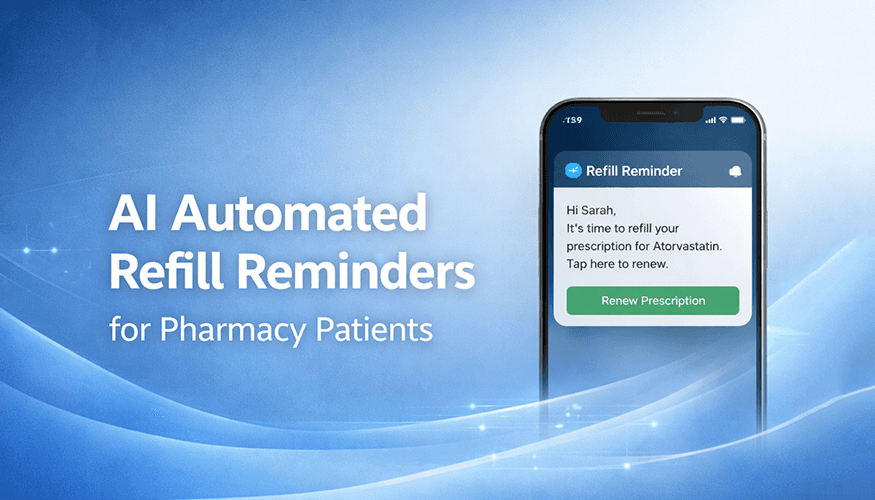
When your phones spike with refill calls, everything else slows down. Voicemails stack up, hold times rise, and your team gets pulled into the same loop all day: "Can you refill this?", "Is it ready?", "Why was it denied?" None of those questions are complicated, but answering them at scale drains staff time, disrupts clinical workflow, and increases the risk of missed refills that generate even more inbound volume.
According to a randomized controlled study of 735,218 patients published in Patient Preference and Adherence, proactive reminder calls increased refill rates by 22.8%, one of the largest real-world demonstrations of what structured outreach does to refill volume.
That is why automated refill reminders for pharmacy patients have become a core operations lever for high-volume pharmacies. The goal is not to send more messages. It is to run a cleaner, more predictable refill workflow that improves follow-through and reduces avoidable calls.
What are automated refill reminders for pharmacy patients?
Automated refill reminders for pharmacy patients are scheduled voice, SMS, or email notifications sent before a prescription runs out. They reduce missed refills, lower inbound pharmacy call volume, and improve medication adherence by reaching patients at the right time with a clear next step, without requiring manual staff outreach. Modern systems use AI and pharmacy management software integrations to automate timing, channel selection, and exception routing.
What the Data Says: The Real Cost of Missed Refills
The case for automated refill reminders is not theoretical. The numbers behind medication non-adherence and pharmacy call volume paint a clear picture of the operational and clinical problem pharmacies are solving.

Medication non-adherence costs the U.S. healthcare system between $100 and $300 billion annually in preventable costs, according to the CDC, making it one of the most expensive and preventable gaps in the entire care continuum.
40–50% of patients with chronic conditions such as diabetes and hypertension do not adhere to their prescribed medication regimens, according to research published in PMC / The Permanente Journal. These are the same patients generating the highest refill volume in your pharmacy.
Forgetfulness is the #1 reason patients miss doses. A survey of 10,000 patients found that 24% cited forgetfulness as their primary barrier to adherence, ahead of side effects, cost, and perceived ineffectiveness. Automated reminders directly address the leading cause of the problem.
Reminder calls increased refill rates by 22.8% in a randomized controlled study of 735,218 Medicare Part D patients at a nationwide pharmacy chain, published in Patient Preference and Adherence (Dove Medical Press). This is one of the largest real-world studies on pharmacy reminder programs to date.
Omnichannel reminder programs improve refill rates by over 20% compared to single-channel outreach, according to a 2023 study in Patient Preference and Adherence, confirming that sequencing SMS, voice, and email consistently outperforms any single channel.
First-time prescription abandonment rates can reach up to 30% for certain medication classes, according to Pharmacy Times, citing research from the New England Healthcare Institute. Proactive outreach and pickup reminders directly reduce this rate.
83% of prescriptions at risk of abandonment are refills for chronic conditions, including hypertension, diabetes, and hyperlipidemia, per a collaborative study published in PMC by The Ohio State University College of Pharmacy. This means the majority of abandonment risk is concentrated in exactly the patient population where automated reminder programs have the most impact.
The pattern is consistent across sources: non-adherence is largely unintentional, the operational burden falls on pharmacy staff, and structured automated outreach produces measurable improvements in both refill completion and call volume. This is the evidence base behind modern automated refill reminder programs.
Automated vs. Manual Refill Reminders: Key Differences
Understanding the difference helps pharmacy teams decide what to automate and what to keep human.
Manual Reminders | Automated Reminders | |
|---|---|---|
Timing | Staff-initiated, inconsistent | Rules-based, triggered by refill eligibility |
Scale | Limited by staff capacity | Handles hundreds of patients simultaneously |
Channels | Typically phone only | Voice, SMS, and email in sequence |
Cost | High (staff time per outreach) | Low marginal cost per reminder |
Exception handling | Ad hoc | Routed automatically by outcome type |
HIPAA compliance | Depends on staff training | Built into system design |
Data & reporting | Minimal | Full audit log and performance metrics |
The real pharmacy problem: why refill reminder automation matters
The operational cost of reactive refill communication goes deeper than call volume alone. Most pharmacies do not struggle because they cannot process refills, they struggle because refill communication becomes repetitive and manual, and the interruptions hit at the worst times. It is not one refill call that causes pain. It is the constant stream layered on top of verification, filling, problem resolution, pickup traffic, and clinical work.
Operational pain points tend to look like this in real life. Call spikes show up around refill cycles, weekends, and after-hours. Voicemail backlogs grow and force delayed callbacks that restart the same conversation later. Patients wait until the last dose, then call urgently, which disrupts the workflow and creates rushed interactions. Meanwhile, a large percentage of inbound calls are “simple” conversations that still consume time: status checks, pickup timing, delivery questions, and basic instructions.
And then there are missed refills. They are not only a patient problem. They become a pharmacy problem when gaps lead to frustrated calls, escalations at the counter, and extra outreach that staff has to manage manually. This is why refill reminder automation is not only about adherence. It is also about operational efficiency in pharmacies and refill efficiency, because a more predictable refill flow is easier to staff, easier to manage, and easier to measure.
Reminders also need to fit inside real operations. That is where pharmacy operations automation matters. A good program reduces work instead of creating new tasks like cleaning up confusing replies, chasing partial information, or contacting patients who were reached too early or too late.
What a Modern Automated Refill Reminder System Must Include
A basic reminder is just an alert. A pharmacy-grade approach supports automation that matches real workflows, including exceptions. This often requires integrating reminder logic with dispensing systems, patient records, and pharmacy management software. For a deeper look at how AI automation works alongside platforms like PioneerRx and other PK software, see our overview of PK software and AI automation for pharmacies.
The difference between a system that “sends reminders” and one that actually improves performance is whether it guides the patient to the next step and then cleanly handles the outcome without creating extra work for the team.
Automated Refill Scheduling Based on Eligibility
Effective refill reminder systems include automated refill scheduling driven by prescription timing, not arbitrary dates. That means reminders go out with enough lead time to prevent last-minute urgency, but not so early that patients tune them out. Integrating with pharmacy management platforms like PioneerRx ensures timing reflects real prescription data rather than a generic calendar rule.
Personalized Channel and Language Preferences
A modern system also needs to support personalized refill reminders based on patient preferences and patterns. Some patients respond best to a short text, others prefer a phone call, and some want email confirmation. A one-size-fits-all approach lowers response rates and increases inbound questions. Adjusting reminders by language preference and channel preference makes patient refill reminders feel relevant rather than automated.
Exception Routing for Denials and Edge Cases
A modern system also needs escalation rules for common exceptions, because "out of refills" and "refill too soon" happen every day. Medication changes, travel, delivery requests, and "please call me" replies are also routine. When the system identifies these outcomes and routes them correctly, reminders become true workflow support instead of noise, and staff only get involved when the situation actually requires human attention.
Compliance Logging and PHI Protection
Equally important is measurement and compliance. Audit-friendly communication logs support pharmacy communication compliance and make it easier to see what is working, including how reminders influence refill completion rates and call deflection over time. This is where single-channel tools often fall short: they notify patients, but they do not help pharmacy teams run a smoother, more predictable refill workflow.
Voice AI for pharmacy workflows: why it changes the math
SMS is effective for many patients, but pharmacies know the reality: some patients ignore texts, some do not read email, and some need a short conversation before they will act. That is where AI voice agents for refills create the biggest operational lift, especially in high-volume environments where every callback steals time from filling, verification, and problem resolution. Pharmacies evaluating this approach can explore what to look for in a solution in our guide to the best Voice AI for pharmacy operations.
With HIPAA compliant voice AI, pharmacies can deliver automated voice reminders healthcare teams can rely on while keeping the interaction clear, controlled, and workflow-friendly. Instead of a one-way alert, voice makes the reminder actionable.
Patients can confirm intent, clarify whether they are still taking the medication, or request delivery versus pickup through conversational AI for prescription refills, without forcing staff into another round of phone tag. This is particularly valuable when you are managing a high volume of medication refill reminders, where small improvements in response rate quickly translate into hours saved each week.
Voice reminders also reduce friction around prescription re-ordering. Many patients do not know whether they are out of refills, whether the request was received, or what step comes next. A short voice interaction can guide them through the right path, capture intent, and route exceptions appropriately. That combination supports refill workflow automation while driving refill abandonment reduction, because fewer patients drop off when the next step is obvious and easy.
Examples of what AI voice agents for refills can handle include:
- “Yes, I need this refilled.”
- “No, I stopped taking it.”
- “I need delivery instead of pickup.”
- “I have questions, can someone call me?”
When voice captures intent and categorizes the outcome, the pharmacy reduces callbacks and improves refill workflow automation without interfering with clinical judgment.
Omnichannel communication that actually reduces call volume
To win on both adherence and workload, pharmacies need omnichannel communication that sequences channels instead of blasting all of them at once. The goal is not just to tell patients “you are due.” It gives them a simple next step, in the channel they are most likely to respond to, while keeping the experience consistent and respectful. This is where modern pharmacy automation technology makes a measurable difference. Instead of separate tools for texting, calling, and email, pharmacies need one coordinated flow that adapts based on engagement.
A proven approach is to start with automated SMS reminders for pharmacy patients because texts are fast, familiar, and easy to act on. If there is no response, follow with phone refill reminders using voice AI for the patients who prefer a short conversation or who rarely reply to written messages. For patients who want documentation, email refill reminders add a helpful touchpoint without increasing staff workload. Complex situations should route to staff only when necessary, so your team stays focused on the cases that truly require human attention.
This is how voice and SMS refill reminders drive measurable pharmacy call volume reduction and support refill abandonment reduction. When patients can confirm intent quickly and know what happens next, pharmacies avoid the “checking in” calls that flood the queue before closing time and at the start of the next business day.
A practical workflow: automate what is repeatable, route what is clinical
This is the key to pharmacy trust. You do not want automation to interfere with clinical judgment. You want it to remove repeatable communication and make it easier for patients to complete routine steps. A practical reminder workflow should be built around what is safe to automate and what must be escalated.
Automate - repeatable, non-clinical work:
- Automated systems can send reminder outreach and follow-ups for all eligible refills without staff involvement.
- Prescription reordering prompts, including pickup versus delivery options, can be captured through voice or SMS responses.
- Refill pickup and delivery confirmation messages can be triggered automatically once the order is processed.
- Refill status updates that do not require clinical review can be delivered in real time, reducing inbound status-check calls.
Route to staff - exceptions and clinical scenarios:
- Out-of-refill, refill-denied, or refill-too-soon outcomes require staff review before the patient receives next-step guidance.
- Prior authorization requirements and payer-related issues must be escalated to the appropriate team member.
- Any patient reply indicating side effects, medication questions, or a need for counseling must reach a pharmacist directly.
- Controlled substances and special-policy prescriptions should always follow a human-reviewed workflow.
This blend drives refill process automation without introducing operational risk. It also supports refill abandonment reduction by ensuring patients are not left guessing when something does require staff action.
Can automated reminders help automate prescription refills?
Yes, with the right workflow design. Automated reminders can support prescription refill automation by triggering structured actions when the patient confirms intent, while still respecting clinical boundaries and pharmacy policies. Think of it as automating the communication and routing layer so routine refill interactions move forward cleanly, and exceptions reach the right staff member quickly.
In practice, this often looks like a patient confirming they want the refill, and then a task, ticket, or structured request being created for the pharmacy team or the appropriate queue. Reminders can be paused or rescheduled if needed, and the patient receives next-step guidance that reduces uncertainty. When done correctly, this approach streamlines prescription re-ordering by making it easier for patients to respond and easier for the pharmacy to route the request into the right workflow.
This is different from claiming the system completes clinical refill authorization. It is refill workflow automation that reduces unnecessary back-and-forth and enables teams to simplify prescription refills, while protecting staff time and improving overall refill efficiency.
Best practices: what improves refill reminders and outcomes
Refill reminder best practices start with a simple principle: strong refill reminder benefits do not come from sending more messages. They come from designing reminders around how refills actually happen in the pharmacy and how patients actually respond.
The most effective programs start with data-driven medication reminders, so timing reflects refill eligibility, not a generic calendar rule. When reminders align with refill reality, patients are more likely to act instead of ignoring the message.
Message clarity also matters. Each reminder should focus on a single action, whether that is confirming the refill, choosing pickup or delivery, or acknowledging that no refill is needed. Personalization plays a major role here. Adjusting reminders by language preference and channel preference makes patient refill reminders feel relevant rather than automated.
Using omnichannel refill reminders instead of a one-size-fits-all approach further improves outcomes. Some patients respond immediately to text, while others need a voice call or written confirmation. A thoughtful sequence across channels prevents over-contacting while still ensuring follow-up. It also supports pharmacies that offer automatic refills, where reminders serve as confirmation and coordination rather than a last-minute alert.
Finally, high-performing pharmacies build a safety net for non-responders and track refill completion rates over time. Reviewing performance and adjusting cadence is what turns reminders into durable medication adherence improvement tools, helping teams reduce missed refills without creating message fatigue.
Compliance: HIPAA compliant refill reminders and PHI handling
Pharmacy teams are right to be cautious with patient communication. Refill reminders touch sensitive information, and trust can be lost quickly if privacy is not respected. HIPAA compliant refill reminders must be designed with safeguards built in, not added later.
A pharmacy-ready approach minimizes PHI in message content, especially in SMS and voicemail, while still giving patients enough context to understand what action is needed. Secure storage, role-based access controls, and encryption protect data behind the scenes, while audit-friendly logs make it easy to review outreach activity if questions arise.
Clear policies for what is communicated over voice versus text are also essential. Voice may be appropriate for certain confirmations, while text should remain brief and non-specific. This balance supports pharmacy communication compliance and protects protected health information (PHI), all while allowing pharmacies to continue proactive refill outreach without unnecessary risk.
How to Evaluate an Automated Refill Reminder Platform
Not all pharmacy automation platforms are built for operational scale. When evaluating a solution, pharmacy leaders should look for:
Omnichannel delivery, voice, SMS, and email in a coordinated sequence, not siloed tools
AI voice agents capable of capturing patient intent and routing exceptions without staff intervention
Native exception handling for out-of-refill, denial, and clinical escalation scenarios
HIPAA-compliant architecture with PHI minimization, audit logs, and role-based access
Integration with pharmacy management software (PioneerRx and similar platforms)
Performance reporting on refill completion rates, call deflection, and response rates by channel
How Whippy Addresses These Requirements
Whippy is built specifically for high-volume pharmacy operations, combining AI voice agents, SMS, and email into a single automated workflow layer. The platform handles proactive refill outreach, captures patient intent through conversational AI, and routes exceptions to staff, all within a HIPAA-compliant framework designed for pharmacy-grade compliance requirements.
For compound pharmacies and multi-location groups managing high communication volume, Whippy's automation engine supports both routine refill workflows and complex edge cases without increasing staff workload. Explore Whippy's pharmacy automation capabilities.
Quick checklist: how to set up automated refill reminders for pharmacy patients
For pharmacy leaders looking to get started, the most effective setups follow a clear operational plan:
Define which prescriptions and patient groups are included, with particular attention to chronic conditions
Set automated refill scheduling rules and reminder cadence based on refill timing, not fixed dates
Choose channels deliberately, often starting with SMS, then adding voice and email as needed to match patient preferences
Build exception routing so clinical cases are sent to staff rather than handled by automation
Confirm all templates and workflows meet HIPAA requirements and are safe for PHI
Track refill efficiency, on-time refills, and call volume reduction, then adjust cadence based on outcomes
Done well, this structure helps pharmacies protect workflow time while improving follow-through and keeping patient communication consistent.
Frequently Asked Questions: Automated Refill Reminders for Pharmacy Patients
Q: How do automated refill reminders work?
A: Automated refill reminders work by connecting to pharmacy management software to identify prescriptions approaching their refill eligibility date. The system then sends a scheduled voice call, SMS, or email to the patient with a clear next step, confirm the refill, choose pickup or delivery, or request a callback. Patient responses are captured and routed into the appropriate pharmacy workflow automatically.
Q: Are automated pharmacy refill reminders HIPAA compliant?
A: Yes, when designed correctly. HIPAA-compliant refill reminder systems minimize protected health information (PHI) in message content, use encrypted data storage, maintain audit logs of all outreach, and apply role-based access controls. Voice and SMS messages should be brief and avoid unnecessary clinical detail while still giving patients enough context to act.
Q: What is the best channel for pharmacy refill reminders : SMS, voice, or email?
A: The most effective approach is an omnichannel sequence rather than a single channel. SMS works well as the first touchpoint because it is fast and familiar. Voice follow-up captures patients who do not respond to text, particularly older patients managing chronic conditions. Email adds a documentation layer for patients who prefer written confirmation. Using all three in sequence consistently outperforms any single channel.
Q: How do automated reminders reduce pharmacy call volume?
A: Automated reminders reduce pharmacy call volume by reaching patients proactively before they run out of medication, which eliminates the urgent "I need a refill now" call. They also provide clear status updates and next-step guidance, which prevents the "just checking" calls that flood pharmacy queues. When patients know what is happening and what to do next, they do not need to call to find out.
Q: Can automated refill reminders handle exceptions like out-of-refills or denied requests?
A: A well-designed system identifies common exception outcomes (out of refills, refill too soon, prior authorization required) and routes them to the appropriate staff member automatically rather than leaving the patient without guidance. This keeps automation handling routine interactions while ensuring clinical and payer exceptions receive human attention.
Q: What types of pharmacies benefit most from automated refill reminders?
A: High-volume independent pharmacies, pharmacy groups, and compound pharmacies benefit most because their refill communication volume is large enough that manual outreach creates significant operational drag. Pharmacies managing patients with chronic conditions (where refill cycles are predictable and adherence is critical) also see strong results from structured reminder programs.
Q: How do I measure whether my refill reminder program is working?
A: Key performance indicators include refill completion rate (percentage of reminded patients who follow through), inbound call volume before and after implementation, refill abandonment rate, and response rate by channel. High-performing programs review these metrics monthly and adjust reminder cadence, timing, and channel sequence based on what the data shows.
The takeaway: reminders should reduce work, not add it
The best reminder programs improve adherence while protecting pharmacy capacity. With the right refill reminders automation, pharmacies can reduce refill abandonment, strengthen patient retention through reminders, and keep the refill queue moving without increasing inbound workload.
See Automated Refill Reminders in Action
Whippy works with high-volume pharmacies to implement omnichannel refill reminder programs that reduce inbound call volume, improve refill completion rates, and keep staff focused on clinical work. Setup includes HIPAA-compliant templates, exception routing, and performance reporting from day one.
Request a personalized demo for your pharmacy ↗
Table of Contents
Table of Contents
- What are automated refill reminders for pharmacy patients?
- What the Data Says: The Real Cost of Missed Refills
- Automated vs. Manual Refill Reminders: Key Differences
- The real pharmacy problem: why refill reminder automation matters
- What a Modern Automated Refill Reminder System Must Include
- Voice AI for pharmacy workflows: why it changes the math
- Omnichannel communication that actually reduces call volume
- A practical workflow: automate what is repeatable, route what is clinical
- Can automated reminders help automate prescription refills?
- Best practices: what improves refill reminders and outcomes
- Compliance: HIPAA compliant refill reminders and PHI handling
- How to Evaluate an Automated Refill Reminder Platform
- Quick checklist: how to set up automated refill reminders for pharmacy patients
- Frequently Asked Questions: Automated Refill Reminders for Pharmacy Patients
- The takeaway: reminders should reduce work, not add it
Try Whippy for Your Team
Experience how fast, automated communication drives growth.

Related Articles
HIPAA Pharmacy Texting: What Pharmacists Must Know
 Elizabeth Long
After Hours Medical Answering Service with AI
Elizabeth Long
Dental Answering Service – 24/7 AI Receptionist Support
Elizabeth Long
Is Zapier HIPAA Compliant? Risks and Alternatives
Elizabeth Long
Best Appointment Reminder System: AI & SMS Automation
Elizabeth Long
How AI Enhances Healthcare Staffing Solutions Software
Elizabeth Long