


Table of Contents
- What Are Standard Message Rates?
- Why SMS Messages Incur Costs
- How SMS Messages Are Charged & Key SMS Billing Rules
- Understanding the Carrier Fee Breakdown
- How SMS Pricing Is Calculated (Step-by-Step)
- Example: How Standard Message Rates Add Up
- Multi-Part SMS, Special Characters & the Character Limit
- MMS Pricing, MMS Carrier Fees & Additional Costs
- Choosing the Right Number Type
- Real-World SMS Pricing Examples
- Why These SMS Pricing Examples Matter
- Common SMS Billing Mistakes That Increase Your Costs
- How to Avoid These SMS Pricing Mistakes
- Advanced Strategies to Reduce Business SMS Pricing
- Deliverability, Compliance & Protecting Your SMS Investment
- Takeaways & Next Steps
- Stop Overpaying for SMS Messaging
- Frequently Asked Questions
Try Whippy for Your Team
Experience how fast, automated communication drives growth.
What Are Standard Message Rates?
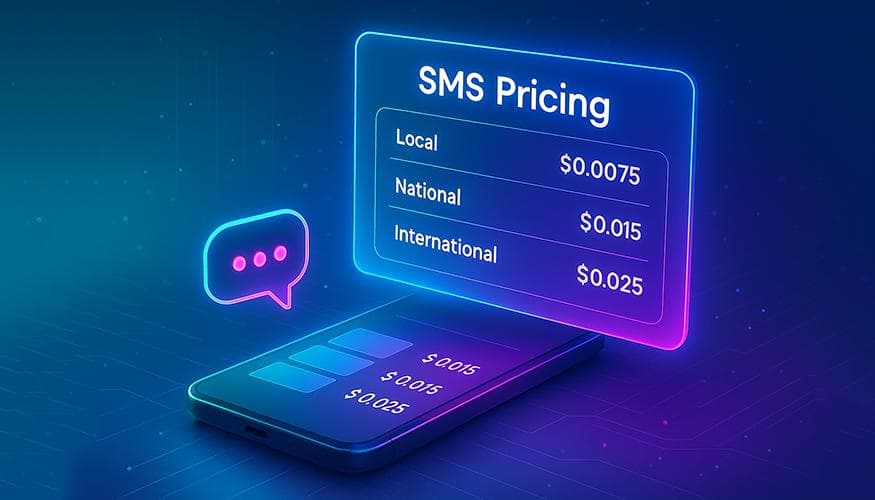
Standard message rates in the U.S. typically range from $0.007 to $0.015 per outbound SMS segment for registered 10DLC business traffic. MMS carrier fees generally fall between $0.005 and $0.010 per message, plus platform markup. Rates vary based on carrier fees, segment count, encoding type, number type, destination country, and compliance status. Multi-part messages are billed per segment.
Carrier A2P fees are reviewed and adjusted periodically, so businesses should verify current pricing with their provider.
Why SMS Messages Incur Costs
Many organizations assume SMS pricing functions similarly to consumer texting. In practice, business messaging operates within a fundamentally different framework.
There is a clear distinction between person-to-person (P2P) messaging and application-to-person (A2P) messaging, which enterprises use for customer communications, notifications, authentication, and marketing outreach.
A2P messaging is delivered through carrier-regulated infrastructure designed specifically for commercial traffic. It requires brand and campaign registration, adherence to industry compliance standards, traffic vetting, throughput management, and ongoing carrier monitoring. These controls ensure message integrity, protect consumers from spam and fraud, and maintain network reliability at scale.
Business SMS pricing reflects the operational, regulatory, and infrastructure costs required to support secure, high-volume messaging within the carrier ecosystem.
A2P vs P2P: Why Business SMS Costs More

P2P (Person-to-Person) texting happens between individual mobile users. It is covered by consumer mobile plans.
A2P (Application-to-Person) messaging is when a business sends texts through software, APIs, or messaging platforms.
Carriers charge A2P SMS pricing differently because business traffic requires registration and brand vetting, spam monitoring infrastructure, higher throughput allocation, ongoing compliance enforcement, and traffic classification systems.
A2P messaging operates at scale. That scale introduces infrastructure and regulatory costs that P2P texting does not.
10DLC and Its Impact on SMS Pricing
In the United States, most business SMS traffic must use registered 10DLC numbers (learn what 10DLC means and why registration matters).
10DLC registration requires:
- Brand verification
- Campaign use-case approval
- Declared message volume
Carriers apply structured A2P fees to registered campaigns, including per-message surcharges and monthly campaign registry costs. Depending on campaign type, businesses may also pay a recurring monthly fee for 10DLC campaign registration. The 10DLC pricing structure includes brand registration fees, campaign registry charges, and ongoing A2P per-message surcharges.
Unregistered traffic often faces:
- Higher carrier fees
- Severe throughput limits
- Message filtering
Because 10DLC traffic is monitored and classified, pricing is directly influenced by campaign type and volume tier.
Spam Filtering Infrastructure
Carriers operate sophisticated filtering systems to protect consumers from:
- Phishing attacks
- Fraudulent marketing
- Illegal robocasting
- Spam campaigns (including messages containing common SMS spam trigger words)
These systems use:
- Machine learning models
- Reputation scoring
- Keyword analysis
- Traffic anomaly detection
Maintaining this infrastructure is one reason SMS carrier fees exist.
Without filtering systems, SMS would quickly become unusable due to abuse.
Carrier Compliance Monitoring (CTIA & TCPA Enforcement)
Business messaging must comply with:
- TCPA (Telephone Consumer Protection Act)
- CTIA Messaging Principles and Best Practices
Carriers actively monitor opt-in consent records, opt-out handling, content categories including SHAFT restrictions, send frequency, and complaint rates. Elevated complaint ratios can increase filtering and impact deliverability.
Enforcing compliance at the carrier level increases operational overhead, which is reflected in A2P SMS pricing.
Throughput Allocation & Network Capacity
Business messaging requires higher throughput than P2P texting.
For example:
- A person may send 50 texts per day.
- A business may send 50,000 texts in minutes.
Carriers must allocate:
- Dedicated messaging routes
- Rate limits per campaign
- Load balancing infrastructure
- Traffic prioritization systems
Higher throughput capacity increases network resource demands and impacts SMS pricing structures. Standard message rates reflect the cost of operating a regulated, high-deliverability business messaging ecosystem, not just transmitting a text message.
How SMS Messages Are Charged & Key SMS Billing Rules
Understanding how SMS messages are charged comes down to three stacked layers that make up the modern SMS billing rules:
LAYER | WHAT IT COVERS |
|---|---|
Base Network Cost | Wholesale transport cost per SMS segment paid to mobile carrier networks. |
Carrier Fees (A2P Fees) | Application-to-person surcharges applied by carriers for business messaging traffic. |
Platform Margin | Provider markup covering routing, infrastructure, compliance tools, and support. |
Always ask vendors for a transparent carrier fee breakdown and line-item invoices to see precisely who keeps what.
Understanding the Carrier Fee Breakdown
FEE TYPE | TYPICAL RANGE | NOTES |
|---|---|---|
Base Message Cost | $0.002 – $0.005 per segment | Wholesale routing cost depending on volume and route quality. |
Carrier A2P Fees | $0.0025 – $0.005 per segment | Adjusted periodically by mobile carriers for registered business messaging traffic. |
Campaign Registry Fee (10DLC) | $2 – $10 per month | Applies to registered 10DLC campaigns depending on use case. |
Non-Compliance Penalties | Varies | May apply for policy violations, unregistered traffic, or restricted content categories. |
Numbers shift each quarter and vary depending on traffic class, region, and compliance status. Businesses should also review invoices for additional fees such as unregistered traffic surcharges, international routing markups, or non-compliance penalties.
How SMS Pricing Is Calculated (Step-by-Step)
When businesses ask about SMS pricing, they often focus on the SMS cost per message or the cost per SMS and see a flat per-message rate. In reality, the total cost of sending a text message is calculated using multiple stacked components.
Here is how standard message rates are determined:
1. Carrier Fee (A2P Surcharge)
Mobile carriers charge an A2P (Application-to-Person) fee for business messaging traffic.
This fee:
- Covers spam monitoring infrastructure
- Supports 10DLC registration compliance
- Funds carrier filtering systems
This is often called a carrier SMS charge, carrier SMS charges, or SMS carrier fee depending on the provider’s invoice terminology.
2. Network Base Rate
This is the wholesale cost to transmit a message across carrier networks.
It varies by:
- U.S. vs international destinations
- Domestic carrier agreements
- Traffic class (registered vs unregistered)
3. Platform Markup
SMS platforms apply a margin on top of carrier fees and base rates.
This covers:
- API infrastructure
- Dashboard tools
- Compliance monitoring
- Message routing optimization
This is why SMS pricing can vary between providers, as SMS platform pricing differs based on infrastructure quality, routing agreements, compliance tooling, and support levels.
4. Encoding Type (GSM-7 vs UCS-2)
Encoding directly impacts SMS cost per message.
- GSM-7 allows 160 characters per segment
- UCS-2 allows only 70 characters per segment
If your message includes:
- Emojis
- Accented characters (é, ñ)
- Special symbols
It may switch to UCS-2 and increase your total SMS pricing.
5. Segment Count
Every SMS segment is billed individually.
For example:
- 1 segment message = 1x charge
- 2 segment message = 2x charge
- 3 segment message = 3x charge
A 180-character GSM-7 message becomes two segments.
A 120-character UCS-2 message may also become two segments.
Segment multiplication is one of the biggest drivers of business SMS pricing increases.
6. Number Type
The type of sending number affects SMS carrier fees:
- 10DLC (registered local numbers) → Lower A2P pricing
- Toll-free numbers → Moderate fees
- Short codes → Highest throughput, higher setup costs
Choosing the right number type can significantly reduce SMS costs.
7. Destination Country
International SMS pricing is higher because:
- Messages require cross-border carrier termination
- Additional inter-carrier settlement fees apply
- Local regulations may impose surcharges
Domestic U.S. SMS pricing is typically more predictable.
Example: How Standard Message Rates Add Up
Let’s say:
- Base + carrier cost = $0.012 per segment
- Message length = 2 segments
- Campaign size = 5,000 messages
Total SMS cost:
5,000 × 2 × $0.012 = $120
If optimized to 1 segment:
5,000 × 1 × $0.012 = $60
Reducing just one segment cuts your SMS pricing in half.
Why This Matters
Understanding how SMS pricing is calculated helps you control the total cost of SMS messaging and:
- Predict texting costs accurately
- Reduce multi-part SMS charges
- Choose the correct number type
- Avoid unexpected carrier fee increases
- Optimize your SMS marketing ROI with the right SMS marketing platform.
Without this breakdown, standard message rates can appear misleadingly simple.
Multi-Part SMS, Special Characters & the Character Limit
A single GSM-7 segment holds 160 characters. Add an emoji or accented “é” and you switch to UCS-2, dropping the limit to 70. That shift triggers multi-part SMS charges, each extra segment multiplies your bill. Because special characters SMS cost more, a 180-character emoji-filled promo quickly becomes three segments and three times the fee.
Pro tip: preview segment counts with Whippy’s free Message Segment Visualisation tool before pressing Send.
For a deeper explanation of character limits and encoding rules, see our full breakdown of SMS pricing and message segments.
For a detailed calculator and character examples, see our SMS character limit explained guide.
MMS Pricing, MMS Carrier Fees & Additional Costs
MMS lets you send images or 1,600-character texts, but convenience brings additional costs:
- MMS carrier fees in Section 4.
- Transcoding surcharges for files > 300 KB.
- Some networks bill inbound MMS, double-check your vendor’s terms.
If rich media isn’t essential, a shortened link can avoid these MMS pricing add-ons.
When MMS Makes Financial Sense
MMS pricing is higher than standard SMS rates, but it can improve engagement in specific use cases.
MMS may justify the added cost when:
- Visual product previews drive conversions
- Branded images increase click-through rates
- Event reminders require scannable QR codes
- Coupons or limited-time offers benefit from visual impact
In high-conversion campaigns, the increased response rate can offset higher per-message costs.
When MMS Can Improve Deliverability
In some cases, MMS messages experience lower filtering than long multi-part SMS campaigns.
For example:
- A 4-segment SMS marketing message may trigger spam filters
- A single MMS with a short caption may deliver more reliably
Deliverability outcomes vary by carrier and campaign type, but using MMS strategically can sometimes reduce filtering compared to lengthy multi-part SMS sends.
When MMS Costs More Long-Term
MMS becomes expensive when:
- Used for high-frequency campaigns
- Sent at scale without conversion tracking
- Replacing short-form SMS unnecessarily
- Sending large media files that trigger processing fees
For example:
10,000 MMS messages at $0.02 each = $200
10,000 single-segment SMS at $0.01 each = $100
Over a year, that difference compounds significantly.
Businesses should evaluate MMS pricing based on campaign ROI, not novelty.
SMS vs MMS: Cost Strategy Considerations
Before choosing MMS, ask:
- Does visual content materially increase conversions?
- Can a shortened link achieve the same result?
- Will segment count exceed 3–4 SMS segments?
- Is this a brand-building campaign or transactional message?
For cost-sensitive campaigns, SMS often delivers higher ROI. For brand-forward promotions, MMS can justify the premium.
For a full strategic comparison, see our SMS vs MMS guide.
Choosing the Right Number Type
NUMBER TYPE | BEST FOR | TYPICAL FEES | PROS & CONS |
|---|---|---|---|
Long Codes | 1-to-1 conversations | $0.01 – $0.03 per SMS | No monthly lease; higher filtering risk for bulk messaging. |
10DLC | Marketing campaigns | $0.0025 – $0.008 per SMS + $2–$10 monthly | Strong deliverability; moderate throughput. |
Toll-Free Numbers | Customer support | $0.004 – $0.009 per SMS | Lower cost; slower send rate than short codes. |
Short Codes | High-volume promotions | $500–$1,000 monthly lease + per-message fees | Highest throughput; higher setup cost. |
Choose wisely, right-sizing your number type can cut SMS costs by 30% or more. Let us guide you to the perfect fit!
Real-World SMS Pricing Examples
SCENARIO | VOLUME | SEGMENTS | CARRIER FEES | TOTAL TEXTING COST* |
|---|---|---|---|---|
Promo blast (GSM-7) | 500 k | 1 | 1750 | 4250 |
Alert w/ emoji | 50 k | 2 | 350 | 900 |
MMS order receipts | 10 k | — | 65 | 350 |
*Estimates include platform margin; actual amounts vary depending vendor contracts. These sms pricing examples highlight why segment management matters.
Understanding standard message rates becomes much clearer when you see the math behind SMS pricing.
Let’s break it down with real numbers.
Example 1: Multi-Segment Message Cost
If you send:
- 5,000 messages
- 2 segments per message
- At $0.012 per segment
Your total SMS cost is:
5,000 × 2 × $0.012 = $120
Now compare that to an optimized version:
If the same campaign is shortened to 1 segment:
5,000 × 1 × $0.012 = $60
Savings: $60 (50% reduction in SMS cost)
Reducing just one segment cuts your SMS pricing in half.
Example 2: Emoji Impact on Business SMS Pricing
Let’s say you send:
- 10,000 promotional messages
- Each message contains emojis
- Encoding shifts to UCS-2
- Message becomes 3 segments instead of 1
- Rate: $0.010 per segment
Total cost:
10,000 × 3 × $0.010 = $300
If optimized to GSM-7 (1 segment):
10,000 × 1 × $0.010 = $100
Difference: $200 extra spend caused by encoding alone
Special characters and emojis can triple your SMS pricing without changing your audience size.
Example 3: Monthly SMS Marketing Budget Scenario
A small business sends:
- 20,000 messages per month
- Average 2 segments per message
- Blended rate: $0.011 per segment
Monthly SMS pricing:
20,000 × 2 × $0.011 = $440 per month
Annual cost:
$440 × 12 = $5,280 per year
If segment count is reduced to 1:
20,000 × 1 × $0.011 = $220 per month
Annual cost:
$220 × 12 = $2,640 per year
Annual savings: $2,640
Segment management directly impacts long-term SMS marketing ROI.
Example 4: International SMS Pricing Impact
If you send:
- 3,000 international messages
- At $0.035 per segment
- 1 segment each
Total cost:
3,000 × $0.035 = $105
International SMS pricing can be 2–4x higher than domestic standard message rates due to cross-border carrier termination fees.
Always separate domestic and international traffic in your SMS budget planning.
Why These SMS Pricing Examples Matter
SMS pricing scales linearly.
Every additional segment multiplies your cost.
Every emoji can increase encoding.
Every international message carries higher carrier fees.
Understanding the math behind standard message rates allows businesses to:
- Forecast SMS marketing budgets accurately
- Reduce multi-part SMS charges
- Optimize message length before sending
- Avoid unnecessary MMS pricing upgrades
- Improve campaign profitability
When evaluating business SMS pricing, always calculate cost per segment, not just cost per message.
Common SMS Billing Mistakes That Increase Your Costs
Even when businesses understand standard message rates, small mistakes can quietly inflate SMS pricing.
Here are the most common billing errors that drive unexpected texting costs.
1. Not Registering 10DLC Properly
Unregistered or improperly registered 10DLC campaigns often face:
- Higher carrier fees
- Throughput restrictions
- Message filtering
- Delivery blocking
Registration stabilizes A2P SMS pricing and improves long-term deliverability.
2. Ignoring Encoding Shifts (GSM-7 vs UCS-2)
Adding a single emoji or accented character can switch your message from:
- 160-character GSM-7
to - 70-character UCS-2
That change can double or triple your segment count — and your SMS cost.
Always preview encoding before sending large campaigns.
3. Sending Long Messages Without Segment Preview
Many businesses calculate cost per message, not per segment.
A 300-character message may be:
- 2 segments in GSM-7
- 5 segments in UCS-2
Without reviewing segment counts in advance, SMS pricing can quickly exceed your projected budget.
4. Using MMS When a Shortened Link Would Work
MMS pricing includes:
- Higher carrier fees
- Media processing costs
- Possible inbound MMS charges
In many cases, a shortened link to a landing page achieves the same result at a lower SMS cost.
5. Not Auditing SMS Invoices Regularly
Carrier billing rules can change quarterly.
Businesses that do not review:
- Segment counts
- Failed message billing
- International routing
- Carrier fee adjustments
May overlook avoidable cost increases.
Regular invoice audits protect your messaging budget.
6. Not Verifying Toll-Free Numbers
Unverified toll-free numbers may experience:
- Filtering
- Reduced throughput
- Lower delivery rates
Poor verification can result in wasted SMS spend due to blocked messages.
Verification improves deliverability and protects campaign ROI.
How to Avoid These SMS Pricing Mistakes
To reduce business texting costs:
- Register campaigns correctly
- Preview segment counts before sending
- Monitor encoding changes
- Separate domestic and international traffic
- Review carrier fees quarterly
- Use compliant opt-in flows
Small optimizations can reduce SMS pricing by 20–50% over time.
Advanced Strategies to Reduce Business SMS Pricing
Beyond segment optimization and compliance, businesses can lower long-term SMS costs through smarter purchasing and contract strategy.
1. Negotiate Volume Tier Pricing
Most SMS providers offer tiered pricing based on monthly message volume, often referred to as bulk SMS pricing or volume-based pricing tiers.
Higher volume tiers typically reduce per-segment cost. Even a small reduction (for example, from $0.012 to $0.010 per segment) can save thousands annually at scale.
Always ask:
- What volume thresholds unlock lower pricing?
- Are carrier fees passed through transparently?
- Are rates renegotiated as usage grows?
2. Separate Domestic and International Traffic
International SMS pricing can be 2–4x higher than U.S. standard message rates.
Segment your audience by geography to:
- Forecast costs accurately
- Avoid blended pricing confusion
- Optimize country-specific campaigns
This prevents international traffic from inflating your domestic SMS budget.
3. Evaluate Long-Term Contracts vs Flexible Pricing
Some providers offer discounted SMS pricing for annual commitments, while others offer usage-based flexibility.
Consider:
- Growth projections
- Seasonal traffic spikes
- Campaign frequency
- Risk tolerance
For rapidly growing businesses, scalable tier pricing may outperform fixed contracts.
4. Monitor Carrier Fee Adjustments Quarterly
Carrier A2P fees can change based on:
- Regulatory updates
- Traffic classification
- Network policy shifts
Review pricing quarterly to ensure your SMS cost per segment remains competitive.
Reducing SMS pricing is not just about shorter messages. It requires ongoing evaluation of volume, compliance status, and provider transparency.
Deliverability, Compliance & Protecting Your SMS Investment
A 98% open rate means nothing if your messages are filtered, blocked, or expose your business to legal risk.
Understanding compliance is essential to managing SMS pricing and avoiding unexpected costs.
Business messaging in the United States is regulated under:
- TCPA (Telephone Consumer Protection Act)
- CTIA Messaging Principles and Best Practices
- Carrier-specific A2P and 10DLC policies
Failure to comply can lead to blocked messages, higher carrier fees, or legal penalties.
TCPA Fines: The Real Financial Risk
The TCPA allows consumers to sue businesses for unsolicited messages.
Penalties range from:
- $500 per violation
- Up to $1,500 per violation for willful misconduct
If you send 1,000 non-compliant messages, the exposure can be significant.
This is why SMS pricing is not just about per-segment cost. Compliance mistakes can cost far more than carrier fees.
The TCPA is enforced at the federal level, and violations may trigger statutory damages per message sent without proper consent. The Federal Communications Commission (FCC) oversees enforcement actions related to unlawful automated messaging practices.
CTIA Guidelines & Carrier Enforcement
The CTIA sets messaging standards that carriers enforce through filtering systems.
Businesses must:
- Obtain clear, documented opt-in consent
- Provide clear opt-out instructions (e.g., “Reply STOP to unsubscribe”)
- Honor opt-outs immediately
- Avoid misleading or deceptive content
- Clearly identify the sending brand
Carriers actively monitor:
- Complaint rates
- Opt-out rates
- Traffic spikes
- Content risk patterns
High complaint ratios can increase filtering and impact your deliverability.
10DLC Registration Requirements
Most U.S. business SMS traffic must use registered 10DLC numbers to comply with carrier policy.
10DLC registration requires:
- Brand verification
- EIN submission (for U.S. entities)
- Campaign use-case disclosure
- Estimated monthly message volume
Carriers review campaigns to ensure messaging aligns with declared use cases and CTIA guidelines.
Failure to register properly may result in traffic suspension or blocking.
Registration ensures lawful business messaging under carrier compliance frameworks.
Opt-In Documentation Requirements
To remain compliant, businesses must maintain records of:
- How the user opted in
- When they opted in
- The exact disclosure language shown
- IP address or form capture data (if digital)
Consent must be:
- Explicit
- Informed
- Documented
- Revocable
If challenged, the burden of proof falls on the sender.
Maintaining clean opt-in records protects both deliverability and financial exposure.
SHAFT Restrictions & Prohibited Content
Carriers prohibit certain content categories commonly referred to as SHAFT:
- Sex
- Hate
- Alcohol
- Firearms
- Tobacco
Even legal businesses in these industries face strict messaging limitations.
Messages that fall into restricted categories may be filtered automatically, regardless of registration status.
Understanding content restrictions helps avoid blocked campaigns and wasted SMS spend.
How Compliance Impacts SMS Pricing
Compliance directly affects SMS pricing through carrier fee tiers, throughput limits, filtering penalties, message blocking, and sender reputation scoring.
Businesses with strong compliance records often experience:
- Better delivery rates
- More predictable SMS pricing
- Lower risk of traffic surcharges
SMS pricing is not just a technical cost. It reflects your sender reputation and compliance standing.
Takeaways & Next Steps
“Standard” rates change often, review each quarter.
Encoding, segment count, and number type can double, or halve, your cost per text message.
Whippy’s dashboard exposes every SMS charge (and MMS carrier fees) in real time, so you can act before overspending.
Stop Overpaying for SMS Messaging
Most businesses overspend on SMS pricing because they don’t see segment counts, carrier fees, or encoding shifts in real time.
Whippy shows:
Exact per-segment SMS pricing
Carrier fee breakdown
Real-time cost previews
Segment visualization before sending
See your segment count before sending. Audit your last SMS invoice in under five minutes. Identify hidden carrier fees instantly.
Book a personalized Whippy demo and uncover your real SMS pricing, before you overspend again.
Frequently Asked Questions
Q: How much does SMS cost per message?
A: SMS cost per message typically ranges from $0.007 to $0.015 per outbound segment for registered U.S. 10DLC traffic. Final pricing depends on carrier fees, segment count, encoding type, number type, and destination country. Multi-part messages increase total cost because each segment is billed individually.
Q: What are standard SMS rates in the U.S.?
A: Standard SMS rates in the U.S. generally fall between $0.007 and $0.015 per segment for business messaging. Rates vary based on A2P carrier fees, 10DLC registration status, and message length. International SMS and unregistered traffic typically cost more.
Q: What are SMS fees?
A: SMS fees are the combined cost of sending a business text message. They include the carrier fee (A2P surcharge), network base rate, and platform markup. Charges are applied per segment, meaning longer or emoji-filled messages may increase your total SMS pricing.
Q: How much does it cost to send 1,000 SMS messages?
A: The cost to send 1,000 SMS messages typically ranges from $7 to $15 for single-segment U.S. 10DLC traffic. If messages contain multiple segments, the total SMS cost increases proportionally. For example, 1,000 two-segment messages at $0.012 per segment would cost $24.
Q: Why are SMS fees different between providers?
A: SMS pricing varies between providers due to differences in platform markup, carrier routing agreements, compliance management, and infrastructure costs. While carrier A2P fees are standardized by mobile networks, each SMS platform adds its own margin and service features, affecting the final cost per message.
Q: What affects business SMS pricing?
A: Business SMS pricing is affected by carrier fees, encoding type (GSM-7 vs UCS-2), segment count, number type (10DLC, toll-free, short code), destination country, and compliance status. Multi-part messages and international traffic typically increase the total cost of SMS campaigns.
Q: Is SMS cheaper than email marketing?
A: SMS usually costs more per message than email, but it delivers significantly higher open rates, often above 90%. While email may cost fractions of a cent per send, SMS pricing reflects carrier fees and compliance infrastructure. Many businesses use SMS for time-sensitive or high-conversion communication.
Q: Why did my SMS bill increase?
A: An increase in SMS billing often results from higher segment counts, encoding shifts caused by emojis or special characters, increased message volume, international sends, or carrier fee adjustments. Reviewing delivery reports and segment previews helps identify the cause of unexpected SMS cost increases.
Q: Do carriers charge for failed SMS messages?
A: In many cases, carriers charge for messages that are successfully handed off to their network, even if the recipient’s device is unavailable. However, rejected or blocked messages may not be billed. Always review your provider’s SMS billing rules to understand how failed messages are handled.
Q: What is A2P SMS pricing?
A: A2P SMS pricing refers to the cost of application-to-person messaging sent by businesses through messaging platforms. Carriers apply A2P fees to cover spam filtering, compliance monitoring, and 10DLC registration enforcement. These fees are separate from consumer texting plans.
Q: How much does 10DLC registration cost?
A: 10DLC registration costs typically include a one-time brand registration fee and ongoing campaign fees. Pricing varies by carrier and use case, but businesses may pay monthly campaign charges in addition to per-message A2P SMS fees. Registration improves deliverability and reduces filtering risk.
Table of Contents
Table of Contents
- What Are Standard Message Rates?
- Why SMS Messages Incur Costs
- How SMS Messages Are Charged & Key SMS Billing Rules
- Understanding the Carrier Fee Breakdown
- How SMS Pricing Is Calculated (Step-by-Step)
- Example: How Standard Message Rates Add Up
- Multi-Part SMS, Special Characters & the Character Limit
- MMS Pricing, MMS Carrier Fees & Additional Costs
- Choosing the Right Number Type
- Real-World SMS Pricing Examples
- Why These SMS Pricing Examples Matter
- Common SMS Billing Mistakes That Increase Your Costs
- How to Avoid These SMS Pricing Mistakes
- Advanced Strategies to Reduce Business SMS Pricing
- Deliverability, Compliance & Protecting Your SMS Investment
- Takeaways & Next Steps
- Stop Overpaying for SMS Messaging
- Frequently Asked Questions
Try Whippy for Your Team
Experience how fast, automated communication drives growth.

Related Articles

Ecommerce SMS Marketing Guide: Strategies That Convert
 Elizabeth Long
Spam Trigger Words: The Complete List + How to Avoid Spam Filters
Elizabeth Long
How to Automate an SMS Sending Every Month
Elizabeth Long
Text Automation for Fitness Studios: Reminders & Retention
Elizabeth Long
Gym Answering Service with AI Voice & SMS Automation
Elizabeth Long
How to Auto Reply to Text Messages (Complete Guide)
Elizabeth Long