


Table of Contents
- What is a virtual assistant for CPA firms?
- The hidden cost of running without one
- What this system actually does for your firm
- The opportunity cost calculation every CPA firm should do
- What the data says about AI for accountants right now
- Two layers of AI: understanding the distinction
- Voice AI vs. traditional receptionist
- How to implement: the 5-step framework
- What to look for in a CPA communication platform
- The firms getting ahead aren't working harder
- See it in action
- FAQs
Try Whippy for Your Team
Experience how fast, automated communication drives growth.
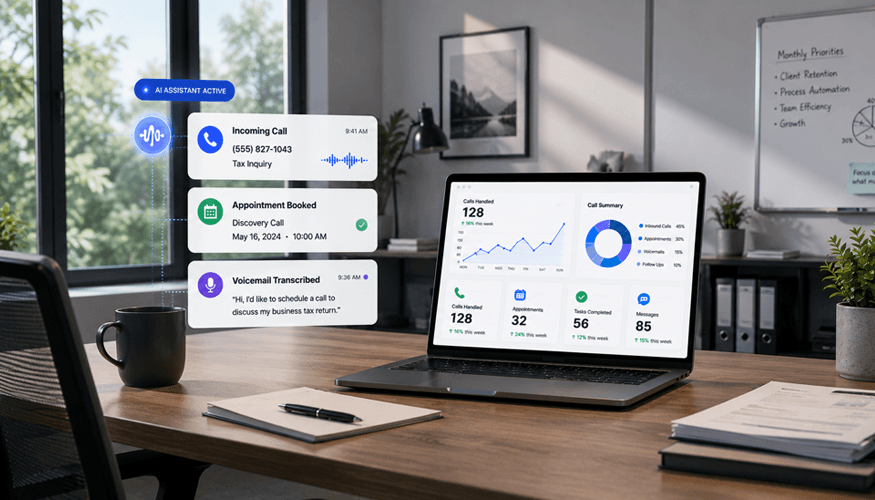
How AI is handling the communication layer of accounting firms so CPAs can focus on the work they were actually trained to do.
Every hour a CPA spends answering a routine call, chasing a document submission, or playing calendar tennis with a client is an hour that isn't billed. According to the AICPA, roughly 17% of an accountant's working time goes to non-billable tasks. For a CPA billing at $200/hour and working 1,800 hours a year, that's over $61,000 in potential revenue quietly evaporating.
What is a virtual assistant for CPA firms?
A virtual assistant for CPA firms is an AI-powered system that handles the communication and scheduling layer of an accounting practice. It covers inbound calls, appointment booking, voicemail transcription, and automated follow-ups, all without human intervention.
It's not a chatbot on your website. It's not a remote contractor. It's a dedicated front desk system that operates 24/7, answers every call on the first ring, routes inquiries intelligently, and keeps your team informed without interrupting their actual work.
The hidden cost of running without one
80% of callers who reach voicemail hang up without leaving a message. The vast majority won't call back.
For a CPA firm receiving 20 after-hours calls per month with an average new client engagement worth $2,000+, that's a potential revenue leak of tens of thousands of dollars annually from missed calls alone. Not from poor service or bad reviews. From no one picking up.
Nearly 39% of surveyed accountants report spending more than half their workday on manual tasks, yet 30% still lack the tools to automate those processes. (MACPA)
When call volume spikes in March and April, the administrative burden spikes with it, precisely when every available hour should be going toward client work. A good accounting virtual assistant doesn't just fix the after-hours gap. It removes the friction from every interaction point: the routine call that pulls a senior CPA out of a financial review, the appointment that never got confirmed, the document reminder that no one sent.
What this system actually does for your firm
Answers every call, around the clock
A CPA virtual assistant answers every inbound call with a personalized, professional greeting: "Thank you for calling Meridian Accounting, how can I help you today?" It does this regardless of the time, the day, or how many other calls are coming in simultaneously. This matters most after hours, when prospects would otherwise hit voicemail, and during peak season, when call volume exceeds staff capacity.
Routes calls based on intent, not guesswork
Smart routing is what separates a genuinely useful AI phone system from a basic answering service. Whippy's Voice AI asks simple intake questions to identify what a caller needs: tax filing help, a bookkeeping question, or a new engagement inquiry, and routes accordingly. Tax questions reach the tax partner. Bookkeeping requests go to the right associate. New business gets prioritized immediately. No transfers that drop, no clients repeating themselves.
Books appointments without back-and-forth
Calendar integration is where a virtual assistant CPA system delivers the most immediately visible time savings. When a client wants to schedule a meeting, the AI checks real-time availability, offers open slots, confirms the appointment, and sends a calendar invite, all within the call. For firms where scheduling coordination consumes 20 to 30 minutes per appointment, this alone justifies the investment.
Transcribes and delivers every voicemail
When a team member isn't available, Voice AI records and transcribes the voicemail and delivers it as text to email, Slack, or both. Your accountant virtual assistant reads client messages at a glance rather than dialing into a queue. For virtual assistant bookkeeping workflows specifically, this means captured context routed to the right person before anyone has to ask twice.
Automates follow-ups that would otherwise fall through
A well-configured bookkeeping virtual assistant triggers follow-up sequences automatically based on what happened in a call:

Client called about Q3 expense reports: reminder goes out 24 hours later.
Appointment not confirmed: pointment not confirmed: reminder texts sent 48 and 2 hours before. reminder texts sent 48 and 2 hours before.
New client inquiry ended without booking: follow-up SMS goes out the next morning.
Document deadline approaching: proactive reminder sent before the client misses it.
None of this requires a staff member to remember to do it. The system handles it based on rules you set once.
The opportunity cost calculation every CPA firm should do
Before choosing the right tool for your firm, run this calculation first:
- Missed call revenue: Monthly missed calls x average new client value x 0.15 = your monthly missed-call revenue floor.
- Administrative time cost: Weekly admin hours (calls, scheduling, reminders) x billing rate = billable value currently absorbed by tasks a virtual assistant can own.
- Seasonal multiplier: During tax season both numbers roughly double. For most small-to-mid-size CPA firms, the combined total lands well above the cost of the tool within the first 60 days.
What the data says about AI for accountants right now
The shift toward AI for accountants isn't hypothetical. Three data points define where the profession stands today.
81% of accountants say AI has positively impacted their productivity. 86% say it has helped reduce their mental load on day-to-day tasks. (Intuit)
AI adoption in accounting firms jumped from 9% in 2024 to 41% in 2025. The firms leading this shift aren't the Big Four. They're regional and mid-size practices that recognized early that automation is how you compete when you can't out-staff larger firms. (CPA Trendlines)
Firms with a clear AI strategy are 3 to 4 times more likely to see revenue growth and efficiency gains. Firms failing to develop an AI plan now could fall irreparably behind within three years. (CPA Trendlines)
For AI for CPA firms specifically, the communication and scheduling layer is the lowest-hanging fruit. It requires no change to how you do accounting work. It just removes the administrative layer that sits on top of it.
Two layers of AI: understanding the distinction
These two terms often get used interchangeably, but they describe different functions.
AI for bookkeeping |
|---|
• Categorizes expenses and transactions |
• Reconciles accounts automatically |
• Flags anomalies in financial data |
• Keeps records organized and current |
AI for accounting (communication layer) |
|---|
• Answers every inbound call 24/7 |
• Routes calls by intent in real time |
• Books appointments automatically |
• Triggers follow-ups and reminders |
AI for bookkeeping supports the transaction layer. A virtual bookkeeping assistant keeps financial records organized and current. AI for accounting is broader. A virtual accounting assistant like Whippy's Voice AI operates at the client-facing layer: calls, scheduling, reminders, and document follow-ups.
The most effective firms deploy both. A virtual assistant for bookkeeping handles the financial data layer. A dedicated system for client communications handles everything else. The two work in parallel without overlap.
Voice AI vs. traditional receptionist
Capability | Traditional receptionist | AI virtual assistant |
|---|---|---|
Hours of coverage | Business hours only | 24/7, 365 days |
Simultaneous calls | One at a time | Unlimited |
After-hours leads | Lost to voicemail | Every call answered |
Appointment booking | Manual coordination | Instant, automated |
Follow-up reminders | Manual, easy to miss | Automated, rule-based |
Tax season scale | Temp staff or overtime | No change required |
Annual cost | $35,000 to $50,000+ salary | Fixed subscription |
The tasks above don't require human judgment. They require consistency, availability, and follow-through. That's exactly what a well-configured AI phone system provides, freeing your team for the work only humans can do.
How to implement: the 5-step framework
Getting up and running with a virtual assistant for CPAs doesn't require a long IT project or significant disruption to existing workflows.
- Connect your phone line. Route your main firm number to the AI system. Every inbound call immediately hits the system first. This takes minutes, not weeks.
- Configure your intake scripts. Define the questions the system asks, the routing logic for different call types, and the greeting tone. For a CPA firm, this typically means routing paths for tax inquiries, bookkeeping support, new client intake, and billing questions.
- Sync your calendar. Connect Google Calendar or Office 365 so the virtual assistant for accounting has live visibility into availability for appointment booking.
- Set notification preferences. Choose how voicemail transcripts and call summaries reach your team: email, Slack, or SMS. Each team member can have different preferences.
- Go live and refine. Use the analytics dashboard in the first few weeks to review call volumes, routing accuracy, and follow-up performance. Adjust rules based on what you observe.
Most firms report that within 30 days, the system is running on near-autopilot with only occasional script refinements needed.
What to look for in a CPA communication platform
Choosing the right virtual assistant accounting software matters. Not every platform is built for the specific demands of a CPA practice. Before committing to any tool, check that it delivers a reliable virtual assistant accounting workflow across these five criteria:
Calendar integration depth
Native sync with Google Calendar and Office 365 is the baseline. Confirm that the system reads real-time availability, not just a static schedule, before committing.
Routing configurability
Your firm's service structure is specific. The system should let you define intake questions, routing logic, and follow-up triggers without requiring engineering work.
Compliance-grade security
Client financial conversations are sensitive and fall under professional confidentiality obligations. Look for end-to-end encryption, SOC 2 Type II compliance, and role-based access controls as non-negotiables.
CRM or practice management integration
Call records, appointments, and voicemail transcripts should flow into your existing systems automatically. A standalone silo creates more administrative work, not less.
Reporting and analytics
You need visibility into call volumes, peak hours, missed calls, and appointment conversion rates, especially during tax season, when this data informs staffing and scheduling decisions in real time.
The firms getting ahead aren't working harder
83% of accounting firms increased profit in 2025, up from 72% in 2024. The firms driving that growth aren't doing it by adding headcount. They're doing it by protecting their team's time and letting technology handle what technology does well. (TaxDome)
The right virtual assistant for accountants doesn't change how you do accounting. It removes the layer of communication management that sits on top of it: the calls, the scheduling, the follow-ups. And it does that more consistently and completely than any manual process can.
The math is straightforward. The implementation is fast. And the firms that adopt this now are building an operational advantage that compounds quietly, quarter over quarter, in client satisfaction, staff capacity, and converted revenue.
See it in action
Watch Whippy's Voice AI handle calls, route inquiries, book appointments, and trigger follow-ups in a firm like yours. No commitment. No lengthy sales process.
Request a free live demo ↗
FAQs
Q: What does a virtual assistant for CPA firms actually handle?
A: It manages inbound call answering, intelligent routing, real-time appointment scheduling, voicemail transcription, and automated follow-up reminders, covering every client communication touchpoint that doesn't require licensed accounting judgment.
Q: How is this different from a basic answering service?
A: A traditional answering service takes a message. A virtual front desk powered by AI routes the call intelligently, books the appointment in real time, transcribes and delivers voicemails instantly, and triggers automated follow-up sequences based on the call outcome.
Q: Is this only useful during tax season?
A: No. Time savings on appointment coordination, document follow-up reminders, and routine call handling apply year-round. Tax season amplifies the value, but the ROI case exists every month of the calendar.
Q: How does this fit into existing accounting software?
A: It operates alongside your existing tools, not in place of them. It handles client-facing communication workflows while your accounting software handles financial data. The two don't overlap.
Q: Can the system handle calls in multiple languages?
A: Yes. Leading platforms support English, Spanish, and additional languages, making them suitable for firms serving diverse client bases.
Q: What security requirements should we verify?
A: At minimum: end-to-end encryption for all calls and transcripts, SOC 2 Type II compliance, role-based access controls, and data retention policies that align with your professional obligations.
Q: How quickly do firms typically see ROI?
A: Most CPA firms report measurable ROI within 60 to 90 days. The primary drivers are reduced administrative labor, improved after-hours lead capture, and lower no-show rates from automated reminders.
Q: What happens to our existing phone number?
A: Your main firm number stays the same. The system routes calls through it seamlessly. Clients never know anything has changed except that someone always picks up.
Table of Contents
Table of Contents
- What is a virtual assistant for CPA firms?
- The hidden cost of running without one
- What this system actually does for your firm
- The opportunity cost calculation every CPA firm should do
- What the data says about AI for accountants right now
- Two layers of AI: understanding the distinction
- Voice AI vs. traditional receptionist
- How to implement: the 5-step framework
- What to look for in a CPA communication platform
- The firms getting ahead aren't working harder
- See it in action
- FAQs
Try Whippy for Your Team
Experience how fast, automated communication drives growth.

Related Articles
EU AI Act: Whippy's Independent Bias Audit
 Elizabeth Long
Colorado SB 26-189: Whippy's Independent Bias Audit
Elizabeth Long
NYC Local Law 144: Whippy's Independent Bias Audit
Elizabeth Long
California FEHA: Whippy's Independent Bias Audit
Elizabeth Long
Illinois HB 3773: Whippy's Independent Bias Audit
Elizabeth Long
Best AI Recruiting Tools for Franchise Staffing
Elizabeth Long