


Table of Contents
- What is enterprise staffing?
- Why enterprise staffing requires AI automation
- Why enterprise staffing requires AI automation at scale
- Core capabilities of AI-driven enterprise staffing solutions
- How AI reduces time-to-hire in enterprise staffing: real results
- Enterprise staffing vs. traditional recruiting
- How to automate enterprise staffing in 5 steps
- Benefits of Enterprise Staffing Automation
- The future of enterprise staffing: predictive AI and continuous optimization
- Ready to transform your enterprise staffing operations?
- Frequently asked questions about enterprise staffing solutions
Try Whippy for Your Team
Experience how fast, automated communication drives growth.
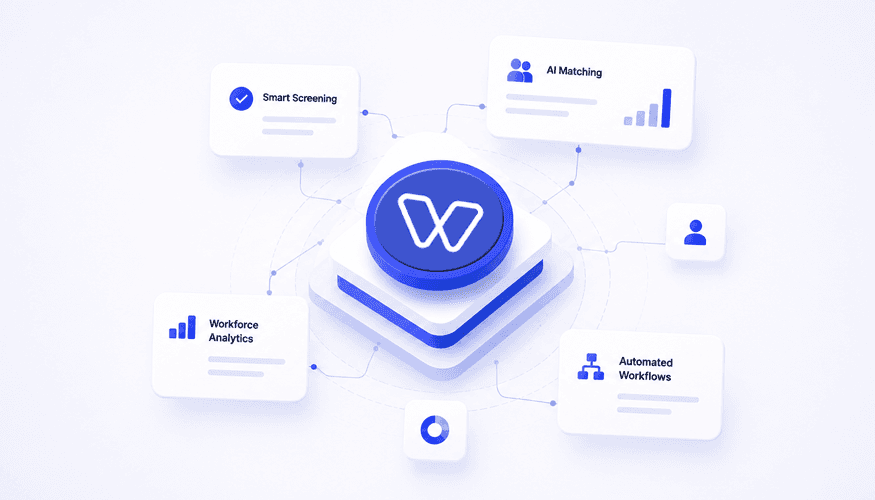
Enterprise staffing solutions are integrated platforms that automate recruiting, screening, and placement at scale, across multiple locations, departments, and workforce types. For large organizations, enterprise staffing goes beyond placing candidates: it synchronizes AI automation, ATS connectivity, and compliance frameworks to manage thousands of applicants simultaneously. Companies using AI-powered enterprise staffing solutions report 30–50% faster time-to-hire and up to 30% lower cost-per-hire, according to SHRM.
Modern enterprise staffing operations span multi-location recruiting, seasonal and hourly hiring, and specialized role placement, all while maintaining compliance across regions. Managing this at scale requires technology that goes beyond spreadsheets: AI automation that screens, schedules, and engages candidates 24/7 without adding headcount. Recruiters need tools that automate the repetitive work, consolidate data, and maintain a consistent candidate experience across every location.
That’s where AI automation emerges as a strategic differentiator. By introducing intelligent systems that can analyze, prioritize, and act at machine speed, companies transform from reactive hiring operations into proactive talent engines. In enterprise staffing, AI doesn't replace recruiters, it empowers them with insights and automation that make hiring faster, more consistent, and dramatically more cost-effective.
What is enterprise staffing?
Enterprise staffing is the large-scale process of sourcing, screening, and placing talent across multiple departments, locations, and workforce types within a single organization. Unlike traditional recruiting, enterprise staffing relies on AI automation, ATS integration, and compliance systems to manage high volumes of candidates (from frontline and hourly roles to specialized positions) consistently and at speed.
Enterprise staffing solutions are the software platforms that make this possible, combining AI-powered outreach, automated screening, and centralized analytics in one unified system.
Why enterprise staffing requires AI automation
Across industries, digital transformation in HR is reshaping how enterprise recruitment teams function. Instead of juggling disconnected tools, emails, and spreadsheets, organizations are adopting AI-powered recruiting platforms that centralize data and workflows. These platforms don’t just make tasks easier; they unlock new ways to automate candidate outreach for staffing firms, deliver better candidate experiences, and scale operations without adding headcount.
Consider a national staffing organization that supports 50 branch locations and handles over 10,000 applicants per month. Before leveraging automation, each branch relied on separate spreadsheets and recruiters struggled to monitor candidate touchpoints across regions. After deploying Whippy’s integrated platform, a leading national staffing firm reduced outreach lag times by up to 45% and reclaimed more than 1,200 recruiter hours per quarter, cutting time-to-fill by 33% across all 50 locations. This mini-case illustrates how digital tools evolve into a strategic workforce engine rather than isolated workflow helpers.
Through automation, recruiters can now focus on strategy rather than execution. AI handles repetitive steps such as outreach, scheduling, screening, and scoring, all while learning from past hires to continually refine its accuracy. The result is enterprise staffing solutions that combine human judgment with algorithmic precision, achieving both speed and personalization at scale.
In today’s HR technology ecosystem, effective staffing solutions require seamless interplay between ATS, CRM, communication channels, and analytics platforms. Whippy’s role is to act as enterprise recruitment software that links these systems into one unified engine. By placing every candidate interaction (from web form to screening call) into a central platform, recruiters gain visibility into hiring pipelines in real time, enabling centralized recruiting operations and richer strategic insight.
Organizations adopting full-cycle automation report an average 33% faster time-to-hire and up to 30% lower cost-per-hire, according to SHRM, proving that enterprise staffing is no longer a manual process but a data-driven hiring strategy.
How AI improves enterprise staffing efficiency
AI’s role in staffing extends far beyond simple task automation. It orchestrates entire recruiting workflows, uniting data, communication, and compliance under one intelligent system.
24/7 recruiting automation ensures candidates receive instant responses, even outside office hours, keeping engagement high across time zones. AI phone screening eliminates the back-and-forth of initial interviews by automatically assessing candidate qualifications through natural language conversations. With AI candidate matching, recruiters instantly see the best-fit applicants, guided by insights drawn from performance data, role requirements, and historical success rates.
Beyond candidate selection, enterprise-level candidate management keeps every recruiter aligned, notes, transcripts, and interview outcomes are stored in one system, creating visibility across distributed teams. Enterprise-grade compliance tools help HR leaders meet global recruiting standards effortlessly.
This is how AI improves staffing efficiency: by converting manual workflows into intelligent, responsive systems that adapt in real time. Recruiters can spend their time engaging top candidates rather than chasing paperwork or scheduling calls. AI becomes their strategic co-pilot, continuously optimizing outcomes while ensuring fairness, speed, and consistency.
Why enterprise staffing requires AI automation at scale
At the enterprise level, hiring complexity scales exponentially. Thousands of applicants flow in from multiple locations, job boards, and referral sources. Human teams alone can’t sustain the pace without sacrificing quality or candidate experience.
AI bridges that gap by introducing enterprise hiring automation that integrates seamlessly with existing systems. It automates outreach, scoring, scheduling, and reporting while giving recruiters real-time insights to guide decision-making.
Enterprise staffing challenge | How AI automation solves it |
|---|---|
Manual outreach to thousands of applicants | Automate candidate outreach for staffing firms |
Inconsistent candidate experiences across locations | Centralized recruiting operations and multi-location hiring consistency |
Long screening cycles and missed opportunities | Streamline screening and scheduling with AI |
Rising recruiting costs | Cost-per-hire reduction through automation |
Unstructured data and limited analytics | Data-driven hiring decisions for continuous improvement |
Organizations that adopt enterprise staffing automation consistently report faster time-to-fill, improved candidate quality, and higher offer acceptance rates. With AI, every recruiter becomes more productive, every applicant receives a faster response, and every hire becomes a measurable contributor to business growth.
Core capabilities of AI-driven enterprise staffing solutions
1. End-to-end enterprise recruiting automation
Today’s AI staffing platforms deliver a seamless ecosystem that handles everything from sourcing to onboarding. Recruiters can automate follow-ups, reminders, interview scheduling, and candidate scoring, freeing them to build stronger relationships with top talent. This holistic automation doesn’t just save time; it establishes repeatable excellence in enterprise recruiting operations.
2. ATS integration and Bullhorn compatibility for enterprise staffing
True efficiency comes from connectivity. Whippy’s solution provides robust ATS integration, including Bullhorn integration for enterprise staffing, so all candidate data, communication, and analytics stay in sync. This interoperability ensures recruiters always operate from the same source of truth, whether inside the ATS, CRM, or HRIS.
You can explore how these integrations work in practice in Whippy’s Bullhorn Automation Use Cases.
3. 24/7 AI engagement for enterprise candidates
AI allows enterprises to operate continuously, engaging, qualifying, and scheduling candidates at any time of day. This constant presence ensures that no lead is ever missed, creating a consistent experience across time zones. For AI for recruitment agencies and large enterprise teams, it means every candidate interaction is immediate, on-brand, and efficient.
4. AI for frontline and hourly hiring in enterprise workforce management
Whether hiring construction workers, logistics coordinators, or clinical staff, AI delivers flexible hiring solutions that scale with fluctuating demand. It supports bulk hiring for seasonal peaks while maintaining compliance and data accuracy. Enterprises gain real-time visibility into workforce distribution, helping leaders forecast needs and balance capacity with precision.
5. Secure and compliant enterprise staffing automation
In a landscape governed by data protection and employment laws, compliance cannot be an afterthought. Whippy’s intelligent staffing system supports secure and compliant enterprise staffing automation that adheres to labor regulations, privacy standards, and audit requirements. Built for global operations, it offers the assurance enterprises need to innovate responsibly.
How AI reduces time-to-hire in enterprise staffing: real results
Enterprise HR leaders consistently report a 30–50% reduction in time-to-fill when adopting AI staffing solutions. This measurable gain comes from eliminating friction in the recruiting funnel, where manual steps once slowed progress from candidate sourcing to final offer.
With recruiting workflow automation, every stage of the process becomes faster and more precise. AI handles sourcing and shortlisting, while automated communication keeps candidates engaged throughout screening and scheduling. These systems create a unified rhythm for recruiters and applicants alike, turning what was once a fragmented process into a cohesive, data-driven hiring engine.
This is possible because AI tools for large-scale hiring bring together multiple layers of intelligence, parsing resumes, analyzing skills, and ranking candidates according to relevance and performance indicators. Recruiters no longer spend hours reviewing applications; instead, they receive prioritized shortlists backed by data-driven hiring decisions.
For enterprises, the result is transformative efficiency. Automation drastically reduces recruiter workload by taking over repetitive outreach, follow-ups, and coordination. It also helps improve offer acceptance rates, as timely communication keeps candidates informed and motivated throughout the process.
Examples of AI in staffing agencies show clear ROI across different sectors:

Automate candidate outreach to secure immediate engagement and faster screening cycles.
Improve recruiter efficiency with AI tools, freeing teams to focus on strategic conversations.
Improve candidate quality with automation, using intelligent ranking to advance only the best fits.
Reduce time-to-fill with AI, turning lengthy hiring cycles into streamlined pipelines ready for rapid placements.
For enterprises managing bulk hiring for seasonal peaks or multi-location recruiting efforts, automation ensures consistency and scalability. It allows HR teams to maintain uniform standards and compliance while hiring at scale, an essential advantage for organizations that need to adapt quickly to shifting workforce demands.
Enterprise staffing vs. traditional recruiting
Understanding the difference between enterprise staffing solutions and traditional recruiting is essential for any organization evaluating HR technology. The gap is no longer about scale alone, it's about intelligence, speed, and the ability to adapt in real time.
In the past, large-scale recruiting relied on manual methods that could not keep up with modern workforce expectations. Traditional recruiting depends heavily on email threads, spreadsheets, and human coordination, systems that break down under the weight of enterprise-level operations.
By contrast, enterprise staffing with AI replaces friction with flow. Through AI-powered recruiting, teams communicate through automated, omnichannel engagement that reaches candidates where they are (text, voice, or email) while maintaining personalization at scale.
Screening and evaluation also undergo a dramatic improvement. Instead of time-consuming phone calls, AI phone screening allows candidates to answer job-specific questions instantly. Combined with intelligent scoring, recruiters can review qualified applicants in minutes rather than days. This streamlines screening and scheduling, giving enterprises the ability to move faster than competitors in a tight labor market.
Candidate experience becomes another defining difference. 24/7 recruiting automation guarantees responsiveness across time zones, creating the consistent communication that enterprise brands are known for. Meanwhile, built-in compliance ensures every step meets enterprise-grade standards for data and fairness.
Scalability may be the most critical distinction. Traditional recruiting grows linearly, more hires require more recruiters. But hiring at scale with automation grows exponentially: once systems are configured, AI and workflow automation can manage thousands of candidates simultaneously.
Ultimately, AI-driven enterprise staffing services empower recruiters rather than replace them. The human connection remains central, AI simply removes the administrative burden so recruiters can focus on building relationships that close top talent.
How to automate enterprise staffing in 5 steps
Automating enterprise staffing begins with a mindset shift, moving from reactive hiring to a continuous, intelligent talent pipeline. Each step in the automation journey compounds efficiency gains and strengthens team collaboration.
1. Map Your Recruiting Workflow
Identify where time and energy are lost. Manual screening, outreach, and data entry are prime candidates for automation. Understanding this flow forms the foundation of your recruiting workflow automation strategy.
2. Integrate AI with ATS/HRIS
Once processes are mapped, connect automation directly to your ATS or HRIS. Whippy’s staffing automation integration with ATS systems ensures that every interaction (from text messages to notes) feeds seamlessly into your enterprise recruitment software, eliminating duplicate data entry.
3. Adopt Enterprise Hiring Software
Choose the best AI staffing software for large organizations (or the best automation software for staffing agencies) that can support your scale, compliance, and multi-location needs. The platform should unify communication, scheduling, and analytics in one place.
4. Activate AI Solutions for Enterprise Recruitment
Deploy automation for sourcing, screening, and communication. Whippy’s enterprise recruitment solutions combine conversational bots, analytics dashboards, and centralized recruiting operations that bring all team activity into one unified workspace.
5. Monitor KPIs Continuously
Measure progress across key metrics: cost-per-hire reduction, recruiter workload, candidate engagement rates, and offer acceptance ratios. Tracking performance helps reveal how to scale enterprise hiring fast while keeping quality high.
By following these steps, organizations learn how to scale enterprise hiring with AI, turning once-manual tasks into a synchronized process that works around the clock. The payoff is agility, consistency, and speed across every part of the recruitment funnel.
Benefits of Enterprise Staffing Automation
AI-driven staffing solutions enable HR teams to streamline hiring with AI and automation while unlocking strategic insights that were previously inaccessible.
The enterprise staffing automation benefits extend beyond cost savings:
Reduced time-to-hire through automated outreach and faster decision-making.
Improved candidate experience from real-time engagement and consistent communication.
Data-driven insights for continuous process optimization.
Global recruiting compliance integrated into daily workflows.
Sourcing passive candidates at scale, reaching talent before competitors do.
Consistent 24/7 recruiting automation that keeps hiring momentum constant.
Enterprise workforce management with AI, allowing leaders to plan resources accurately and adjust to changing market conditions.
When combined, these elements create a self-improving system, a unified enterprise recruitment solution capable of adapting, learning, and scaling without friction. Over time, automation compounds its impact, building a recruiting organization that is both faster and smarter.
The future of enterprise staffing: predictive AI and continuous optimization
The next evolution of enterprise recruiting solutions lies in systems that not only execute workflows but also learn from every outcome. Predictive automation transforms static processes into adaptive engines that forecast, prioritize, and improve with each hire.
Future-ready organizations will rely on AI to forecast hiring needs, anticipate market shifts, and maintain consistent talent pipelines. Intelligent analytics will allow leaders to optimize recruiter workflows dynamically, making precise adjustments based on historical data and performance patterns.
Whippy’s AI automation for enterprise recruitment teams embodies this future. Its platform unites people, data, and systems into one intelligent hiring engine, providing the insights needed to refine decisions continuously and reduce uncertainty. This is the frontier of enterprise recruitment software, a solution that scales effortlessly, learns endlessly, and keeps your business ready for whatever comes next.
Ready to transform your enterprise staffing operations?
Transform how your organization hires.
Whippy delivers enterprise staffing solutions that combine AI automation, multi-location recruiting, and ATS integration in one unified platform. From outreach and AI screening to compliance and real-time analytics, every stage of the hiring process is covered.
Whether you're scaling to meet seasonal demand, managing bulk hiring across locations, or reducing cost-per-hire, Whippy gives your team the enterprise staffing automation to do it faster, smarter, and at scale. Request a demo to see how Whippy can transform your enterprise staffing operations today.
Request a Demo↗ to see how Whippy can help your enterprise scale hiring efficiently, compliantly, and 24/7.
Frequently asked questions about enterprise staffing solutions
Q: What is enterprise staffing?
A: Enterprise staffing is the large-scale process of recruiting, screening, and placing talent across multiple locations, departments, and workforce types within a large organization. It relies on AI automation, ATS integration, and compliance systems to manage high-volume hiring consistently and at speed.
Q: What are enterprise staffing solutions?
A: Enterprise staffing solutions are AI-powered software platforms that automate the end-to-end recruitment process, including candidate sourcing, screening, scheduling, and analytics. Leading platforms like Whippy combine multi-location recruiting, ATS integration, and 24/7 candidate engagement to reduce time-to-hire by 30–50%.
Q: How does AI improve enterprise staffing efficiency?
A: AI improves enterprise staffing efficiency by automating repetitive tasks (outreach, follow-ups, scheduling), screening candidates 24/7 via AI phone calls, ranking applicants using performance data, and syncing all activity across ATS and CRM platforms, freeing recruiters to focus on high-value conversations.
Q: How do I automate enterprise staffing?
A: To automate enterprise staffing:
1. Map your recruiting workflow to identify bottlenecks
2. Integrate an AI platform with your ATS/HRIS
3. Activate automated outreach and screening
4. Deploy candidate scoring and analytics
5. Monitor KPIs, time-to-fill, cost-per-hire, and offer acceptance rates.
Q: What is the difference between enterprise staffing and traditional recruiting?
A: Traditional recruiting scales linearly, more hires require more recruiters. Enterprise staffing with AI scales exponentially: once automation is configured, it manages thousands of candidates simultaneously. Key differences include 24/7 engagement, automated compliance, AI shortlisting, and centralized pipeline visibility.
Q: How much does enterprise staffing software reduce time-to-hire?
A: Enterprise staffing software powered by AI reduces time-to-hire by 30–50% on average, with organizations also reporting up to 30% lower cost-per-hire and 33% faster overall hiring cycles, according to SHRM. One leading staffing firm recovered 1,200+ recruiter hours per quarter after deploying Whippy across 50 branch locations.
Table of Contents
Table of Contents
- What is enterprise staffing?
- Why enterprise staffing requires AI automation
- Why enterprise staffing requires AI automation at scale
- Core capabilities of AI-driven enterprise staffing solutions
- How AI reduces time-to-hire in enterprise staffing: real results
- Enterprise staffing vs. traditional recruiting
- How to automate enterprise staffing in 5 steps
- Benefits of Enterprise Staffing Automation
- The future of enterprise staffing: predictive AI and continuous optimization
- Ready to transform your enterprise staffing operations?
- Frequently asked questions about enterprise staffing solutions
Try Whippy for Your Team
Experience how fast, automated communication drives growth.

Related Articles
Best AI Recruiting Tools for Franchise Staffing
 Elizabeth Long
The Staffing Operating System for Avionté
Elizabeth Long
Automated License Verification for Staffing Agencies
Elizabeth Long
Write Job Descriptions That Make AI Recruiters Perform
Elizabeth Long
The Candidates You Need Are Already in Your ATS
Elizabeth Long
Payroll Communication for Staffing Agencies
Elizabeth Long