


Table of Contents
- Why Staffing Workers Ask Payroll Questions in the First Place
- The Real Cost of Manual Payroll Support in Staffing
- What Payroll Verification Actually Means in Staffing
- How to Automate Payroll Communication in a Staffing Agency
- The Operational Results
- Stop Answering Payroll Questions. Start Making Placements.
- Frequently Asked Questions
Try Whippy for Your Team
Experience how fast, automated communication drives growth.
Every staffing firm has a version of the same story.
A recruiter is mid-call with a client about an open order. Their other line lights up. It's a temp worker asking when they get paid. They put the client on hold, answer the payroll question, get back to the client, and the moment is gone.
That interruption didn't cost a minute. It cost a placement.
Payroll communication for staffing agencies is one of the most overlooked operational drains in the staffing industry. Across staffing companies of every size, the pattern is the same. Not because it's complicated, most payroll questions are simple. But because the volume is relentless, the timing is unpredictable, and every single one pulls your team away from revenue-generating work.
This article breaks down why payroll inquiries staffing agencies receive are a structural problem, not a staffing one, and what it looks like when the system handles it instead of your people, especially inside modern all-in-one communication platforms.
Why Staffing Workers Ask Payroll Questions in the First Place
To understand the problem, you have to understand the worker's experience.
Temporary workers and contractors move between assignments, clients, and schedules, often without a fixed office, a direct manager they know well, or easy access to their pay records. When something looks wrong, or when they're simply unsure, they do what any employee would do: they call, unless your agency is using an AI communication app that handles these questions automatically.
So why do staffing workers ask payroll questions? The answers are predictable:
- They don't know the pay schedule for a new assignment
- Their hours don't match what they expected
- A rate change wasn't communicated clearly
- They're new and haven't been through the process before
- Something looks different on their pay stub and they don't know why
These aren't complaints. They're information gaps. And when your agency is the employer of record, your team is the first (and often only) point of contact.
The most common payroll questions in staffing agencies cluster around three themes: payment timing ("When do I get paid?"), hours accuracy ("Why are my hours missing?"), and rate confirmation ("Is my rate correct?"). These are the common payroll issues staffing firms deal with week after week, predictable, repetitive, and entirely automatable. Temp worker paycheck questions follow these patterns almost universally, regardless of industry or firm size.
The problem isn't the questions. It's that your recruiters and payroll staff are the ones fielding them, every time, all day, often after hours.
The Real Cost of Manual Payroll Support in Staffing
Here's what manual payroll communication actually costs.
Every inbound call about a paycheck is a non-revenue generating task for staffing. The recruiter who answers it isn't sourcing. The payroll staffer who handles it isn't resolving a billing dispute or closing a compliance issue. They're repeating information that could have been delivered automatically.
Recruiter time wasted on payroll calls compounds fast. A firm placing 200 active workers might field 30 to 50 payroll-related contacts per week, paycheck problems at a temp agency don't stop at one or two calls. Missing hours, pay rate discrepancies, payment dates, direct deposit issues: each one lands on a recruiter's desk. At five minutes per interaction, that's four hours of recruiter and payroll staff time, every week, on questions that generate zero revenue.
Multiply that across branches, and the staffing agency back-office burden becomes significant. Multiply it across a year, and you've funded a headcount position that was never hired, it was just absorbed, invisibly, into every payroll cycle by your existing team.
The administrative headcount problem in staffing is real: firms often reach for another coordinator or payroll administrator when the actual fix is a better system for handling worker payroll questions. More people answering the same questions isn't a solution. It's an expensive band-aid. It's why firms are shifting toward recruitment process automation instead of expanding administrative headcount.
There's also a consistency problem. When payroll inquiries staffing agencies receive are handled by whoever picks up the phone, the quality and accuracy of responses varies. One branch tells a worker their check processes on Thursdays. Another says Fridays. A third doesn't answer at all after 5pm. The worker gets a different experience every time they call, and their trust in the agency erodes, which affects retention and redeployment rates downstream.
What Payroll Verification Actually Means in Staffing
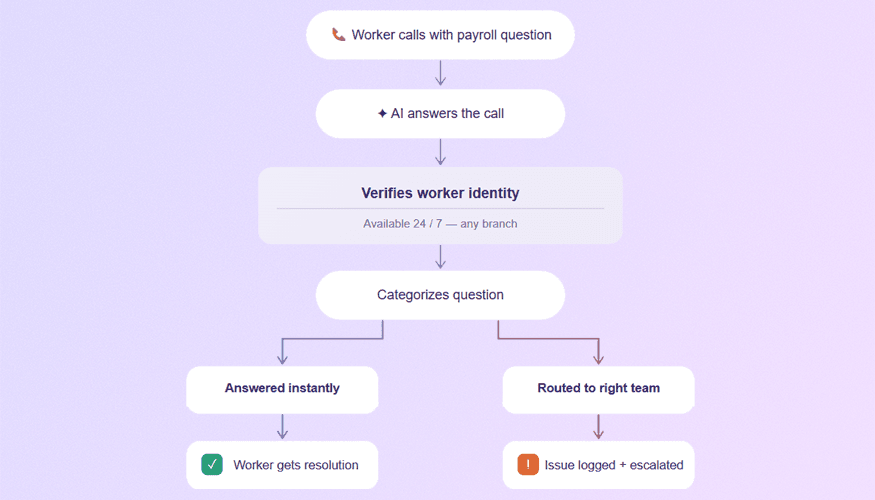
Payroll verification in staffing is the process of confirming a worker's identity before sharing any pay information, and then delivering accurate, role-specific answers in real time.
This matters for two reasons. First, payroll data is sensitive. A system that hands out pay details without confirming who it's talking to creates compliance exposure. Second, the information itself has to be accurate and current, not scripted responses that don't reflect the worker's actual assignment details.
Worker identity verification for payroll is the first step in any responsible payroll communication system. Before any information is shared (pay dates, rate confirmations, hours on record) the worker's identity is confirmed. Only then does the system provide the relevant data.
After verification, the system can answer standard payroll questions instantly: payment schedule, hours logged, rate in effect, last pay stub details. These are the questions that make up the vast majority of payroll call volume for staffing agencies. They're also the easiest to automate accurately.
For more complex cases, missing hours disputes, rate discrepancies that require investigation, sensitive termination pay situations, the system captures the full details and routes them to the right person. Staffing agency payroll issues that once sat in voicemail for hours now arrive with full context, ready to resolve.
The result: payroll dispute resolution in staffing becomes faster for workers and less disruptive for staff. Payroll operations run cleaner when complex cases arrive with full context, not just a message that says "call me back".
How to Automate Payroll Communication in a Staffing Agency
Automating payroll communication in a staffing agency doesn't mean replacing your payroll team. It means building payroll support for staffing firms that doesn't depend on your team being available, free, and consistent all at once.
Here's how it works in practice with Whippy's AI agent for staffing:
Inbound contacts are handled immediately.
When a worker calls or messages with a payroll question, the system responds in real time, not during business hours only, but around the clock. Payroll communication after business hours is one of the most common gaps in staffing operations. Workers on overnight shifts, early morning starts, or weekend assignments often can't reach anyone when questions come up. An always-on system eliminates that gap entirely.
Identity is confirmed before anything is shared.
Worker identity verification runs automatically at the start of every payroll interaction. This protects sensitive data and keeps the firm compliant.
Standard questions are resolved instantly.
Payment dates, rate confirmation, hours on record, automated payroll responses for staffing handle these immediately, with information specific to that worker's assignment. Not generic answers. The worker's actual data.
Complex issues are captured and routed.
When a worker reports missing hours, a rate that doesn't match their offer letter, or any issue that requires investigation, the system collects the full details, specific dates, amounts, what the worker expected versus what they received, and routes the case to the right team with a complete summary. No lost context, no vague voicemails, no follow-up required just to understand the problem.
Every interaction is consistent.
Payroll communication consistency across branches is one of the biggest operational gains firms see when they automate. Every worker, in every location, at any hour, gets the same quality of response. The firm's payroll communication is no longer dependent on who happens to pick up the phone.
This is what Whippy's platform delivers as part of a unified AI system for staffing operations, not a standalone chatbot, but a payroll chatbot for staffing agencies built into the same infrastructure that handles onboarding, assignment confirmations, and redeployment. Payroll verification is one of the use cases Whippy runs across the full staffing lifecycle.
The Operational Results
When payroll communication is automated in staffing, the impact shows up in measurable ways. Staffing firm operational efficiency improves across the board, not because of one dramatic change, but because dozens of small interruptions stop happening every day. That's what staffing operations efficiency actually looks like in practice.
Fewer interruptions for recruiters and payroll staff.
The payroll call volume staffing agencies absorb drops significantly when workers have an immediate, accurate channel for self-service. Recruiter productivity in staffing rebounds immediately. Payroll staff handle real issues instead of repeating the same answers.
Faster resolution for workers.
Payroll inquiry response time in staffing drops from hours, or days, when a message gets lost, to seconds. Workers get answers when they need them. Payroll resolution time in staffing, from first contact to closed issue, compresses from days to minutes for standard questions, which reduces frustration and improves retention.
Consistent communication across every branch.
Payroll communication automation means the firm speaks with one voice, everywhere, always. The branch in one city handles payroll questions the same way as the branch in another.
Better visibility into payroll issues.
When complex cases are captured and routed systematically, patterns become visible. If missing hours complaints are spiking at a specific client site, or if rate discrepancy reports cluster around a particular assignment type, leadership can see it (and fix it) before it becomes a larger problem.
No need to grow administrative headcount to handle volume.
As the firm scales, payroll self-service for staffing workers scales with it. The system handles more workers without adding more staff to answer the same questions.
The connection to staffing agency revenue focus is direct: every hour your team isn't answering basic payroll questions is an hour they're available to make placements, build client relationships, and drive growth. That's the real return on automating payroll communication.
Stop Answering Payroll Questions.
Start Making Placements.
If your team is fielding payroll questions all day, your operation isn't focused on revenue, it's focused on maintenance. The work that grows your firm is getting crowded out by questions that a system should be handling.
Whippy's AI receptionist for staffing handles payroll communication as part of a complete operational system, from the first inbound contact through identity verification, instant answers, complex case routing, and consistent communication across every branch and every hour.
The result is a staffing operation where your recruiters recruit, your payroll team resolves real issues, and your workers get the answers they need the moment they need them.
See how it works. Book a demo with Whippy.
Frequently Asked Questions
A payroll FAQ for staffing workers and the operations teams who support them.
Q: What are the most common payroll questions in staffing agencies?
A: The most common worker payroll questions in staffing fall into three categories: payment timing (when will I be paid, what day does direct deposit hit), hours accuracy (my hours don't look right, I'm missing a day), and rate confirmation (is this the rate we agreed on, why did my pay change). These questions make up the large majority of payroll contact volume and are the most straightforward to handle through automation.
Q: How do staffing agencies handle payroll inquiries today?
A: Most staffing agencies handle payroll inquiries manually, through inbound calls routed to recruiters or payroll staff, voicemails that get checked periodically, or email that sits in a shared inbox. This approach creates inconsistency, delays payroll inquiry response time, and pulls staff away from revenue-generating work. High-performing firms are moving toward automated payroll communication systems that handle standard questions instantly and route complex cases to the right people.
Q: Can AI answer payroll questions for staffing workers?
A: Yes. AI payroll communication for staffing can handle identity verification, answer standard questions about pay dates and rates using real assignment data, capture detailed information about complex issues like missing hours or rate discrepancies, and route those cases to the appropriate team member, all without human involvement for routine contacts. The AI agent handles the volume; your team handles the judgment calls.
Q: How do you handle missing hours complaints in staffing?
A: When a worker reports missing hours, the system collects the specifics: which dates are affected, what hours they believe they worked, which client site, and any supporting context. That structured case is then routed to the payroll team with everything they need to investigate, no follow-up call required just to gather basic information. Payroll dispute resolution moves faster because the intake is complete from the start.
Q: What is payroll verification in staffing and why does it matter?
A: Payroll verification in staffing is the process of confirming a worker's identity before sharing any pay-related information. It matters because payroll data is sensitive, rates, hours, and banking details shouldn't be accessible to anyone who calls and provides a name. A proper verification step protects workers, protects the firm from liability, and ensures that automated payroll responses go to the right person.
Q: How do you reduce payroll interruptions in staffing?
A: Reducing payroll interruptions in staffing requires moving standard payroll support out of your recruiters' workflow entirely. When workers have a dedicated channel, available 24/7, capable of verifying their identity and answering their questions instantly, they stop calling the main line. The interruptions don't decrease gradually; they stop being the default response path.
Q: Does automated payroll communication work after business hours?
A: Yes, and after-hours payroll support is one of the highest-value applications in staffing. Workers on early shifts, overnight assignments, or weekend placements often can't reach anyone when a paycheck question comes up. A system that operates continuously ensures those workers get answers when they need them, not the next business day, when the frustration has already built.
Table of Contents
Table of Contents
- Why Staffing Workers Ask Payroll Questions in the First Place
- The Real Cost of Manual Payroll Support in Staffing
- What Payroll Verification Actually Means in Staffing
- How to Automate Payroll Communication in a Staffing Agency
- The Operational Results
- Stop Answering Payroll Questions. Start Making Placements.
- Frequently Asked Questions
Try Whippy for Your Team
Experience how fast, automated communication drives growth.

Related Articles
EU AI Act: Whippy's Independent Bias Audit
 Elizabeth Long
Colorado SB 26-189: Whippy's Independent Bias Audit
Elizabeth Long
NYC Local Law 144: Whippy's Independent Bias Audit
Elizabeth Long
California FEHA: Whippy's Independent Bias Audit
Elizabeth Long
Illinois HB 3773: Whippy's Independent Bias Audit
Elizabeth Long
Best AI Recruiting Tools for Franchise Staffing
Elizabeth Long