


Table of Contents
- What Is Candidate Reactivation in Staffing?
- The Hidden Revenue Loss in Staffing
- Why Staffing Firms Restart the Hiring Cycle
- What Candidate Reactivation Looks Like
- How Candidate Reactivation Works (Step-by-Step)
- Manual Follow-Up vs Automated Reactivation
- The Business Impact of Candidate Reactivation
- Reactivation Is Not Engagement. It Is Revenue Recovery.
- Reactivation Boosts Staffing Efficiency
- How to Reactivate Candidates in Staffing (Best Practices)
- How Whippy Enables Candidate Reactivation
- When Should You Use Candidate Reactivation?
- Why Candidate Reactivation Is a Competitive Advantage
- Final Thought
- Ready to Turn Your Database Into Revenue?
- Frequently Asked Questions
Try Whippy for Your Team
Experience how fast, automated communication drives growth.
Most staffing firms focus on filling roles. Fewer focus on what happens after placement.
That is where revenue is quietly lost.
Every time a placement ends and a worker drops out of your active pipeline, your team faces a choice. Go back to job boards and restart sourcing. Or reuse talent you already paid to acquire.
The difference between those two decisions directly impacts cost per placement, time to fill, and overall staffing profitability, as well as broader business efficiency and operational efficiency across your recruiting operations.
This is where candidate reactivation in staffing becomes a revenue strategy, not just an operational task.
Candidate reactivation is not a one-time action. It is part of a structured lifecycle workflow that begins at placement, continues through inactivity, and systematically drives redeployment. This lifecycle approach ensures that completed assignments become the starting point of the next placement cycle, not the end of it.
What Is Candidate Reactivation in Staffing?
Candidate reactivation in staffing is the process of re-engaging previously placed or qualified candidates after a period of inactivity to place them into new roles without restarting the sourcing cycle, helping teams re-engage candidates and reactivate past candidates in a structured way.
It is a structured approach to candidate database reactivation and candidate database re-engagement, where past talent is systematically evaluated, updated, and redeployed into new job placements through consistent candidate redeployment and reactivation workflows.
The Hidden Revenue Loss in Staffing
Every time a placement ends and a worker drops out of your active pipeline, your team faces a choice. Go back to job boards and restart sourcing. Or reuse talent you already paid to acquire.
The difference between those two decisions directly impacts cost per placement, time to fill, and overall staffing profitability, as well as broader business efficiency and operational efficiency across your recruiting operations.
But when that worker is not reused, the process starts again from zero.
You are not just restarting a process. You are duplicating cost.
You pay again for sourcing, spend time screening again, and delay placements that could have been filled faster.
This creates a hidden layer of inefficiency that most staffing firms do not track directly.
It is not visible in a single metric, but it shows up across your operations:
- higher acquisition costs per candidate
- slower placement cycles
- lower utilization of your candidate pipeline and talent pipeline
Over time, this compounds into a structural problem. You are not just spending more. You are earning less from the same talent.
That is why understanding how to reduce cost per hire in staffing is not only about sourcing better candidates. It is about fully utilizing the candidates you already have.
Many staffing agencies assume the problem is talent shortage.
In reality, the problem is often unused talent sitting in the candidate pipeline.
Why Staffing Firms Restart the Hiring Cycle
Most recruiting teams do not intentionally ignore past candidates. The issue is structural.
Common challenges include issues increasingly visible in recruiting trends:
- lack of visibility into inactive candidates
- reliance on recruiter memory
- no triggers for candidate re-engagement
- fragmented recruitment technology
- limited ATS automation and recruitment process automation systems
As a result, even strong candidates are forgotten.
The pipeline exists, but it is not activated. These limitations are common in teams that have not yet implemented modern recruitment automation workflows designed for scale.
What Candidate Reactivation Looks Like
Effective candidate reactivation is not a generic follow-up or a one-off message asking “are you available?”
It is a structured process of candidate database reactivation and candidate database re-engagement that focuses on collecting updated, decision-ready candidate information that recruiters can immediately act on.
When done correctly, this goes beyond simple outreach, continuously refreshing candidate data so recruiters make decisions with accurate, up-to-date information.
This includes confirming availability, but also understanding:

current work status and shift preferences
preferred locations or willingness to travel
newly acquired certifications or licenses
updated constraints such as schedule or compensation expectations
readiness for immediate redeployment
This is what separates basic candidate engagement from true candidate re-engagement and supports stronger candidate retention through more effective candidate redeployment.
You are not just reconnecting. You are requalifying.
These are not cold candidates. They are already screened, validated, and proven in real assignments. That is what makes reactivation significantly more efficient than restarting the sourcing process.
This requalification layer is what makes reactivation actionable.
Without updated candidate information, recruiters are forced to make assumptions. That leads to mismatches, delays, and missed opportunities.
With structured candidate database re-engagement, every interaction becomes a data point that improves matching accuracy.
Instead of asking, “Who might be available?” recruiting teams can operate with clarity:
- who is ready now
- who fits a specific role
- who can be placed immediately
This shift reduces uncertainty and allows recruiters to move faster with confidence, improving placement quality and reducing delays.
How Candidate Reactivation Works
(Step-by-Step)
To fully understand how to reactivate candidates in staffing, it is important to see it not as a campaign, but as a continuous workflow embedded into your recruiting operations.
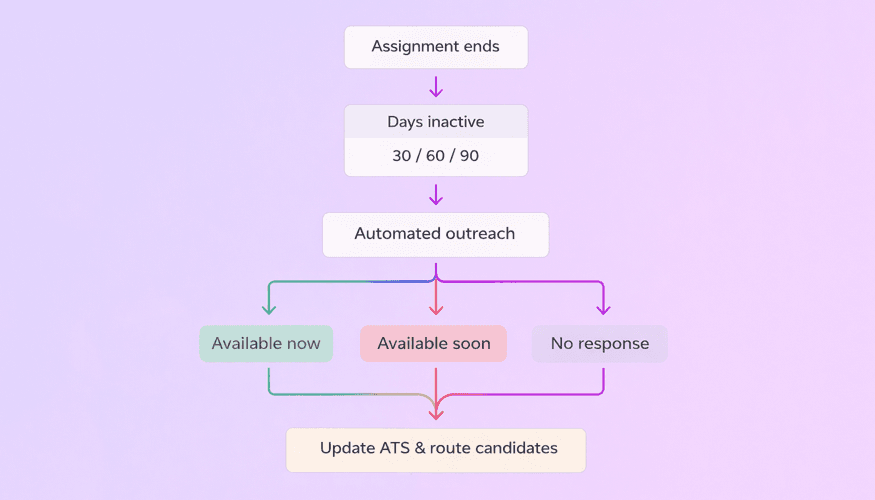
The process begins with clearly defined inactivity triggers. Once a candidate completes an assignment and has not been placed again within a defined window, such as 30, 60, or 90 days, the system automatically initiates outreach.
This is where automated tools and modern recruitment automation tools play a critical role. Instead of relying on manual follow-ups, automated candidate outreach ensures that every eligible candidate is contacted at the right moment, without gaps or delays.
This type of system is especially critical in environments that rely on high volume recruiting strategies to maintain pipeline velocity.
From there, candidates are guided through a structured interaction to capture updated information. This is not just a check-in. It is a qualification layer that helps determine whether the candidate is ready for immediate redeployment or requires additional steps.
Once responses are collected, ATS automation updates candidate records instantly. This eliminates the lag between communication and system updates, ensuring that recruiters always work with accurate data.
Based on candidate responses, the system can automatically:
- update worker records inside the ATS
- apply structured redeployment tags
- route available candidates directly to open roles
- notify recruiters when high-value talent is ready for placement
- trigger qualification refresh workflows when required
This transforms reactivation from a communication step into a decision engine that drives faster placements.
At this point, candidates can be evaluated and matched against open roles, allowing recruiters to quickly redeploy workers instead of restarting sourcing cycles. Those who meet requirements are surfaced to recruiters, while others may enter secondary workflows for qualification refresh or future follow-up.
This is how recruiting process automation transforms reactivation into a scalable system. It removes inconsistency, reduces manual effort, and directly contributes to reducing time to hire and improving overall pipeline efficiency.
At this point, redeployment is no longer dependent on recruiter memory. It becomes a systematic, repeatable process driven by automation and real-time data.
For a broader view of how reactivation fits within the full staffing lifecycle, including demand generation, qualification, placement, and continuous operations, see our complete guide to AI agents use cases for staffing.
Manual Follow-Up vs Automated Reactivation
Manual Process | Automated Reactivation |
|---|---|
Depends on memory | System-driven workflows |
Inconsistent outreach | Automated recruiting workflows |
Slow response time | Instant engagement |
Limited scale | Fully scalable |
Data not updated | Real-time updates via recruitment workflow automation |
This shift is driven by the adoption of AI recruiting agents that automate candidate engagement at scale. Automation in recruiting transforms reactivation from a manual task into a scalable growth engine.
The Business Impact of Candidate Reactivation
The impact of candidate reactivation is not limited to operational improvements. It directly influences financial performance across the entire staffing lifecycle.
When staffing firms consistently reuse existing candidates, they significantly reduce dependency on external sourcing channels. This leads to a measurable decrease in acquisition costs, which directly improves margins.
At the same time, reactivation accelerates placements, improving time to fill and reducing cost per hire. By working with already qualified candidates, recruiters fill roles faster and respond more efficiently to client demand.
This has a compounding effect on revenue optimization and staffing ROI performance.
It also increases worker lifetime value by extending placements per candidate, turning each worker into a recurring revenue asset rather than a one-time placement.
Faster placements mean:
more roles filled per recruiter
higher utilization of existing talent
increased placement frequency
improved client satisfaction
Over time, this drives stronger profitability and more predictable revenue growth.
In the staffing industry, where margins are often pressured by competition and rising sourcing costs, these gains are not incremental. They are structural.
Reactivation does not just improve efficiency. It reshapes how revenue is generated.
Reactivation Is Not Engagement.
It Is Revenue Recovery.
Many teams confuse candidate engagement with reactivation.
They are not the same.
- Engagement is ongoing communication
- Reactivation is targeted, time-based, and outcome-driven
The goal is not to stay in touch.
The goal is to recover lost revenue from inactive talent.
That is why candidate re-engagement should be part of your core recruitment strategy, not an afterthought.
Reactivation Boosts Staffing Efficiency
If you are evaluating how to improve staffing efficiency, it is important to shift the focus from acquisition to utilization.
Most staffing firms optimize for sourcing. They invest in job boards, advertising, and outbound recruiting efforts to bring new candidates into the pipeline.
But efficiency is not just about adding more candidates. It is about maximizing the value of the candidates you already have.
Most discussions around recruiting trends focus on sourcing more candidates, expanding reach, or adopting new channels, but these approaches increase volume, not efficiency.
True efficiency comes from improving how your system operates. It comes from process improvements that reduce friction, eliminate redundancy, and increase the speed of decision-making.
Candidate reactivation is one of the most effective ways to achieve this because it directly addresses underutilization within your pipeline, often caused by candidate drop-off and inactive talent pools.
Instead of expanding the top of the funnel, you activate what is already inside it.
This is where staffing redeployment, also known as redeployment staffing, becomes critical.
By systematically reactivating and redeploying talent through structured talent reactivation, firms can maintain a more dynamic and responsive candidate pipeline.
Instead of rebuilding from scratch with every new role, recruiters can draw from a continuously refreshed pool of qualified candidates.
This approach improves:
- pipeline quality
- placement speed
- recruiter productivity
- workforce management
It also reduces friction across the hiring process. When candidates are already known, vetted, and recently requalified, decision-making becomes faster and more reliable.
Ultimately, the question is not just how to re-engage inactive candidates.
It is how to integrate reactivation into your core recruitment strategy so that your pipeline remains active, accurate, and revenue-generating at all times.
How to Reactivate Candidates in Staffing
(Best Practices)
Understanding how to reuse candidates in recruiting requires more than implementing a tool. It requires intentional process improvements across your recruiting operations.
First, define clear reactivation criteria. Not all candidates should be treated the same, segment your database by role type, placement history, and redeployment likelihood.
Next, implement consistent outreach using automated recruiting workflows. This ensures that no candidate is missed and that communication remains timely and relevant.
Then, focus on collecting meaningful updates that allow you to re-engage inactive talent with accurate, up-to-date information. The goal is not just to reconnect, but to gather updated candidate information that improves matching accuracy.
Finally, ensure that your systems are connected. Without proper integration, even the best outreach will fail to translate into action. This is where recruitment workflow automation and ATS automation become essential.
When these elements are aligned, reactivation becomes predictable, scalable, and measurable.
How Whippy Enables Candidate Reactivation
Modern staffing firms need more than a traditional ATS.
They need recruiting process automation that connects communication, data, and workflows as part of a modern talent acquisition strategy.
With Whippy, teams can:
automate candidate outreach across channels
trigger reactivation workflows based on inactivity
sync updates directly into ATS systems
streamline candidate pipeline management
improve recruiting efficiency through automation
This transforms your database into an active revenue engine.
When Should You Use Candidate Reactivation?
Candidate reactivation is critical if:
- you run staffing firms with recurring placements
- your candidate pipeline includes inactive talent
- your cost per hire is increasing
- your time to fill is slowing down
- your recruiting teams rely heavily on sourcing
If you are constantly sourcing new candidates, you are likely leaving revenue on the table.
Why Candidate Reactivation Is a Competitive Advantage
In the staffing industry, speed and efficiency define competitive advantage.
Most staffing firms compete by sourcing more candidates instead of leveraging AI-powered recruiting systems that optimize existing pipelines. They invest in job boards, outbound recruiting, and expanding their reach.
But that approach increases volume, not performance.
The firms that outperform the market are not the ones with the largest pipelines. They are the ones that know how to activate them.
When you build a system for candidate redeployment and reactivation, you shift from acquisition to utilization.
Instead of asking, “How do we find more candidates?” you operate from a stronger position:
- who in our talent pipeline is ready now
- who can be placed faster than new applicants
- how quickly can we redeploy workers into open roles
This allows recruiting teams to re-engage candidates, reactivate past candidates, and re-engage inactive talent in a consistent and scalable way.
The result is not just faster placements. It is a structural advantage:
- reduced reliance on external sourcing
- lower recruitment costs
- improved time to fill
- stronger client responsiveness
- higher placement rates
Over time, this compounds into a more efficient and resilient operation.
Candidate reactivation becomes more than a workflow. It becomes a core driver of revenue optimization and long-term growth.
Final Thought
Your candidate database is not just a record of past work.
It is your most underutilized source of future revenue.
Every inactive candidate represents lost opportunity, lost efficiency, and lost margin.
Candidate reactivation in staffing turns that loss into growth.
Completed assignments should not be operational endpoints. They should be the beginning of the next placement cycle.
Ready to Turn Your Database Into Revenue?
If you want to:
reuse existing candidates
reduce cost per placement and lower recruitment costs
improve staffing profitability
automate your recruiting workflows
Request a demo and see how it works.
Frequently Asked Questions
Q: What is candidate reactivation in staffing?
A: Candidate reactivation in staffing is the process of re-engaging previously placed or qualified candidates after inactivity to place them in new roles without restarting sourcing. It helps firms reuse existing talent and improve recruiting efficiency.
Q: How to reactivate candidates in staffing?
A: To reactivate candidates in staffing, firms use automated candidate outreach triggered after inactivity. This process collects updated availability, preferences, and qualifications, allowing recruiters to match candidates to new roles without restarting the hiring cycle.
Q: How does candidate reactivation reduce cost per hire in staffing?
A: Candidate reactivation reduces cost per hire in staffing by eliminating the need to source and onboard new candidates. By reusing existing candidates, staffing firms lower recruitment costs and improve recruitment ROI.
Q: How does candidate reactivation help reduce time to fill positions?
A: Candidate reactivation helps reduce time to fill positions by providing immediate access to pre-qualified candidates. Recruiters can quickly redeploy workers who are already vetted, improving speed and placement efficiency.
Q: What is the difference between candidate reactivation and candidate engagement?
A: Candidate engagement focuses on ongoing communication, while candidate reactivation is a structured process to re-engage inactive candidates and place them into new roles. Reactivation is outcome-driven and directly tied to revenue.
Q: When should staffing firms use candidate reactivation?
A: Staffing firms should use candidate reactivation after a defined period of inactivity, typically 30 to 90 days after assignment completion. It is especially useful when cost per hire increases or time to fill slows down.
Q: Is candidate reactivation better than sourcing new candidates?
A: Candidate reactivation is often more efficient than sourcing new candidates because it leverages already qualified talent. While sourcing remains important, reactivation reduces costs, improves speed, and increases placement rates.
Table of Contents
Table of Contents
- What Is Candidate Reactivation in Staffing?
- The Hidden Revenue Loss in Staffing
- Why Staffing Firms Restart the Hiring Cycle
- What Candidate Reactivation Looks Like
- How Candidate Reactivation Works (Step-by-Step)
- Manual Follow-Up vs Automated Reactivation
- The Business Impact of Candidate Reactivation
- Reactivation Is Not Engagement. It Is Revenue Recovery.
- Reactivation Boosts Staffing Efficiency
- How to Reactivate Candidates in Staffing (Best Practices)
- How Whippy Enables Candidate Reactivation
- When Should You Use Candidate Reactivation?
- Why Candidate Reactivation Is a Competitive Advantage
- Final Thought
- Ready to Turn Your Database Into Revenue?
- Frequently Asked Questions
Try Whippy for Your Team
Experience how fast, automated communication drives growth.

Related Articles

Best AI Recruiting Tools for Franchise Staffing
 Elizabeth Long
The Staffing Operating System for Avionté
Elizabeth Long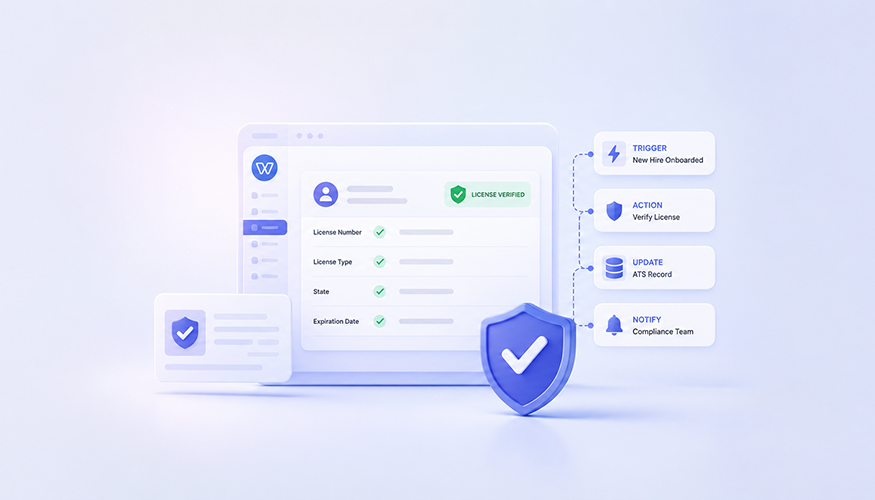
Automated License Verification for Staffing Agencies
Elizabeth Long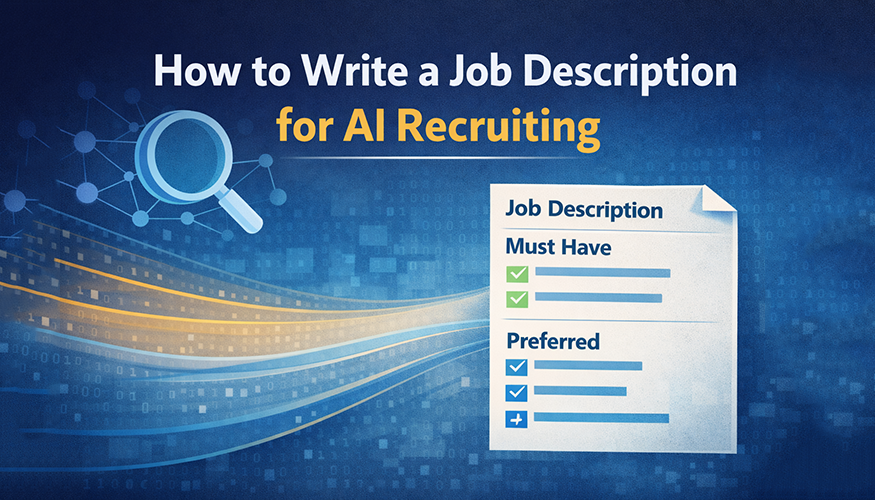
Write Job Descriptions That Make AI Recruiters Perform
Elizabeth Long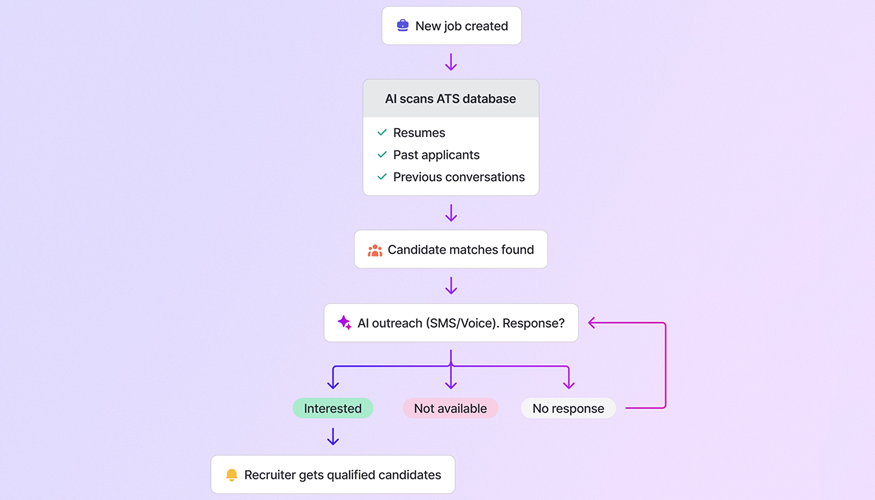
The Candidates You Need Are Already in Your ATS
Elizabeth Long
Payroll Communication for Staffing Agencies
Elizabeth Long