


Table of Contents
- Why human-written job descriptions fail AI recruiters
- The two-layer framework: the fix that actually works
- Before and after: the same role, two very different outcomes
- What makes a qualification measurable
- Pre-screening questions: when and how to use them
- The job description template that works for AI recruiters
- How to build this into your ATS workflow
- When AI interviews go wrong: a troubleshooting guide
- Best practices: a quick reference
- Put this structure to work in your next role
- Frequently asked questions
Try Whippy for Your Team
Experience how fast, automated communication drives growth.
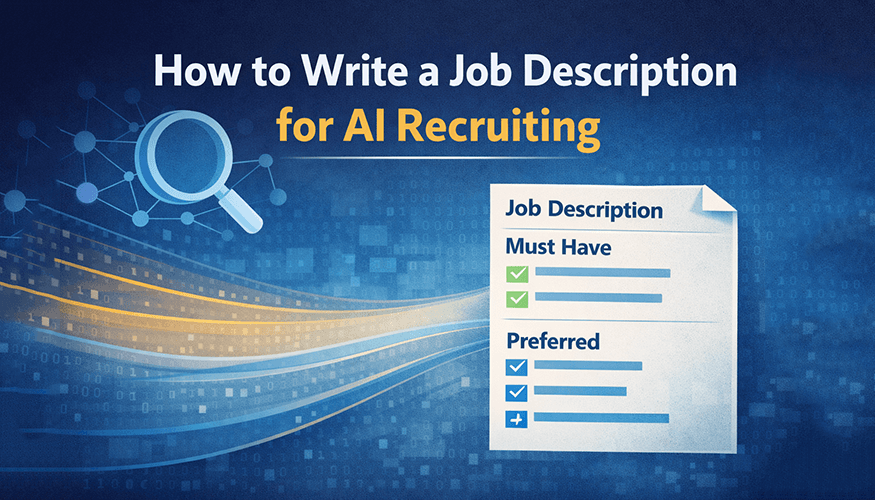
Your AI recruiter is only as smart as the job description you feed it. Here's how to write a job description that works, not just for job boards, but for the AI doing the screening.
You set up your AI recruiter. You connected it to your ATS. You posted the role. And then the interviews came back generic, the wrong candidates moved forward, or a clearly qualified applicant got screened out for no obvious reason.
The instinct is to blame the tool. But in almost every case, the problem starts earlier, with the job description itself.
This is the core challenge of AI recruiting that almost no one talks about: job posting quality that attracts humans on a job board is not the same structure that makes an AI recruiter perform. Understanding that difference, and fixing it, is the single highest-leverage change a recruiter or hiring manager can make.
Garbage in, garbage out recruiting is real: a vague, unstructured job description produces vague, inconsistent interviews every time.
Why human-written job descriptions fail AI recruiters
A human reads a job description and brings context. They know that soft skills like 'must be reliable' or 'team player' are filler, that the license requirement buried in paragraph three is actually a hard deal-breaker, and that the physical demands listed at the bottom matter as much as the technical skills at the top.
An AI recruiter doesn't have that intuition. It reads the job description structure for AI as literal input. It weighs what's explicitly labeled, uses that to generate questions and evaluate potential candidates, and scores them against what's been defined as must-have vs. preferred qualifications. Without a structured job description, those signals are buried in paragraphs, mixed with marketing language, or never explicitly separated, and the AI has no reliable foundation to work from.
The result is weak screening questions, inconsistent candidate scoring, and AI interview quality that frustrates everyone involved. This isn't a technology failure, it's a job description input problem.
The two-layer framework: the fix that actually works
To write a job description your AI recruiter can actually use, you need to think in two distinct layers: content that provides context, and content that drives scoring.
Layer 1: Job summary vs requirements: why the separation matters
The job summary describes the role: what the work involves, what the environment is like, who the candidate reports to, and what a typical day looks like. This is the layer the AI uses to answer candidate questions about the working environment during the interview, 'What does the schedule look like?' or 'Who would I be working with?', the kind of questions any prospective team member asks before committing to an open position.
It is also where employer branding lives, your culture, mission, and what makes this opportunity worth pursuing. It is not where your requirements live. Any requirement that only appears in the job summary is likely to be missed or underweighted by the AI.
Layer 2: Key requirements (this is what drives everything)
This is where role requirements do the heaviest lifting for AI recruiter performance. It must be divided into two clearly labeled sublayers:
- Must Have: true non-negotiables only. If a candidate doesn't meet these, they do not move forward. The AI uses these for pass/fail candidate scoring and generates its highest-priority screening questions from them.
- Preferred: helpful but not disqualifying. The AI uses these for ranking candidates who have already passed the Must Have threshold.
The most common job description mistake in AI recruiting: too many items in Must Have. If everything is critical, nothing is. A bloated Must Have list causes the AI to reject qualified candidates at scale.
Before and after:
the same role, two very different outcomes
Here is what the same job responsibilities section looks like written for a human reader versus written as proper structured input for an AI recruiter.
Before: written for humans
We're looking for a dependable Class B driver who is a team player and comfortable in a fast-paced environment. The ideal candidate has a clean record, can handle physical work, and has some flatbed experience. Early morning availability is a plus. Must work well independently.
After: written for AI
Must Have
- Valid Class B Driver's License
- Clean driving record, no recent violations
- DOT road experience
- Available 5am start times
Preferred
- Flatbed truck experience
- Manual transmission operation
- Able to lift 50 lbs and secure loads
The first version produces AI interviews about teamwork and attitude, things that are nearly impossible to screen for and irrelevant to the role. The second version gives the AI recruiter measurable qualifications to generate precise screening questions from job description sections that actually matter.
What makes a qualification measurable
Measurable qualifications are the building blocks of high-quality AI interviews. The rule is simple: if you cannot verify it with a yes or no answer, a number, or a document, it is too vague to score against.
Vague (avoid) | Measurable (use this) |
|---|---|
Experienced driver | Valid Class B Driver's License |
Good communicator | Bilingual English/Spanish required |
Available to work early | Available for 5am shift start, Monday–Friday |
Physically fit | Able to lift 50 lbs repeatedly and stand for 8-hour shifts |
Some warehouse experience | Minimum 1 year forklift operation, certified preferred |
Relevant work experience | 2+ years in a similar role, verifiable by reference |
Customer service experience | 1+ year in a client-facing or frontline service role |
Every item in your Must Have list should pass this test. If a hiring manager can't tell whether a candidate meets it from a single direct answer, rewrite it until they can.
Pre-screening questions:
when and how to use them
Pre-screening questions are an optional but powerful layer of job description optimization. When included, they directly guide the AI recruiter toward asking specific questions early in the interview, often using the exact wording you provide, or a close variation.
The rules for using them effectively:

Every pre-screening question must map directly to a listed requirement. Do not ask about things that aren't in the key requirements.
Use them to reinforce your highest-stakes Must Have criteria, especially when the stakes of getting it wrong are high, safety, compliance, licensing.
Remove any pre-screening questions about skills or experience that aren't part of the role. An unrelated question dilutes the interview and confuses candidate scoring.
The job description template that works for AI recruiters
Use this structure in your ATS for every new role. It is built for AI recruiter performance and plugs directly into Whippy AI Recruiter via your ATS.
How to build this into your ATS workflow
1. Open the job description in your ATS
Writing a job description for staffing agencies means it lives in your ATS, and most applicant tracking systems pass that content directly to the AI recruiter as raw input. Whether that's TempWorks, Avionté, Aqore, or Crelate, the structured format above works directly as input for Whippy AI Recruiter.
2. Write the job summary first
This is where the hiring manager job description brief translates into AI-readable context, what the role involves, what the environment is like, what success looks like. Do not embed requirements here.
3. Build your Must Have list ruthlessly
Include only true deal-breakers. If a candidate without this qualification could still do the job, move it to Preferred.
4. Add Preferred qualifications separately
These improve candidate ranking without disqualifying anyone. Keep them realistic, role-relevant, and focused on what matters long term for the hire.
5. Add pre-screening questions only if needed
Use them for high-stakes requirements where the exact wording of the question matters, compliance, safety, licensing.
6. Standardize across your team
Consistent job description format across roles produces consistent AI interview quality. Build this structure into your team's standard operating procedure.
When AI interviews go wrong:
a troubleshooting guide
Symptom | Likely cause | Fix |
|---|---|---|
AI asks generic or weak screening questions | Job duties and requirements are vague or buried in the job summary instead of the Key Requirements section | Move all requirements into explicit Must Have / Preferred lists with measurable criteria |
Qualified candidates are being rejected | Too many items in Must Have | Audit the list, move non-essential qualifications to Preferred |
AI misses key role requirements | Requirements only appear in the job summary section | Duplicate any critical requirement from the summary into Key Requirements |
Inconsistent interviews across similar roles | Job description format varies between postings | Standardize structure across all job descriptions in your ATS |
Pre-screening questions feel off-topic | Questions don't map to listed requirements | Remove any question that doesn't correspond to a Must Have or Preferred item |
Best practices: a quick reference
These job description best practices apply whether you're filling one role or a hundred, use bullet points for requirements, never paragraphs:
Treat the job description as AI input, not just a job posting, structure is everything.
Keep Must Have limited to genuine non-negotiables, five or six items maximum in most roles.
Use measurable qualifications: licenses, certifications, years of experience, availability windows.
Never bury a deal-breaker inside a paragraph, if it matters, it belongs in the Must Have list.
Include real working conditions: schedule, physical demands, environment, travel requirements.
Keep formatting consistent across every role in your ATS for the most reliable AI performance.
Review the job description structure before every new posting, not just when something goes wrong.
Put this structure to work in your next role
Whippy AI Recruiter reads the job description structure you just learned and turns it into precise interviews, accurate candidate scoring, and faster fills, automatically, 24/7, at any scale. See it live.
Request a demo ↗
Frequently asked questions
Q: How do I write a job description for an AI recruiter?
A: Structure it in two layers: a job summary for context, and a Key Requirements section divided into Must Have and Preferred qualifications. Use measurable, specific criteria in both. Avoid embedding requirements inside paragraphs, the AI reads structured lists far more reliably than flowing prose.
Q: What is the difference between Must Have and Preferred qualifications?
A: Must Have qualifications are non-negotiable, candidates who don't meet them do not advance. Preferred qualifications are helpful but not disqualifying; they are used to rank candidates who have already passed the Must Have threshold. Keeping these two layers clearly separated is the most important structural decision in a job description for AI screening.
Q: Why does my AI recruiter ask generic questions?
A: Generic screening questions almost always trace back to vague or unstructured job descriptions. When requirements are buried in prose or missing from the Key Requirements section entirely, the AI has no specific criteria to generate targeted questions from. Restructuring the job description using the Must Have / Preferred format typically resolves this immediately.
Q: What are pre-screening questions in a job description?
A: Pre-screening questions are optional prompts you can add to your job description to guide the AI recruiter toward asking specific questions early in the interview. They are most effective when every question maps directly to a listed requirement, particularly for high-stakes Must Have criteria involving safety, licensing, or compliance.
Q: Does job description format affect AI candidate scoring?
A: Yes, directly. The AI recruiter uses the Must Have list as its primary scoring input. Candidates are evaluated against these criteria first. If the Must Have list is too long, too vague, or missing key requirements, scoring becomes unreliable, producing both false rejections and false passes at scale.
Table of Contents
Table of Contents
- Why human-written job descriptions fail AI recruiters
- The two-layer framework: the fix that actually works
- Before and after: the same role, two very different outcomes
- What makes a qualification measurable
- Pre-screening questions: when and how to use them
- The job description template that works for AI recruiters
- How to build this into your ATS workflow
- When AI interviews go wrong: a troubleshooting guide
- Best practices: a quick reference
- Put this structure to work in your next role
- Frequently asked questions
Try Whippy for Your Team
Experience how fast, automated communication drives growth.

Related Articles

Best AI Recruiting Tools for Franchise Staffing
 Elizabeth Long
The Staffing Operating System for Avionté
Elizabeth Long
Automated License Verification for Staffing Agencies
Elizabeth Long
The Candidates You Need Are Already in Your ATS
Elizabeth Long
Payroll Communication for Staffing Agencies
Elizabeth Long
Automated Employee Call-Off System for Staffing Firms
Elizabeth Long