


Table of Contents
- What Is an Automated Employee Call-Off System?
- Why Staffing Firms Have a Unique Call-Off Problem
- How an Automated Call-Off System Works for Staffing
- Business Hours vs. After-Hours Call Handling
- AI-Powered vs. Traditional Systems: What Actually Differs
- Injury Report Handling: The Compliance Risk Most Agencies Ignore
- Protecting the Recruiter Workflow
- Attendance Policy Enforcement and Compliance Documentation
- How Whippy's AI Receptionist Handles This for Staffing Firms
- Ready to Eliminate Missed Call-Offs at Your Staffing Firm?
- Frequently Asked Questions
Try Whippy for Your Team
Experience how fast, automated communication drives growth.
At 5:42 AM, a placed worker calls to report they won't make their shift. No one answers. They leave a voicemail and go back to sleep. By 8:30 AM, your client is short a worker, your supervisor is fielding calls, and somewhere in a voicemail queue is the proof that this was preventable, and nobody listened to it.
This is the defining operational problem for staffing firms that haven't implemented an automated employee call-off system: absence information arrives late, gets lost, or never gets documented at all. The consequences compound fast, missed coverage, undocumented injuries, compliance gaps, and recruiters interrupted from the work that actually drives revenue.
This guide explains how a purpose-built employee call-off hotline for staffing firms solves this problem completely, what the best systems do differently, and why AI-native solutions are now setting the standard for staffing agency operations inside modern all-in-one communication platforms.
What Is an Automated Employee Call-Off System?
An automated employee call-off system is a dedicated, centralized solution that handles absence and incident reporting from placed workers, 24 hours a day, 7 days a week, without requiring a human operator on the other end of the line.
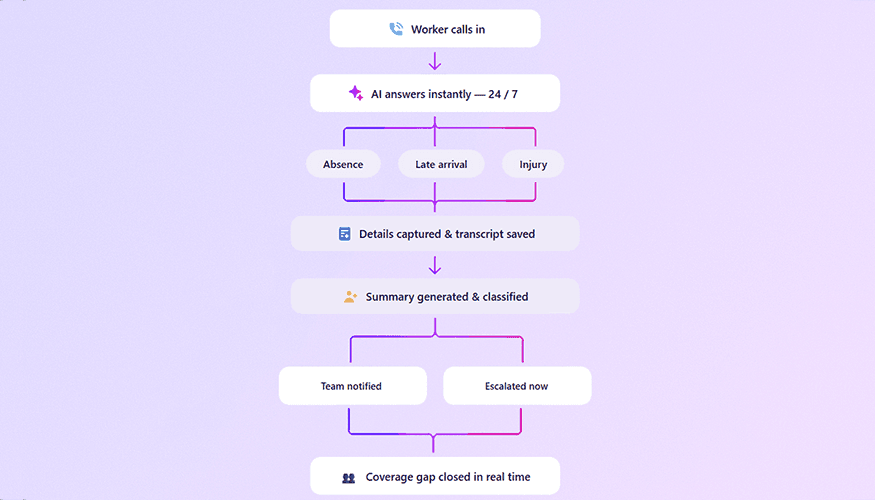
When a worker needs to report they won't be on shift, they make a single phone call. The system answers immediately, collects structured information about the absence, classifies the call, and routes notifications to the right contacts, all in real time.
For staffing firms, this replaces the voicemail box, the on-call recruiter's cell phone, and the clipboard on the front desk. It is not a phone tree. It is not a live answering service. It is an operational layer that captures, documents, and acts on every absence the moment it is reported.
The key distinction: a voicemail captures a message. An automated call-off system captures structured data, triggers workflows, and creates compliance-ready records, automatically. In practice, this is exactly where an AI communication app becomes more useful than a basic phone system.
Why Staffing Firms Have a Unique Call-Off Problem
Most businesses manage call-offs from employees who work in their own building, on a predictable schedule, reporting to a known supervisor. Unplanned absences are disruptive anywhere, but staffing firms don't have that luxury.
Placed workers report to client sites, work under client schedules, and operate in environments your agency doesn't control. When a job site call-off happens, the communication chain involves the worker, the client supervisor, your branch office, and potentially payroll, and every link in that chain can break.
The operational reality for most staffing agencies looks like this:
• Workers call a general agency number or a recruiter's direct line to report an absence
• The call goes unanswered or to voicemail during early morning shifts, overnight, or weekends
• The absence is discovered late, after the shift has already started short-staffed
• Injury reports are treated the same as routine call-offs, with no separate capture or escalation
• Coverage response is reactive, not proactive
• Documentation is inconsistent, incomplete, or missing entirely
This isn't a process problem. It's a structural gap. And it persists because most employee call-in systems were designed for direct employers, not for the triangulated relationship between a staffing agency, a placed worker, and a client site.
How an Automated Call-Off System Works for Staffing
A properly configured automated absence reporting system handles the entire absence intake workflow without human involvement. Here is what that looks like in practice.
Step 1: The worker calls the dedicated absence reporting line
Every placed worker has a single number to call: your agency's dedicated absence reporting line. It doesn't matter if it's 4 AM on a Saturday or 6 PM on a holiday. The system answers on the first ring, every time. For firms centralizing communication across branches, this works even better when you can receive texts and calls on a US number.
Step 2: Structured data capture
The AI voice agent guiding the call immediately begins structured data capture. It collects:

The caller's full name and employee ID
The job site or client location they are assigned to
The reason for the call, absence, late arrival, or injury report
Expected return date or shift
Any additional context required by your agency's call-off process
This is not a free form voicemail. Every field is collected consistently, every time, using the same intake logic your agency defines.
Step 3: Classification and routing
The system classifies the call, call-off, injury report, late arrival, or general inquiry, and routes it according to your operational rules. Branch manager notifications are sent immediately by email or text message. If the call involves a workplace injury, it can be escalated to a dedicated injury reporting hotline workflow or routed to your compliance contact, regardless of the hour.
For agencies that already rely on business messaging, this works especially well when paired with tools such as Landline Texting for Business.
Step 4: Documentation
Every call generates a full conversation summary, a complete transcript, and a classification record. This structured absence documentation becomes your compliance-ready absence records, timestamped and stored automatically. No manual entry. No reconstruction after the fact.
Step 5: Coverage response
Because the branch manager or operations team receives real-time absence notifications the moment the call ends, shift coverage management can begin immediately, closing coverage gaps before shift start, not scrambling after the shift is already short. Shift backfill workflows can be triggered automatically based on the absence type and client site.
Business Hours vs. After-Hours Call Handling
One of the most operationally important features of a well-configured employee call-out system is how it behaves differently depending on when the call comes in.
During business hours, calls can be transferred directly to a specific recruiter, department, or operations coordinator. The system acts as an intelligent front desk, routing by caller intent, not by who happens to pick up first.
After hours, your after-hours call-off line switches to a capture-and-notify mode. Routine call-offs are documented and queued for morning. Urgent matters, injury reports, emergency situations, are escalated to an emergency contact immediately, bypassing the standard queue.
This eliminates the 2 AM interruption problem for non-critical absences while ensuring that genuinely urgent calls always reach the right person. Your 24/7 employee call-off hotline handles the volume. Your team handles the decisions.
AI-Powered vs. Traditional Systems: What Actually Differs
When employee call-off hotline systems are compared side by side, the choice for staffing firms typically comes down to three options: voicemail, a live agent hotline, or an AI-powered system. Each has a fundamentally different operational profile.
Voicemail
Voicemail captures a message, not data. Nothing is structured, nothing is automatically routed, and nothing happens until someone manually listens and acts. For staffing operations running 24/7 across multiple client sites, voicemail is not a system, it is a documentation gap.
Live agent hotline (traditional call center)
A live agent vs. automated system comparison reveals several real-world limitations of the live agent model: agents can mishear names, miscategorize absences, enter wrong job site codes, and introduce inconsistency into your records. Pricing is typically usage-based, making costs unpredictable month to month. And live agents can't scale instantly during high-absence periods, a Monday morning surge in winter means hold times and dropped calls.
IVR (Interactive Voice Response)
Traditional IVR vs. AI receptionist systems differ significantly in caller experience. IVR follows a fixed menu tree. It cannot handle open-ended responses, adapt to a caller's answer, or capture nuanced context. It is better than voicemail, but it is not conversational, and that matters when a worker is reporting an injury or explaining a complex situation.
AI-powered call-off system
An AI-powered call-off system, built on a modern AI voice agent absence reporting layer, handles natural conversation, adapts its questions based on prior answers, captures exactly the fields your agency requires, and does all of this without hold times, human error, or unpredictable per-minute billing. It is available 24/7, scales to any call volume, and produces structured records automatically.
For staffing firms, the AI receptionist for staffing agencies model is categorically different from any traditional hotline approach. It is not an answering service. It is an operational system. CCS Construction Staffing, after evaluating 15 AI vendors, chose Whippy to handle inbound calls across their operation, and is on pace to save $1.64M annually. See the case study.
Injury Report Handling: The Compliance Risk Most Agencies Ignore
Most automated call-off systems treat all inbound calls the same way, they capture the information and send a notification. For staffing firms, this creates a serious compliance gap.
Workplace injuries reported by placed workers at client site absences carry specific documentation, reporting, and response obligations. An injury reported at 4:45 AM cannot wait in a queue until business hours. The report needs to be captured completely, classified immediately, escalated to your compliance or risk contact, and documented with a full record, regardless of the hour.
A properly configured employee injury report hotline for staffing agencies handles this as a separate workflow within your absence management system. When the AI detects an injury-related call, it triggers a different intake path: more detailed questions, a different notification chain, and immediate escalation.
This is the distinction between a call-off system and a true operational layer. The call-off captures the absence. The operational layer recognizes when the call requires a different response, and delivers it.
Protecting the Recruiter Workflow
Every call-off that reaches a recruiter is a workflow interruption. In staffing, recruiter time is revenue time, time spent calling workers, qualifying candidates, filling orders, and managing client relationships.
When your employee call-in line routes to a recruiter's cell phone, you're not just creating an operational risk. You're pulling your highest-value team members out of their core recruiter workflow to handle an administrative function that should never require human involvement.
An automated employee call-off system for staffing agencies removes this category of call entirely from recruiter responsibility. Workers call the employee call-out hotline. The system handles intake, documentation, and notification. The branch manager or operations team receives the structured summary. Recruiters are never interrupted.
This is not a marginal improvement. In high-volume staffing environments, the cumulative time saved across a week of interruptions represents hours of productive recruiter time returned to workforce placement.
Attendance Policy Enforcement and Compliance Documentation
For staffing firms that operate an attendance point system or need to enforce specific employee call-in procedures across their placed workforce, an automated system provides something manual processes cannot: consistency.
Every call goes through the same intake flow. Every absence is captured with the same fields. Every record is timestamped and stored. This means that when a client questions whether a call-off was properly reported, or when a placed worker disputes a no-show designation, your agency has a complete, defensible record, automatically.
The system also reduces no-call no-show incidents and drives reduced absenteeism over time by giving workers a clear, accessible channel to report absences. When calling off is as simple as dialing one number and answering a few questions, there's no excuse for unreported absences. And when a no-call no-show does occur, your records confirm that the worker had the option and did not use it.
For automated policy enforcement, the system can be configured to collect the specific information your agency requires for different absence types, including family and medical leave protected under the Family and Medical Leave Act (FMLA), workers' comp, and personal leave, and route each accordingly.
How Whippy's AI Receptionist Handles This for Staffing Firms
When a placed worker calls your Whippy line at 3 AM to report they won't make their shift, here's what happens: the AI answers on the first ring, captures their name, job site, and reason, classifies the call, and sends your branch manager a structured summary, before they've even woken up. No voicemail. No follow-up. No missing information.
StaffWorks, a multi-branch staffing firm, faced exactly this problem, call-offs, injury notifications, and payroll questions routing through front desk staff who couldn't always answer. When receptionists were unavailable, calls went to voicemail and recruiters were pulled off placements to cover. After implementing Whippy, StaffWorks eliminated six receptionist roles and recovered $382,000 in annual labor costs, while ensuring every call-off was answered immediately. Read the case study.
For employee absence reporting and call-off management, it functions as your agency's always-on attendance hotline service and employee absentee service: capturing structured data on every call, routing by intent and business hours, generating full documentation, and ensuring that no call-off, injury report, or absence notification is ever missed or undocumented.
It supports the full scope of staffing communication, screening and intake for job inquiries, onboarding questions, payroll-related calls, and call-off management, without pulling recruiters off their core work. And it operates as a configurable layer, not a fixed script. Your routes, your recipients, your escalation logic.
The employee call-off hotline function within Whippy's platform captures:
Full caller name and identification
Whether the call is a job site call-off, late arrival, or injury report
Job site, client location, and expected return date
Additional context based on your agency's intake requirements
Every call generates a conversation summary, full transcript, and classification, routed to the right team member the moment the call ends.
Ready to Eliminate Missed Call-Offs at Your Staffing Firm?
If your agency is still relying on voicemail, recruiter cell phones, or manual tracking to manage worker call-offs, you're not running a process. You're managing a risk, one that compounds every time a client site goes short-staffed without notice or an injury goes undocumented.
Whippy's AI Receptionist gives staffing firms a dedicated, always-on automated employee call-off system that handles absence reporting, injury escalation, and real-time notifications, configured to your operations, available 24/7, and built to protect your placements, your clients, and your compliance records.
See it configured for your operation. Request a demo, and we'll show you exactly how Whippy handles call-offs, injury reports, and absence documentation for staffing firms.
Frequently Asked Questions
Q: What is an automated employee call-off system?
A: An automated employee call-off system is a dedicated solution that captures absence reports from employees or placed workers 24/7, without a human operator. It collects structured information, classifies the call, and routes notifications and documentation automatically.
Q: How do I handle employee call-offs at a staffing agency?
A: The best employee call-off system for staffing firms is a dedicated employee call-off hotline that handles intake automatically. Workers call one number, the system captures all relevant information, and the branch manager or operations team receives an immediate notification, without recruiter involvement.
Q: How does an AI receptionist handle call-offs differently than a live agent?
A: An AI receptionist captures structured data consistently on every call, without human error, hold times, or per-minute billing. It adapts its questions based on the caller's responses, handles any call volume, and operates 24/7 without staffing constraints. A live agent is subject to mishearing, miscategorization, and availability limits.
Q: What to do when a placed worker calls in sick?
A: The placed worker should call your agency's dedicated absence reporting line, ideally before their shift start, but the system accepts calls at any hour. The AI captures their name, job site, reason, and expected return, then immediately notifies the branch manager. The entire process takes under 90 seconds and produces a timestamped record automatically.
Q: How do you document employee absences in staffing?
A: An automated call-out tracking system generates a timestamped record for every absence call: conversation summary, full transcript, and classification. These become your compliance-ready absence records, accessible for payroll, client reporting, and dispute defense.
Q: What is an employee call-off hotline for staffing agencies?
A: It is a dedicated absence reporting line that placed workers call to report they won't be on shift, are arriving late, or need to report a workplace injury. A well-configured hotline handles intake automatically, routes notifications in real time, and documents every call, replacing voicemail and manual tracking entirely.
Q: How do you handle employee injury reports at a staffing firm?
A: Injury reports should be captured through a separate injury reporting hotline workflow within your call-off system. When the AI detects an injury-related call, it triggers a different intake path with more detailed questions, immediate escalation to your compliance contact, and full documentation, regardless of when the call comes in.
Table of Contents
Table of Contents
- What Is an Automated Employee Call-Off System?
- Why Staffing Firms Have a Unique Call-Off Problem
- How an Automated Call-Off System Works for Staffing
- Business Hours vs. After-Hours Call Handling
- AI-Powered vs. Traditional Systems: What Actually Differs
- Injury Report Handling: The Compliance Risk Most Agencies Ignore
- Protecting the Recruiter Workflow
- Attendance Policy Enforcement and Compliance Documentation
- How Whippy's AI Receptionist Handles This for Staffing Firms
- Ready to Eliminate Missed Call-Offs at Your Staffing Firm?
- Frequently Asked Questions
Try Whippy for Your Team
Experience how fast, automated communication drives growth.

Related Articles
EU AI Act: Whippy's Independent Bias Audit
 Elizabeth Long
Colorado SB 26-189: Whippy's Independent Bias Audit
Elizabeth Long
NYC Local Law 144: Whippy's Independent Bias Audit
Elizabeth Long
California FEHA: Whippy's Independent Bias Audit
Elizabeth Long
Illinois HB 3773: Whippy's Independent Bias Audit
Elizabeth Long
Best AI Recruiting Tools for Franchise Staffing
Elizabeth Long