


Table of Contents
- What Is an AI Receptionist for Staffing Agencies?
- Why Staffing Agencies Are Adopting AI Receptionists
- How an AI Receptionist Works in Staffing (Real Workflow)
- Core Capabilities of an AI Receptionist
- Key Use Cases in Staffing (Overview)
- Who Should Use an AI Receptionist?
- When Should You Implement an AI Receptionist?
- AI Receptionist vs Traditional Answering Service
- Real Business Impact
- Why AI Receptionists Are Becoming Core Infrastructure
- Getting Started with Whippy
- Request a Demo ↗
- Final Thoughts
- Frequently Asked Questions
Try Whippy for Your Team
Experience how fast, automated communication drives growth.
Staffing agencies do not lose business because of lack of demand.
They lose it because of missed calls, slow response times, and constant interruptions that compound across daily operations.
Every unanswered or delayed call can mean a lost placement, while repetitive questions pull recruiters away from revenue-generating work. Over time, these inefficiencies create a system that is time consuming, reactive, and difficult to scale.
An AI receptionist for staffing agencies solves this by acting as a centralized, always-on communication layer that handles inbound calls, routes requests, and automates workflows across your entire operation.
Instead of relying on fragmented processes or overloading your support teams, it creates a consistent, structured way to manage communication at scale. This not only improves efficiency but also ensures that every interaction with your product or service reflects reliability and professionalism, which ultimately builds trust with both candidates and clients.
What Is an AI Receptionist for Staffing Agencies?
An AI receptionist for staffing agencies is an AI-powered voice system that answers inbound calls, understands caller intent, and automatically routes or resolves requests in real time. As a voice AI receptionist, it functions as an operational AI tool designed specifically to manage communication at scale.
Unlike a traditional staffing agency answering service, it does not just take messages. It executes operational workflows across recruiting, payroll, and internal communication.
This distinction is critical. Traditional systems act as intermediaries, while an AI receptionist actively handles real tasks instead of simply forwarding them.
It performs functions such as core staffing call handling, including:

Inbound call handling and intelligent routing
Automated call handling across departments
Call screening and lead qualification
Generating call summaries and voicemail transcription
Supporting multilingual answering for diverse candidate pools
Rather than existing as a separate tool, it becomes part of your operational infrastructure. In practice, it functions as a fully automated front desk for staffing operations, running 24/7 and ensuring that no call goes unanswered and no request is left unprocessed.
Why Staffing Agencies Are Adopting AI Receptionists
Staffing firms face a unique communication challenge that is both constant and complex.
They must manage:
- Continuous high call volume from candidates and clients
- Frequent and unpredictable recruiter interruptions
- Repetitive questions across multiple locations
- Increasing administrative workload
- A slow hiring process caused by delays in communication
What makes this more difficult is that these challenges are interconnected. A missed call leads to a delayed response. A delayed response affects candidate experience. And poor experience impacts placements and retention.
Traditional systems rely heavily on manual call handling, which introduces friction at every step. Recruiters are forced to context-switch throughout the day, handling inquiries that could be resolved automatically. Support staff become overloaded, and communication becomes inconsistent across branches.
The result is predictable: more missed calls, lost leads, slower placements, and a fragmented experience for candidates and clients.
An AI answering service for staffing companies addresses this by removing manual bottlenecks. It allows agencies to automate calls in staffing agencies without sacrificing quality, ensuring that every interaction is handled instantly, consistently, and intelligently.
See how recruiting process automation improves high-volume hiring.
How an AI Receptionist Works in Staffing (Real Workflow)
Most content explains features. What matters in practice is how those features operate together in real staffing environments.
This is how an AI receptionist actually functions day to day.
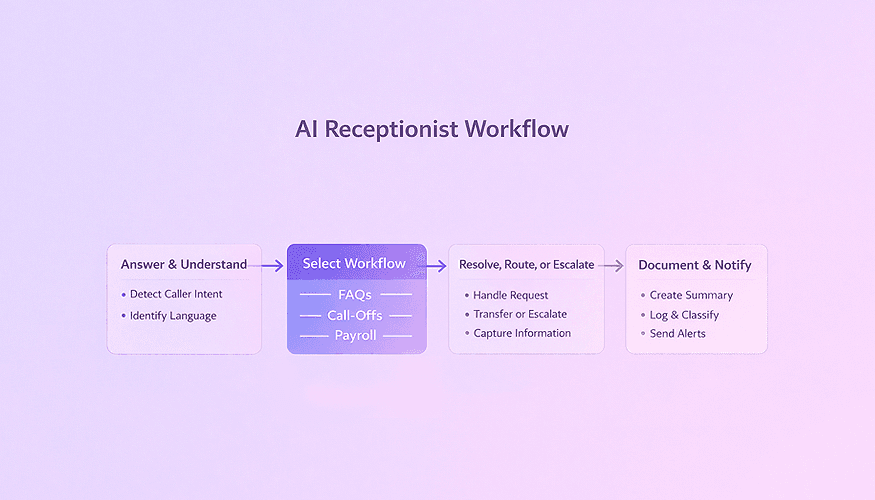
Step 1: Call Answering and Intent Detection
Every inbound call is answered immediately through call answering 24/7, eliminating delays and ensuring availability at all times.
When a call comes in, the system initiates a structured interaction:
- It greets the caller naturally
- Detects language for multilingual answering
- Identifies the caller’s intent based on conversation
This is especially valuable for AI phone answering for recruiters, where understanding intent quickly determines whether the call should be routed, answered, or converted into a workflow.
Instead of relying on rigid menus, the system understands what the caller actually needs.
Step 2: Intelligent Call Routing
Once intent is identified, the system activates a staffing call routing system that determines the next step.
Depending on the situation, it can:
- Route the call to the correct recruiter, branch, or department
- Trigger a predefined workflow
- Provide an immediate answer without transferring
This is not a static interactive voice response (IVR) or menu-based system. It is intelligent call routing driven by real-time conversation and business logic.
The result is faster resolution, fewer transfers, and a smoother experience for both candidates and clients.
Step 3: Automated Workflow Execution
One of the biggest advantages of an AI receptionist is its ability to act, not just respond.
Instead of passing calls between people, the system performs tasks automatically:
- Sends job application links via SMS
- Captures candidate details
- Triggers ATS workflows
- Supports appointment scheduling for interviews or follow-ups
- Performs lead qualification and qualifies leads before routing them to the appropriate recruiter or sales team
Example:
A candidate calls → intent is detected → the system sends a job link → the candidate applies → the recruiter is notified.
This removes unnecessary steps and reduces dependency on manual coordination.
In practice, this is what enables agencies to automate inbound calls staffing while maintaining speed and consistency.
Step 4: Documentation and Visibility
Every interaction handled by the system is automatically documented.
This includes:
- Structured call summaries
- Full transcripts
- Call recording for compliance and quality review
- Categorization of call type (job inquiry, absence, payroll, etc.)
Instead of relying on notes or memory, your team gains a complete, searchable record of communication, creating visibility across operations and making it easier to track trends, identify issues, and improve processes.
It also reduces the burden on teams that would otherwise spend time logging or following up on conversations manually.
What makes this system powerful is not any single feature, but how everything works together in real staffing operations.
An AI receptionist is not just answering calls. It is continuously understanding intent, executing workflows, routing communication intelligently, and creating visibility across the organization.
Most importantly, it removes the time consuming communication overhead that slows down staffing agencies, allowing recruiters and support teams to focus on placements, relationships, and growth.
Core Capabilities of an AI Receptionist
Automated Reception at Scale
An AI virtual receptionist is designed to handle communication at a level that traditional systems simply cannot match. Instead of managing one call at a time, it can process unlimited simultaneous conversations without delays, queues, or dropped interactions.
This is what makes automated receptionist staffing so powerful. Whether your agency receives ten calls or hundreds within the same hour, every caller receives immediate attention. No one is placed on hold, and no opportunity is lost due to capacity limits.
From an operational standpoint, this transforms your front desk into a scalable system, ensuring every candidate or client receives a consistent and professional response from the first touchpoint.
Staffing Communication Automation
At its core, the system becomes a centralized layer of staffing communication automation. It connects candidates, recruiters, payroll teams, and operations into a single, coordinated flow of information.
Instead of relying on disconnected tools or manual handoffs, communication moves seamlessly between systems and people. For example, a candidate inquiry can trigger follow-up text messages, update internal systems through CRM integration, and notify the appropriate team member, all without manual intervention.
Because the system draws from structured knowledge bases, it ensures that answers are accurate, consistent, and aligned with your internal policies. This eliminates guesswork and reduces the risk of misinformation across different branches or departments.
The result is a communication environment where every interaction contributes to a more organized and efficient operation.
24/7 Call Handling
With the ability to automate inbound calls staffing, your agency is no longer limited by business hours. Calls are answered instantly at any time, ensuring that candidates and clients always receive a response when they reach out.
This is particularly important in staffing, where opportunities are time-sensitive. A candidate calling after hours is often actively searching for work, and a delayed response can result in lost engagement.
By maintaining continuous availability, the system ensures that communication remains active even when your internal team is offline. Critical information is captured, expectations are set clearly, and follow-ups are prepared for the next business day.
This level of responsiveness helps maintain momentum across your pipeline and reinforces a reliable experience that builds trust over time.
Learn how after-hours answering services powered by AI work.
Flexible, Configurable Workflows
A modern AI receptionist software is not built around rigid scripts. It adapts to your operational structure, allowing you to define how communication should be handled across different scenarios.
This includes:
- Routing calls based on location, department, or role
- Applying different rules during business hours and after hours
- Escalating specific cases to a human agent when needed
- Customizing workflows for different types of inquiries
For example, a call from a job seeker can follow a completely different path than a payroll-related request, all within the same system.
This flexibility ensures that the receptionist behaves as an extension of your team rather than a separate tool. It supports each team member by reducing interruptions while still ensuring that important conversations are handled appropriately.
In this way, a virtual receptionist for staffing agencies becomes a configurable operational layer that evolves with your business.
Key Use Cases in Staffing (Overview)
An AI receptionist staffing solution supports multiple workflows. Below are the most important ones.
These workflows are part of a broader system of AI agents designed to support staffing operations end-to-end. Explore the full range of AI agent use cases in staffing.
FAQ Handling and Candidate Questions
With staffing FAQ automation, the system can answer:
Job application questions
Office information
General policies
This reduces repetitive inbound calls and improves response speed.
Call-Offs and Absence Reporting
With call off handling staffing, the AI can:
Capture employee details
Identify absence type
Log structured information
This enables accurate absence reporting staffing and faster decision-making.
Payroll Verification and Inquiries
With payroll verification staffing, the system can:
Answer payroll-related questions
Capture issues
Escalate when needed
This reduces interruptions to recruiters and payroll teams.
Each of these workflows can be expanded independently without interrupting operations.
Who Should Use an AI Receptionist?
An AI receptionist is especially valuable for staffing agencies that are experiencing growth or operational complexity.
This includes organizations with high call volume, multiple branches, or extended service hours, but it also applies to teams that are beginning to feel the strain of manual communication processes.
Agencies that benefit most rely heavily on phone-based communication, manage steady candidate inquiries, and experience frequent recruiter interruptions that reduce focus and productivity.
For these teams, an AI receptionist becomes more than a convenience. It becomes a strategic tool that allows recruiters to concentrate on placements while ensuring that every inbound interaction is handled professionally.
Even smaller teams can benefit, especially when they want to scale operations without adding additional headcount. By automating communication, they can maintain responsiveness without increasing operational complexity.
When Should You Implement an AI Receptionist?
The right time to implement an AI receptionist is usually when communication begins to slow down your ability to operate efficiently.
There are several clear signals that indicate this shift is happening.
If your team is consistently dealing with missed calls, it means opportunities are being lost before they even enter your pipeline. When recruiters are interrupted throughout the day, it becomes difficult for them to focus on higher-value tasks such as candidate placement or client management.
Another key indicator is a high volume of repetitive inquiries that create bottlenecks across your workflow.
In some cases, payroll or absence-related calls can further disrupt operations, pulling attention away from recruiting activities. In others, communication may vary between branches, leading to inconsistent experiences.
These are all signs that your current system is limiting your ability to scale. Implementing an AI receptionist at this stage allows your organization to move from reactive communication to a structured, automated process where every interaction is handled consistently and efficiently.
Ultimately, it enables your team to make a more informed decision about how to allocate time and resources, shifting focus toward growth rather than routine tasks.
AI Receptionist vs Traditional Answering Service
Traditional answering services were designed to ensure that calls are not missed. However, they rely heavily on manual processes and human intervention, which limits their scalability and consistency.
An AI receptionist fundamentally changes this model by enabling full staffing agency call automation, rather than simply capturing messages.
Traditional Answering Service | AI Receptionist |
|---|---|
Limited availability | 24/7 call answering |
24/7 call answering | Automated call handling |
Inconsistent responses | Standardized communication |
High operational cost | Scales without headcount |
No workflow automation | Full staffing agency call automation |
Dependent on human agent availability | Hybrid escalation to human agent when needed |
The difference is not just about answering calls more efficiently. It is about transforming how communication is handled across your organization.
An AI receptionist ensures that every interaction is processed within a defined system, while still allowing escalation to a live agent or human agent when the situation requires it. This creates a balance between automation and human oversight, ensuring both efficiency and quality.
Real Business Impact
Implementing an AI voice agent staffing solution has a measurable impact on daily operations.
It reduces the number of missed calls and eliminates the need for constant manual handling of routine inquiries. As a result, your team spends less time reacting to communication and more time focusing on strategic tasks.
The reduction in administrative workload is significant. Tasks that were previously repetitive and time consuming are handled automatically, freeing up internal resources. This allows recruiters to maintain focus, improves response times, and enhances the overall candidate experience.
Beyond efficiency, the system also improves visibility. With structured call data, summaries, and transcripts, your team gains a clearer understanding of communication patterns and operational needs.
Most importantly, the impact is felt in how your team works. Recruiters focus on placements instead of interruptions. And over time, this shift creates a more scalable, efficient, and reliable staffing operation that can grow without increasing complexity
Why AI Receptionists Are Becoming Core Infrastructure
The biggest shift is operational.
An AI communication platform staffing solution is no longer just a tool. It becomes:
- Your front desk
- Your intake system
- Your routing engine
- Your communication backbone
It supports recruiting, onboarding, placement, and payroll workflows continuously.
Getting Started with Whippy
Whippy provides a complete AI receptionist for staffing agencies built to handle real-world communication at scale.
Instead of adding more tools or increasing headcount, Whippy centralizes inbound calls, automates workflows, and ensures every interaction is handled instantly and consistently.
With Whippy, staffing teams can automate inbound communication, improve routing and response times, reduce recruiter interruptions, and standardize communication across locations, all within a single AI-powered platform designed specifically for staffing operations.
Request a Demo ↗
If your agency is dealing with high call volume, missed calls and lost leads, or constant recruiter interruptions, your communication system is limiting your growth.
Whippy helps you capture every opportunity, respond instantly, and scale operations without adding overhead.
Final Thoughts
Staffing is a speed-driven business where response time directly impacts placements.
An AI receptionist for staffing agencies ensures that every call is answered, every request is handled, and every workflow keeps moving without interruption.
More than automation, it becomes the communication system that keeps your entire operation running efficiently, allowing your team to focus on what matters most: placing candidates and growing your business.
Frequently Asked Questions
Q: What is an AI receptionist for staffing agencies?
A: An AI receptionist for staffing agencies is a voice AI system that answers inbound calls, understands caller intent, and automatically routes or resolves requests. It replaces manual call handling with intelligent workflows that support recruiting, payroll, and operational communication.
Q: How does an AI receptionist work in staffing agencies?
A: An AI receptionist answers calls instantly, identifies the caller’s intent, and either provides an answer or routes the request. It can send application links, qualify candidates, log call details, and trigger workflows, all while operating 24/7 without delays.
Q: What problems does an AI receptionist solve for staffing agencies?
A: It solves common issues such as missed calls, recruiter interruptions, repetitive questions, and slow response times. By automating inbound communication, it reduces administrative workload and improves both candidate and client experience.
Q: Can an AI receptionist replace a staffing answering service?
A: Yes. Unlike traditional answering services that only take messages, an AI receptionist can automate workflows, route calls intelligently, and respond in real time. It also allows escalation to a live agent when necessary.
Q: Is an AI receptionist available 24/7?
A: Yes. An AI receptionist operates 24/7, ensuring all inbound calls are answered instantly, even outside business hours, weekends, and holidays. This helps staffing agencies capture opportunities at any time.
Q: How does an AI receptionist help recruiters?
A: It reduces recruiter interruptions by handling routine calls, qualifying leads, and routing only relevant conversations. This allows recruiters to focus on placements and higher-value tasks instead of managing inbound communication.
Q: Can an AI receptionist handle candidate inquiries?
A: Yes. It can answer common questions, provide job information, send application links, and guide candidates through the next steps. This improves response speed and creates a better candidate experience.
Q: Does an AI receptionist support multiple locations or branches?
A: Yes. AI receptionists can route calls based on location, department, or team structure. This makes them ideal for staffing agencies operating across multiple offices or regions.
Q: What happens if a call requires human assistance?
A: If a situation requires human intervention, the system can transfer the call or escalate it to a live agent. This ensures that complex or sensitive issues are handled appropriately.
Q: Is an AI receptionist difficult to implement?
A: No. Modern AI receptionist solutions are configurable and designed to adapt to your existing workflows. They can integrate with your systems and be tailored to match your business rules without disrupting operations.
Table of Contents
Table of Contents
- What Is an AI Receptionist for Staffing Agencies?
- Why Staffing Agencies Are Adopting AI Receptionists
- How an AI Receptionist Works in Staffing (Real Workflow)
- Core Capabilities of an AI Receptionist
- Key Use Cases in Staffing (Overview)
- Who Should Use an AI Receptionist?
- When Should You Implement an AI Receptionist?
- AI Receptionist vs Traditional Answering Service
- Real Business Impact
- Why AI Receptionists Are Becoming Core Infrastructure
- Getting Started with Whippy
- Request a Demo ↗
- Final Thoughts
- Frequently Asked Questions
Try Whippy for Your Team
Experience how fast, automated communication drives growth.

Related Articles
EU AI Act: Whippy's Independent Bias Audit
 Elizabeth Long
Colorado SB 26-189: Whippy's Independent Bias Audit
Elizabeth Long
NYC Local Law 144: Whippy's Independent Bias Audit
Elizabeth Long
California FEHA: Whippy's Independent Bias Audit
Elizabeth Long
Illinois HB 3773: Whippy's Independent Bias Audit
Elizabeth Long
Best AI Recruiting Tools for Franchise Staffing
Elizabeth Long