


Table of Contents
- What Is Automated License Verification?
- Why Manual License Checks Slow Down Staffing Agencies
- How AI Browser Agents Automate License Verification Without an API
- RN License Verification in Practice
- What This Means Beyond License Checks
- License Verification Software vs. Compliance Monitoring Platforms
- How to Automate License Verification for Your Agency
- Frequently Asked Questions
Try Whippy for Your Team
Experience how fast, automated communication drives growth.
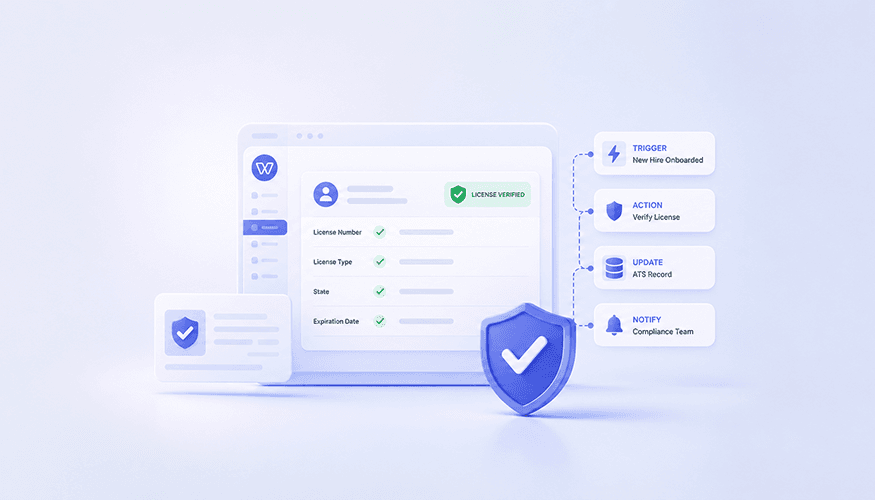
A recruiter opens a new nurse's file, opens a second tab, navigates to a state board of nursing website, types in a license number, waits for the page to load, and copies the result back into the applicant tracking system. Multiply that by every candidate, every renewal, every state, and what looks like a five-minute task becomes one of the most time consuming manual processes buried inside an otherwise fast-moving hiring process.
That gap between "the candidate is ready" and "the paperwork confirms it" is where placements stall. Automated license verification closes it by letting software do the lookup instead of a person, in real time, inside the same workflow that already manages candidate communication.
This guide breaks down what automated license verification actually is, how it works technically, where the newest generation of tools (AI browser agents) fit in, and how staffing agencies are putting it to work inside Whippy today, as part of a broader shift toward AI for staffing agencies.
What Is Automated License Verification?
Automated license verification is the use of software to confirm that a candidate's professional license or certification is active and in good standing, without a person manually visiting a licensing board's website. Instead of a recruiter typing a license number into a state database by hand, a system does it on command and returns the license status, active, inactive, expired, or not found, directly into the recruiter's existing tools.
This process is also referred to as automated credential verification when applied to certifications beyond a single state license. Either way, it's different from a one-time background check ordered from a screening vendor. It's a workflow step: something that happens automatically at a specific point in your recruitment process, the moment you need an answer, not a separate report you have to go request.
The mechanics behind it fall into two categories. Some licensing boards expose the data through a direct feed, so a license verification API can pull the record programmatically. Most don't. For those, the only way to get the answer has historically been a human, a browser, and a form. That second category is what changed recently, and it's worth understanding why.
Why Manual License Checks Slow Down Staffing Agencies
Professional license verification isn't optional in most regulated placements. Under federal hospital participation rules (42 CFR § 482.11), healthcare facilities are required to confirm that clinical staff hold valid, active licensure, and the Centers for Medicare & Medicaid Services can put a facility's ability to participate in Medicare and Medicaid at risk if that requirement isn't met. A significant share of U.S. states layer additional licensing and certification requirements on top of that federal baseline for roles in nursing, healthcare, and skilled trades. Meeting that regulatory requirement manually depends entirely on someone remembering to run the check before a placement goes out the door.
Manually, the process looks the same every time: open the state board's site, enter identifying information, read the result, transcribe it into the ATS or a spreadsheet, and repeat for the next candidate. None of that is difficult work. It's just slow, repetitive manual data entry, dependent on a person's memory rather than a system's consistency.
For a staffing agency running dozens of placements a week, this adds up to real hours, and worse, real risk. A license check that gets skipped during a busy week, or completed a day too late, means a candidate on a client site without a valid credential, reducing the risk only when someone catches it in time. Automating the check isn't just about speed, it's about ensuring compliance holds even during your busiest weeks. This is exactly the gap staffing agency compliance automation is meant to close.
How AI Browser Agents Automate License Verification Without an API
Here's the piece that's new. Most state licensing boards don't offer a license verification API. Their sites are built for a person to search and read, not for software to query. For years, that meant this specific check couldn't be automated at all, it had to be done by hand, full stop.
Agentic AI workflows changed that. Rather than waiting for every state board to publish a developer-friendly API (most won't, and there's no reason to expect that to change soon), an AI browser agent does what a human would do, just automatically.
What Is an AI Browser Agent?
An AI browser agent is software that operates a real web browser on its own, navigating pages, filling in forms, reading results, and extracting data, the same way a person would, but triggered on command and completed in seconds. It doesn't scrape raw HTML looking for patterns; it interacts with the page itself: it types a license number into the correct field, submits the form, and reads back what the page displays.
This is a form of browser automation, but the "AI" part matters. Traditional browser automation follows a rigid script and breaks the moment a website changes a button's position. An AI browser agent interprets the page the way a person reads it, which makes it considerably more resilient to the small, constant changes government and licensing board websites tend to make.
Does License Verification Require an API?
No. License verification does not require an API when an AI browser agent is used, because the agent interacts with the website's public interface directly, the same way a human user would. This matters because the majority of state licensing boards, along with plenty of client portals and public registries, were never built to be queried programmatically. An API integration simply isn't on the table for most of them. A browser agent doesn't need one.
RN License Verification in Practice
To make this concrete: imagine a workflow built specifically to verify nursing license status the moment a candidate's file is ready, with no recruiter opening a second tab.
A webhook fires with the candidate's license number and state, triggers a browser agent to open the relevant state board of nursing's verification page, enters the license number, reads the returned status, and sends the result back into the workflow, active or not, in well under a minute.
Here's what that RN license verification sequence looks like end to end:
- Trigger: A webhook fires with the candidate's license number and state.
- Invoke the agent: A browser automation function opens the state board's verification page and submits the license number.
- Wait for completion: The agent processes the page (typically 10-20 seconds).
- Read the result: The workflow retrieves the returned status: active, inactive, or not found.
- Branch on the outcome: A qualified candidate moves forward automatically; a flagged result routes to a recruiter for review.
This was built and tested against a live nursing license lookup on a state board of nursing site with no public API, confirming the license as active in a single automated pass. No integration project. No custom scraper to maintain. Just a workflow step that does what a recruiter would otherwise do by hand.
What This Means Beyond License Checks
Nursing license verification is simply the clearest example; the same logic extends to contractor licenses, real estate licenses, and other state-issued credentials. An agent that reads and acts on a website the way a person would applies to any site without an API: a client's vendor management systems, a public certification registry, a state contractor licensing lookup, or an internal system a client insists you check manually.
This is where staffing agency workflow automation stops being limited to what your ATS vendor decided to build an integration for. Whether it's a single check or dozens per week, this step fits naturally into a broader automated recruitment process rather than sitting outside it as an afterthought. If a task can be done in a browser, it can, in principle, be automated inside the same workflow that already handles your candidate texting, scheduling, and follow-ups.
License Verification Software vs. Compliance Monitoring Platforms
It's worth being precise about what this is and isn't, and about what people are usually really looking for when they search for software license verification tools: an on-demand check, or a continuous monitoring service. They're not the same thing.
Automated license verification, in the sense described here, is an on-demand check performed at a specific point in a workflow. It is not the same as a continuous compliance monitoring platform, the kind of system that tracks every license across your entire workforce, alerts you before renewals lapse, and maintains an ongoing audit trail as a dedicated service. Both approaches contribute to maintaining compliance, they just operate on different timelines: one is continuous, the other runs on demand.
On-demand verification (AI browser agent) | Continuous compliance monitoring | |
|---|---|---|
What it does | Checks a single license at a specific moment | Tracks every license across your workforce over time |
When it runs | Triggered on demand, inside a workflow | Runs continuously, in the background |
Best for | Confirming status before a placement or application step | Catching renewals and lapses across an entire workforce |
Setup | A workflow step, no API needed | A dedicated compliance service or platform |
Added vendor? | No, runs inside your existing tools | Typically yes, a separate system of record |
If your agency needs full-time monitoring across hundreds of active credentials with automated renewal alerts, that's a different category of tool built specifically for that job. If what you need is a fast, accurate check at the moment a candidate is ready to be placed, without adding another vendor to your stack, that's exactly what an AI browser agent inside your existing workflow platform is built for.
Is automated license verification the same as primary source verification? Not quite. Primary source verification (PSV) is a formal, often accreditation-required process of confirming a credential directly with the issuing body, typically as part of a regulated healthcare compliance program. An automated check against a state board's public lookup can confirm the same underlying fact, active or inactive, but agencies with formal PSV obligations should confirm with their compliance team whether an automated public-record check satisfies their specific accreditation requirements.
How to Automate License Verification for Your Agency
If you're evaluating this for your own operation, the practical path looks like this:

Identify the check you're currently doing by hand and the site it happens on.
Confirm there's no existing API (most boards don't have one, but it's worth five minutes to check).
Build the workflow as part of a proper automation system, so the check triggers automatically at the right stage, on application, before placement, or on a recurring schedule, rather than waiting for someone to remember.
Route the outcome: an active license clears the candidate to move forward; anything else notifies a recruiter instead of silently sitting in a queue.
Beyond saving time, the bigger win is that the check simply never gets skipped. Agencies that automate this step also report reduced manual workload almost immediately, since it no longer depends on someone's memory during a busy week. Faster verification improves candidate experience too, nobody enjoys waiting days to hear back on something a system could confirm in under a minute.
Inside Whippy, this runs as one more step in the same Automations engine already coordinating candidate texts, calls, and ATS updates for staffing agencies. A verification result can trigger an SMS to the recruiter, a Voice AI call, or a status update written straight back into your ATS through Whippy's existing integrations, so the check doesn't live in a silo, it becomes part of the same pipeline that's already moving the candidate toward a placement.
Manual credential checks were never the bottleneck anyone designed for, they're just the task that was left over once everything else got automated.
If your team is still verifying licenses by hand, request a demo to see how it fits into a workflow that's already running your candidate communication.
Frequently Asked Questions
Q: What is automated license verification?
A: Automated license verification is software-driven confirmation that a candidate's professional license is active, performed without a person manually searching a licensing board's website. It returns a license status, active, inactive, or expired, directly into a hiring workflow.
Q: What is an AI browser agent?
A: An AI browser agent is software that navigates and interacts with websites the way a person would, clicking, typing, and reading results, so tasks on sites without an API can still be automated.
Q: Does license verification require an API?
A: No. Because an AI browser agent interacts directly with a website's existing interface, no license verification API or developer integration is needed, which matters since most state licensing boards don't offer one.
Q: Is automated license verification the same as primary source verification?
A: Not exactly. Primary source verification is a formal, often accreditation-bound process of confirming a credential directly with the issuing body. Automated verification checks the same public record but isn't a substitute for a formal PSV program where one is required.
Q: How do I automate license verification for my staffing agency?
A: Identify the manual check you're currently running, confirm whether the licensing board has an API, and build a workflow step, using a browser agent if there's no API, that triggers the check automatically and routes the result to the right person.
Q: Can this be used for licenses other than nursing?
A: Yes. The same approach applies to any credential verified through a public website, contractor licenses, professional certifications, and other state-specific registrations included, not only a nursing license.
Table of Contents
Table of Contents
- What Is Automated License Verification?
- Why Manual License Checks Slow Down Staffing Agencies
- How AI Browser Agents Automate License Verification Without an API
- RN License Verification in Practice
- What This Means Beyond License Checks
- License Verification Software vs. Compliance Monitoring Platforms
- How to Automate License Verification for Your Agency
- Frequently Asked Questions
Try Whippy for Your Team
Experience how fast, automated communication drives growth.

Related Articles

Best AI Recruiting Tools for Franchise Staffing
 Elizabeth Long
AI Call Center Solutions: The Complete Guide
Elizabeth Long
The Staffing Operating System for Avionté
Elizabeth Long
Write Job Descriptions That Make AI Recruiters Perform
Elizabeth Long
The Candidates You Need Are Already in Your ATS
Elizabeth Long
Payroll Communication for Staffing Agencies
Elizabeth Long