


Table of Contents
- What Is a Candidate Satisfaction Survey?
- Why Candidate Experience Fails Without Measurement
- From Surveys to an Experience Measurement System
- Survey & NPS as a Performance Layer
- When to Trigger Candidate Satisfaction Surveys
- What to Include in a Candidate Satisfaction Survey
- Turning Feedback Into Retention Intelligence
- Client Experience and Staffing Account Health
- Benchmarking and Performance Metrics
- Benefits of a Candidate Satisfaction Survey System
- Performance Impact of Candidate Satisfaction Surveys
- How Whippy Powers Candidate Satisfaction Surveys
- Conclusion
- See It in Action
- Frequently Asked Questions
Try Whippy for Your Team
Experience how fast, automated communication drives growth.
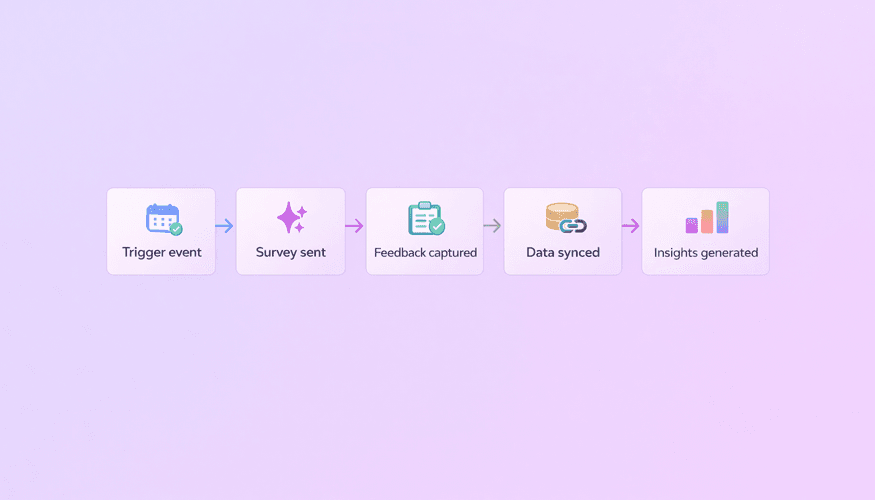
Staffing teams invest heavily in sourcing, screening, and placing candidates, but often lack visibility into what happens after placement. Candidates drop off, clients become dissatisfied, and issues are only addressed when it is too late.
A candidate satisfaction survey fills that gap by turning every interaction across the candidate journey into measurable data, enabling better retention, stronger client relationships, and more informed decisions as part of a broader AI-driven staffing strategy.
More importantly, it enables a shift toward candidate experience management, where feedback is not just collected but used to drive better outcomes.
This guide explains how to use a candidate satisfaction survey for staffing agencies as a real operational system, not just a feedback form.
What Is a Candidate Satisfaction Survey?
A candidate satisfaction survey is a structured method used by staffing teams to collect feedback from job applicants and placed workers across the hiring and placement lifecycle.
At a basic level, it includes:

Satisfaction ratings
Candidate Net Promoter Score (NPS)
Targeted candidate experience survey questions
Open ended questions for deeper qualitative insight
High-performing staffing teams go beyond this baseline.
A modern candidate satisfaction survey is not just a questionnaire or feedback form. It is part of a broader candidate feedback system designed for continuous feedback data collection.
What makes this approach effective?
This approach provides:
- Continuous visibility across the candidate journey
- Comparable data across roles, clients, and time periods
- Immediate insight into where experience breaks down
When combined with automation, sending surveys becomes systematic rather than manual. This ensures feedback is captured at the right moment, not after problems have already escalated.
Over time, this evolves into a full candidate experience management layer, where feedback is used to:
- Improve recruiter performance
- Refine processes
- Strengthen relationships with candidates and clients
Many staffing firms also align this with a broader recruitment satisfaction survey strategy, measuring both candidate and client experience to improve overall service delivery.
The key shift: This is no longer about collecting feedback. It is about operating with continuous experience data.
Why Candidate Experience Fails Without Measurement
Most staffing firms believe they understand their candidate experience, but in reality, they operate with limited and fragmented visibility.
Without structured measurement, feedback becomes inconsistent, delayed, and difficult to act on.
Common gaps in staffing teams
- No reliable recruitment process feedback
- Limited visibility into the real hiring experience
- Feedback only collected when problems arise
- Misalignment between role expectations and actual assignments
What this leads to
- Increased candidate churn in staffing
- Lower redeployment rate in staffing
- Weaker staffing agency retention
- Poorer outcomes for both candidates and clients
Recruitment teams are then forced to make decisions without clear data. Even experienced teams struggle to identify root causes or improve consistently.
Why measurement changes everything
With clear candidate experience metrics, staffing firms can:
- Measure candidate experience consistently across roles, clients, and time periods
- Identify areas for improvement before they impact retention
- Make faster, more informed decisions
Without measurement, experience is reactive. With measurement, experience becomes manageable and improvable.
From Surveys to an Experience Measurement System
The real transformation happens when staffing firms stop treating surveys as one-off actions and start building a complete experience measurement system.
In most organizations, surveys are still used as isolated tools. A form is sent occasionally, feedback is collected, and results are reviewed manually. By the time issues are identified, candidates may already be disengaged and clients may already be dissatisfied.
High-performing staffing teams take a different approach.
They treat surveys as part of a continuous system that captures feedback across the entire candidate journey. Instead of relying on manual processes, they automate sending surveys at key lifecycle moments, ensuring feedback is collected when it is most relevant and accurate.
Feedback becomes centralized and actionable, giving teams real-time visibility into candidate and client experience, and can be written back into ATS or internal systems to enrich candidate and account records.
At this stage, surveys are no longer just a reporting tool. They become an operational layer powered by:
Survey automation to trigger feedback at the right time
Feedback automation to analyze responses instantly
Integrated recruitment analytics to track trends and performance, as part of a broader recruitment process automation strategy
This system directly supports better outcomes across the business. It helps recruitment teams improve hiring decisions, strengthens client relationships, and enables continuous recruitment optimization through structured, real-time feedback.
More importantly, it enables staffing firms to move from reactive problem-solving to proactive performance management.
Instead of asking “what went wrong?”, teams can continuously:
- Identify issues early
- Improve processes in real time
- Optimize candidate and client experience at scale
This is the difference between collecting feedback and building a true workforce experience measurement layer.
And it is what allows staffing teams to create a positive candidate experience that drives retention, redeployment, and long-term growth.
Survey & NPS as a Performance Layer
Within a staffing operation, surveys do not replace core workflows. They sit on top of them.
Core workflows focus on execution:
- Demand capture
- Candidate qualification
- Placement
- Assignment management
For a full breakdown of how these workflows operate across the staffing lifecycle, see the AI agents use cases for staffing guide.
A candidate satisfaction survey operates as a separate layer designed to measure how those workflows perform.
It does not execute hiring, fill roles, or manage candidates. Instead, it captures structured feedback across the lifecycle and translates it into measurable operational intelligence.
This distinction is critical.
Without a measurement layer, staffing teams rely on assumptions. With one in place, they gain continuous visibility into how candidates and clients actually experience their processes.
For staffing agencies focused on retention, client expansion, and operational consistency, this layer becomes essential for:
- Identifying gaps across the candidate journey
- Measuring recruiter and branch-level performance
- Tracking satisfaction trends over time
- Supporting more informed, data-driven decisions
This is where a candidate satisfaction survey moves beyond feedback collection and becomes part of a broader experience measurement system.
When to Trigger Candidate Satisfaction Surveys
Timing is critical. The effectiveness of a candidate satisfaction survey is not just about what you ask, but when you ask it.
Most staffing firms make the mistake of sending surveys too late, after issues have already impacted retention or client satisfaction. High-performing teams take a different approach. They align surveys with key lifecycle moments, ensuring feedback is captured when experiences are still fresh and actionable.
This approach allows recruitment teams to collect meaningful staffing candidate feedback, improve decision-making, and continuously optimize the candidate journey.
Post Screening Survey
After interviews or AI-driven screening, a post screening survey captures early impressions from job applicants and potential candidates.
At this stage, candidates are evaluating your process just as much as you are evaluating them. This is your first opportunity to measure perception and identify early friction.
A well-timed survey helps staffing teams:
- Evaluate communication clarity and responsiveness
- Identify confusion in role expectations or process steps
- Improve early-stage candidate engagement
- Strengthen the experience for your broader talent pool
Capturing feedback here helps refine your screening process and ensures better alignment before hiring decisions are made.
Post Onboarding Survey
A post onboarding survey is essential for collecting structured employee onboarding feedback immediately after onboarding is completed.
This is where expectations meet reality.
Even small gaps at this stage can lead to disengagement later. By capturing feedback early, staffing firms can:
- Identify onboarding inefficiencies
- Detect misalignment between job descriptions and actual roles
- Surface early dissatisfaction signals
- Improve communication between recruitment teams and clients
This step is critical for building a positive candidate experience and ensuring candidates feel supported from day one.
After First Shift
The first shift is often the most revealing moment in the entire candidate journey.
Collecting assignment feedback in staffing at this point provides immediate insight into how well the placement matches expectations.
At this stage, teams evaluate:
- Role alignment and job fit
- Supervisor and management quality
- Work environment conditions
- Overall satisfaction with the assignment
Early feedback at this stage is one of the most effective ways to reduce turnover in staffing agencies, especially when combined with automated shift reminders. It enables proactive intervention before dissatisfaction turns into churn.
Post Placement Survey
A post placement survey evaluates satisfaction during the active assignment, providing ongoing visibility into the candidate experience.
Instead of waiting until the end, this helps staffing teams:
- Track candidate engagement over time
- Monitor satisfaction trends across different roles and clients
- Identify early warning signs of candidate churn in staffing
This is where continuous feedback data collection becomes essential. Regular insights allow teams to adjust quickly and maintain a strong connection with candidates throughout the assignment.
End of Assignment
At the end of an assignment, surveys provide a complete view of the candidate journey from start to finish.
This stage is critical for long-term strategy.
Feedback collected here helps:
- Improve future role matching
- Strengthen redeployment strategies
- Increase the redeployment rate in staffing
- Support long-term candidate retention in staffing
It also provides valuable insights into how clients deliver on expectations, helping staffing firms improve both candidate and client outcomes.
What to Include in a Candidate Satisfaction Survey
To be effective, a candidate satisfaction survey must go beyond generic templates. It should capture both structured data and meaningful context.
A strong survey balances quantitative metrics with qualitative insight.
Core Components
Every effective survey should include:
- A 1 to 10 satisfaction score
- Candidate Net Promoter Score to measure loyalty
- Role-specific candidate experience survey questions
- Open ended questions to capture deeper insights
These elements allow staffing firms to measure performance consistently while also understanding the “why” behind the data.
Example Candidate Survey Questions
Well-designed candidate survey questions should focus on the actual experience, not just general satisfaction.
For example:
- How satisfied are you with your placement?
- Did the role match your expectations?
- How would you rate communication from your recruiter?
- What could have improved your experience?
- Would you recommend this agency to other job candidates?
These questions help capture both structured metrics and nuanced feedback that can guide improvement.
Using a candidate experience survey template can help standardize your approach, but the most effective surveys are tailored to specific roles, clients, and industries.
Turning Feedback Into Retention Intelligence
The impact of a candidate satisfaction survey depends on how feedback is used.
This is where many staffing firms fall short.
A well-designed candidate feedback system transforms feedback into actionable insight by identifying patterns across the candidate journey.
It helps uncover:
Poor job fit or mismatched expectations
Communication breakdowns between recruiters and candidates
Site-level or supervisor-related issues
Declining engagement before churn occurs
When combined with automation, low scores can trigger alerts that enable recruitment teams to act immediately.
This allows teams to:
Intervene early and resolve issues
Prevent assignment drop-offs
Strengthen relationships with both candidates and clients
Improve candidate engagement through structured check-ins and ongoing feedback
This directly supports:
Reduce turnover in staffing agencies
Improve candidate retention in staffing
Increase the redeployment rate in staffing
The key shift: Feedback is no longer reactive. It becomes a proactive signal for action.
Client Experience and Staffing Account Health
Candidate feedback is directly connected to client performance and satisfaction.
By analyzing client satisfaction in staffing, agencies gain visibility into how well their services are delivered across different accounts.
Survey data can reveal:
- Perceived candidate quality
- Speed to fill roles and operational efficiency
- Communication reliability between teams
- Overall satisfaction with products or services
This strengthens:
- Client experience in staffing
- Long-term partnerships
- Opportunities for account growth and expansion
Many staffing firms also use surveys to track NPS for staffing firm client satisfaction, providing a consistent way to measure loyalty and identify at-risk accounts before issues escalate.
Benchmarking and Performance Metrics
When survey data is aggregated, it becomes a powerful tool for performance management.
Instead of isolated insights, staffing firms gain a comprehensive view of how their organization performs across different dimensions.
Teams can analyze:
- Recruiter performance and consistency
- Branch-level results
- Time-based trends and seasonality
- Job category outcomes
This enables:
- More accurate staffing performance metrics
- Data-driven talent acquisition strategies
- Improved time to fill
- Smarter, faster hiring decisions
With consistent data, leaders can move beyond intuition and make informed decisions that improve both operational efficiency and candidate experience.
Example Workflow in Action
A candidate completes their first shift.
The process is automatic:
- A survey is triggered at the right moment
- The candidate submits feedback
- Survey responses are analyzed instantly
- A low score triggers an alert
- The recruiter intervenes before the issue escalates
This is how feedback automation transforms passive feedback into real-time operational action.
Benefits of a Candidate Satisfaction Survey System
When implemented as a system, not just a tool, surveys deliver measurable and compounding impact.
Key operational benefits include:
Early detection of candidate churn in staffing
Improved staffing candidate experience
Stronger client satisfaction in staffing
Increased staffing agency retention
Better hiring performance and decision-making
More effective use of recruitment analytics
Faster identification of underperforming roles, clients, or recruiters
Over time, surveys become a core operational layer that drives continuous improvement across the entire organization.
Performance Impact of Candidate Satisfaction Surveys
When implemented as a structured system, a candidate satisfaction survey provides more than feedback. It delivers a measurable view of performance across the entire staffing operation.
At the executive level, this enables:
- Consistent measurement of both candidate and client experience
- Early detection of churn risk before it impacts retention or revenue
- Benchmarking across recruiters, branches, and accounts
- Clear visibility into satisfaction trends over time
Survey data can be aggregated and analyzed across:
- Recruiters
- Branch locations
- Clients
- Job categories
- Time periods
This transforms individual survey responses into a continuous stream of operational insight.
It also allows staffing leaders to identify where performance is strong, where it is declining, and where intervention is required.
Most importantly, it shifts feedback from a reporting function to a strategic input.
Instead of reviewing satisfaction after outcomes are already impacted, staffing teams can act earlier, adjust faster, and improve performance across both candidate experience and client relationships.
How Whippy Powers Candidate Satisfaction Surveys
For staffing teams, the challenge is not collecting feedback, but operationalizing it at scale.
With an AI-powered platform like Whippy.ai, staffing firms can:
Automate sending surveys across the entire lifecycle
Centralize feedback data collection from candidates and clients
Capture insights in real time
Integrate seamlessly with ATS and internal systems
Turn feedback into immediate, actionable insights
Increase response rates through omnichannel communication powered by AI messaging software
This transforms surveys into a true experience measurement system, embedded directly into daily workflows.
Instead of reacting to problems, teams gain the visibility and control needed to continuously improve performance.
Conclusion
A candidate satisfaction survey is no longer just a feedback tool. For staffing agencies, it is a critical system for measuring performance, improving retention, and maintaining control over the candidate experience.
Without a structured way to measure candidate experience, staffing teams operate reactively. Issues surface too late, candidate churn increases, and client relationships weaken. With a candidate satisfaction survey system in place, feedback becomes continuous, measurable, and actionable across the entire hiring and placement lifecycle.
This is what enables staffing teams to:
- Improve candidate retention in staffing
- Reduce candidate churn in staffing
- Strengthen client satisfaction in staffing
- Increase redeployment rates and long-term value of the talent pool
- Make faster, more informed operational decisions
The difference is not in collecting more feedback. It is in building a system that turns feedback into action.
Staffing firms that win are those that treat candidate experience as a measurable, controllable part of their operations, not as a passive outcome.
If you are not consistently measuring candidate experience, you are relying on assumptions. And in staffing, assumptions lead to lost candidates, lost clients, and missed revenue.
See It in Action
Turn your candidate satisfaction survey into a real performance layer.
Request a demo
See how leading staffing teams automate surveys, capture real-time insights, and improve retention across every stage of the candidate journey.
Frequently Asked Questions
Q: What is a candidate satisfaction survey?
A: A candidate satisfaction survey is a structured feedback method used by staffing agencies to measure candidate experience across the hiring and placement lifecycle. It collects data on satisfaction, engagement, and overall experience to help improve retention and reduce candidate churn.
Q: What questions should be included in a candidate satisfaction survey?
A: Candidate satisfaction survey questions should include satisfaction ratings, candidate Net Promoter Score (NPS), and open ended questions. Key questions focus on job fit, recruiter communication, onboarding experience, and overall satisfaction with the hiring process.
Q: When should staffing agencies send candidate satisfaction surveys?
A: Staffing agencies should send candidate satisfaction surveys at key lifecycle stages, including post screening, post onboarding, after the first shift, and at assignment completion. These moments provide the most accurate insights into the candidate journey.
Q: How do candidate satisfaction surveys improve retention in staffing?
A: Candidate satisfaction surveys improve retention in staffing by identifying dissatisfaction early. By analyzing survey responses, staffing teams can detect issues such as poor role alignment or communication gaps and intervene before candidates disengage or leave assignments.
Q: What is NPS for staffing agencies?
A: NPS for staffing agencies is a metric that measures how likely candidates or clients are to recommend your services. It uses a 0 to 10 scale to evaluate satisfaction, loyalty, and overall experience, helping staffing firms track performance over time.
Q: How do staffing firms measure candidate experience?
A: Staffing firms measure candidate experience using surveys, candidate experience metrics, and feedback systems. This includes tracking satisfaction scores, NPS, engagement levels, and qualitative feedback across each stage of the hiring and placement process.
Q: Why is candidate experience important in staffing?
A: Candidate experience is critical in staffing because it directly impacts retention, redeployment, and client satisfaction. A positive candidate experience increases engagement, reduces turnover, and strengthens long-term relationships with both candidates and clients.
Q: How can staffing agencies improve candidate experience?
A: Staffing agencies can improve candidate experience by collecting structured feedback, automating surveys, improving communication, and acting on insights quickly. Using a candidate satisfaction survey system allows teams to identify issues early and continuously optimize the hiring process.
Table of Contents
Table of Contents
- What Is a Candidate Satisfaction Survey?
- Why Candidate Experience Fails Without Measurement
- From Surveys to an Experience Measurement System
- Survey & NPS as a Performance Layer
- When to Trigger Candidate Satisfaction Surveys
- What to Include in a Candidate Satisfaction Survey
- Turning Feedback Into Retention Intelligence
- Client Experience and Staffing Account Health
- Benchmarking and Performance Metrics
- Benefits of a Candidate Satisfaction Survey System
- Performance Impact of Candidate Satisfaction Surveys
- How Whippy Powers Candidate Satisfaction Surveys
- Conclusion
- See It in Action
- Frequently Asked Questions
Try Whippy for Your Team
Experience how fast, automated communication drives growth.

Related Articles

Best AI Recruiting Tools for Franchise Staffing
 Elizabeth Long
The Staffing Operating System for Avionté
Elizabeth Long
Automated License Verification for Staffing Agencies
Elizabeth Long
Write Job Descriptions That Make AI Recruiters Perform
Elizabeth Long
The Candidates You Need Are Already in Your ATS
Elizabeth Long
Payroll Communication for Staffing Agencies
Elizabeth Long