


Table of Contents
- What Causes No-Shows in Staffing
- The Hidden Cost of No-Shows
- Why Manual Shift Confirmation Fails
- What Are Shift Confirmations in Staffing
- What Assignment Confirmations Actually Verify
- How Automated Shift Confirmations Work
- Real Example: $90K Saved with Automation
- Shift Confirmations vs Shift Reminders
- Operational Impact of Shift Confirmations
- Best Practices for Staffing Agencies
- Conclusion: From Reactive to Predictable Staffing
- See How It Works
- FAQs
Try Whippy for Your Team
Experience how fast, automated communication drives growth.
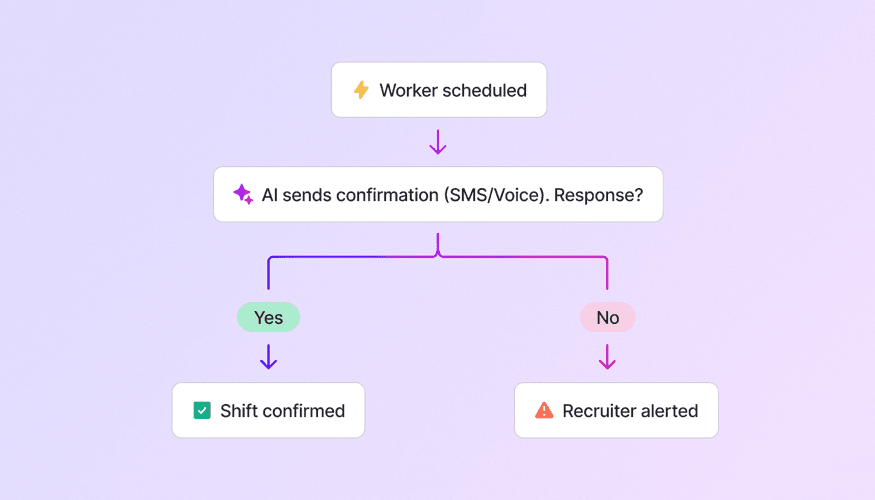
No-shows in staffing are not random. They are unconfirmed risks.
To reduce no-shows in staffing, agencies need more than reminders. They need a system that verifies worker intent, detects risk early, and enables fast intervention before a shift begins. This is where shift confirmations change the game.
Instead of reacting to missed shifts staffing issues and broader staffing coverage issues after they happen, leading staffing teams use automated shift confirmations to prevent no-shows, protect client relationships, and improve workforce reliability at scale.
No-shows are not random events. They are operational failures caused by unverified intent.
What Causes No-Shows in Staffing
The staffing no-show problem is rarely about forgetfulness. It is a combination of operational gaps and human behavior.
Common staffing no-show causes include:
- Unconfirmed shifts staffing workflows where no real intent is captured
- Workers juggling multiple jobs or opportunities
- Poor or one-way communication instead of two-way messaging staffing
- Low commitment signals that go unnoticed
- Lack of employee availability tracking before shifts
In many cases, employee no-shows and candidate no-shows happen because agencies assume attendance instead of verifying it.
Unconfirmed shifts staffing environments create coverage risk staffing issues that only surface when it is too late.
Why Workers Don’t Show Up
To prevent no-shows staffing agencies must understand that most failures are predictable. They follow consistent behavioral patterns that traditional workflows fail to capture.
Common real-world patterns include:
- Double-booking shifts: Workers accept multiple assignments and choose the best option last minute, leaving gaps in coverage.
- Last-minute better offers: Higher-paying or closer opportunities often take priority when there is no confirmed commitment.
- Ghosting candidates staffing workflows: When communication is weak or one-directional, workers disengage and stop responding entirely.
- Lack of accountability signals: Without structured confirmation, there is no psychological or operational commitment to the shift.
- Unclear expectations or details: Missing information about location, client, or timing leads to uncertainty and drop-offs.
These patterns explain why workers don’t show up. The issue is not just behavior. It is the absence of a system that captures intent early.
The Hidden Cost of No-Shows
The cost of no-shows staffing goes far beyond a missed shift.
A worker misses a 7am shift. By 7:15, the client is already calling. By 7:30, operations are disrupted. By 8:00, trust is already damaged.
This is how no-shows impact staffing businesses in real time.
It impacts:
- Staffing revenue protection, staffing profit protection, and overall profitability
- Client satisfaction staffing and long-term contracts
- Recruiter productivity staffing and dispatcher workload
- Staffing operational costs and internal efficiency
A single no-call no-show staffing incident can lead to:
- Lost revenue
- Damaged client trust
- Emergency reassignments
- Increased staffing operational risk
Beyond the immediate disruption, the cost of no-shows staffing compounds over time:
- Client churn: Repeated coverage failures lead clients to switch providers.
- SLA failures: Missed shifts break service expectations and damage contractual performance.
- Lost future placements: One failed assignment can eliminate multiple future opportunities with the same client.
No-shows are one of the fastest ways to reduce staffing revenue loss, increase operational instability, and ultimately reduce revenue loss staffing across accounts.
Why Manual Shift Confirmation Fails
Many agencies still rely on manual processes to confirm shifts with employees. This approach does not scale.
Common limitations include:
- Recruiters do not have time to call every worker
- No centralized staffing confirmation workflow
- No real-time staffing visibility into risks
- Late detection of issues when coverage is already impacted
Manual confirmation creates blind spots in staffing operational workflow.
By the time a problem is visible, it has already become a client issue.
What Are Shift Confirmations in Staffing
Shift confirmations, also known as employee shift confirmation processes, are a structured method used to verify that a worker will show up for a scheduled assignment.
They go beyond reminders by validating intent. Confirmations are not acknowledgments. They validate intent.
A proper shift confirmation system includes:

Confirm shift time and job details
Confirm location and client information
Capture worker availability and commitment
Perform shift intent confirmation before the assignment
This transforms attendance tracking from assumption into verification.
What Assignment Confirmations Actually Verify
Assignment confirmations go beyond simple notifications. They verify the critical details that determine whether a shift will be successfully covered.
A strong shift confirmation system ensures that every assignment is actively validated, not assumed.
Each confirmation verifies:
Shift start time: Confirms the worker knows exactly when the shift begins, reducing missed shifts staffing issues caused by timing confusion.
Job location: Ensures there is no ambiguity about where to report, especially important for multi-site or last-minute assignments.
Client name: Reinforces context and accountability, helping workers clearly understand who they are representing.
Worker intent to show up: This is the most important layer. It captures real commitment, not passive acknowledgment. This is where shift intent confirmation enables early detection no-shows.
When these elements are verified through an automated confirmation system, staffing teams gain real-time staffing visibility into assignment readiness.
Instead of relying on assumptions, agencies can detect unconfirmed shifts staffing risks early, trigger staffing intervention workflows, and reassign shifts quickly when needed.
This is what transforms confirmations into a true no-show prevention system and a core part of staffing risk management, reducing assignment risk staffing across every shift.
How Automated Shift Confirmations Work
An automated confirmation system replaces manual outreach with a scalable, real-time process, improving shift management staffing and strengthening the overall staffing scheduling system.
Here is how it works:
- The system sends SMS for staffing agencies or voice messages before the shift
- Workers respond through two-way messaging staffing channels
- Responses are logged instantly for employee attendance tracking
- The system performs shift risk detection based on responses
- Teams are alerted for staffing issue escalation if risk is identified
- Recruiters can reassign shifts quickly if needed
Assignment Confirmation Workflow
- Send confirmation
- Capture response
- Detect risk
- Flag issue
- Reassign shift
What Happens When Risk Is Detected
- No response → follow-up triggered: The system automatically sends reminders or escalates outreach to ensure no assignment is left unverified.
- Hesitation → flagged as risk: Unclear or delayed responses are treated as early warning signals, enabling staffing intervention workflows before the shift is at risk.
- Negative response → immediate reassignment: If a worker cannot attend, the system allows teams to reassign shifts quickly and prevent coverage failures.
This turns confirmations into a structured no-show prevention system, not just a communication step.
Instead of reacting, teams act in advance.
Real Example: $90K Saved with Automation
A multi-branch staffing company implemented automated workflows, including structured confirmations, as part of its staffing process automation.
Before:
- High volume of missed shifts staffing issues
- Manual follow-ups consuming hours daily
- Limited staffing attendance visibility
After:
- Automated staffing workflows handled confirmations
- Real-time staffing visibility into worker intent
- Significant reduction in employee no-shows
The result:
$90,000 saved annually
Over 300 hours saved monthly
Improved client satisfaction staffing outcomes
This is what staffing no-show reduction looks like when treated as a system, not a task, and a core driver of staffing profit protection.
For more details, see the full case study: How one Express Location saved $90k/year by Automating Workflows.
Shift Confirmations vs Shift Reminders
Shift reminders and shift confirmations are not the same.
Shift Reminders | Shift Confirmations |
|---|---|
Notify workers | Verify intent |
Passive communication | Active validation |
No commitment check | Confirms availability |
No risk detection | Enables early detection |
If you want to explore reminders further, you can read: Automated shift reminders.
Operational Impact of Shift Confirmations
This is not communication. This is staffing risk management.
Reduce No-Shows and Absenteeism
Automated shift confirmations help reduce employee no-shows, improve worker attendance, and reduce absenteeism staffing by verifying intent before shifts begin. Instead of assuming attendance, teams confirm worker commitment in advance, eliminating unconfirmed shifts staffing risks and significantly reducing last-minute gaps.
Protect Client Relationships
By preventing coverage failures, agencies protect client relationships staffing and improve staffing client retention. When shifts are consistently covered, clients experience reliability, which strengthens trust and increases long-term placement opportunities.
Save Time and Improve Efficiency
Automation reduces dispatcher workload and improves staffing operations efficiency across teams. Instead of manually calling or chasing confirmations, recruiters can focus on higher-value tasks, increasing recruiter productivity staffing while reducing repetitive operational work.
Create Visibility and Control
With staffing attendance visibility and employee attendance tracking, teams gain real-time insight into workforce reliability. This level of transparency allows agencies to identify risks early and manage staffing coverage proactively instead of reacting after issues occur.
Enable Fast Intervention
Staffing intervention workflows allow teams to prevent last-minute cancellations and reassign shifts quickly. When risks are detected early, agencies can act before the shift starts, avoiding disruptions and maintaining consistent service delivery.
Over time, this reduces staffing operational risk and improves workforce scheduling outcomes.
Best Practices for Staffing Agencies
To maximize results, follow these reduce no-shows staffing agency strategies:
Send confirmations at the right time
Timing directly impacts response rates and reliability:
- 24 hours before the shift → establishes early commitment
- 12 hours before → reinforces intent and catches uncertainty
- Same-day (2–4 hours before) → final validation and risk detection
Using multiple touchpoints ensures worker availability confirmation is not left to chance.
Use SMS for faster response rates
SMS for staffing agencies consistently outperforms email and calls.
- Enables instant two-way messaging staffing communication
- Increases response speed and engagement
- Improves candidate engagement staffing across the lifecycle
This is critical for early detection no-shows and real-time staffing visibility.
Define response benchmarks
Tracking response rates helps identify risk before it escalates:
- 90–100% confirmed → strong coverage confidence
- 70–89% confirmed → moderate risk, monitor closely
- Below 70% → high coverage risk staffing, requires immediate action
Clear benchmarks turn confirmations into a measurable staffing operational workflow.
Set escalation timing rules
Do not wait until the shift is at risk. Define when to act:
- No response after initial message → follow-up within 1–2 hours
- No response after second attempt → escalate or flag as risk
- Negative or uncertain response → immediate staffing issue escalation
This ensures teams can reassign shifts quickly and prevent assignment failures.
Track availability and confirmation trends
Consistent employee availability tracking helps identify patterns:
- Workers with frequent late confirmations
- High-risk roles or shift types
- Recurring no-show behavior
This improves staffing risk management and long-term workforce scheduling decisions, especially when integrated with employee scheduling software.
A strong shift confirmation process is not just about communication. It is about staffing risk management.
Conclusion: From Reactive to Predictable Staffing
No-shows are predictable. The problem is not the worker. It is the lack of a system.
With automated shift confirmations, staffing agencies can:
- Prevent assignment failures
- Protect staffing revenue
- Improve worker reliability
- Reduce operational chaos
This is how modern teams move from reactive staffing to controlled, predictable operations.
See How It Works
No-shows don’t have to be part of your operation. With the right system, they become predictable and preventable.
If you want to reduce no-shows in staffing, protect revenue, and ensure every shift is covered with confidence:
Request a demo
Whippy helps staffing teams automate shift confirmations, detect risk early, and take action before issues impact clients.
FAQs
Q: How do staffing agencies reduce no-shows?
A: Staffing agencies reduce no-shows by implementing a no-show prevention system that confirms worker intent before shifts, tracks responses, and enables early intervention when risk is detected. This replaces manual follow-ups with a scalable staffing operational workflow.
Q: What is shift confirmation in staffing?
A: Shift confirmation is the process of verifying that a worker intends to show up for a scheduled shift by confirming key details such as time, location, and availability. It ensures assignments are validated, not assumed.
Q: Do SMS confirmations reduce no-shows?
A: Yes. SMS confirmations significantly improve response rates through two-way messaging staffing communication, enabling faster replies, real-time staffing visibility, and early detection no-shows before shifts begin.
Q: What is the difference between reminders and confirmations?
A: Reminders notify workers about a shift. Confirmations verify intent and trigger action if risk is detected. This makes confirmations a core part of a no-show prevention staffing agencies system, not just communication.
Q: When should shift confirmations be sent?
A: Shift confirmations should be sent at multiple intervals, typically 24 hours before the shift, 12 hours before, and again a few hours prior. This ensures worker availability confirmation and reduces last-minute coverage risk staffing issues.
Q: What happens if a worker does not confirm a shift?
A: If a worker does not confirm, the system triggers follow-ups or flags the assignment as a risk. This allows staffing teams to intervene early, escalate if needed, and reassign shifts quickly to prevent coverage failures.
Q: Why do workers not show up to shifts?
A: Workers often miss shifts due to double-booking, better last-minute opportunities, unclear job details, or lack of accountability. Without structured confirmation, these risks remain hidden until the shift is already impacted.
Table of Contents
Table of Contents
- What Causes No-Shows in Staffing
- The Hidden Cost of No-Shows
- Why Manual Shift Confirmation Fails
- What Are Shift Confirmations in Staffing
- What Assignment Confirmations Actually Verify
- How Automated Shift Confirmations Work
- Real Example: $90K Saved with Automation
- Shift Confirmations vs Shift Reminders
- Operational Impact of Shift Confirmations
- Best Practices for Staffing Agencies
- Conclusion: From Reactive to Predictable Staffing
- See How It Works
- FAQs
Try Whippy for Your Team
Experience how fast, automated communication drives growth.

Related Articles

Best AI Recruiting Tools for Franchise Staffing
 Elizabeth Long
The Staffing Operating System for Avionté
Elizabeth Long
Automated License Verification for Staffing Agencies
Elizabeth Long
Write Job Descriptions That Make AI Recruiters Perform
Elizabeth Long
The Candidates You Need Are Already in Your ATS
Elizabeth Long
Payroll Communication for Staffing Agencies
Elizabeth Long