


Table of Contents
- What is Job Order Intake in Staffing?
- Why Staffing Agencies Miss Job Orders?
- When Staffing Job Orders Typically Arrive
- How Staffing Agencies Capture Job Orders Today
- How to Automate Job Order Intake
- How AI Captures Staffing Job Orders Automatically
- What Information AI Collects During Job Order Intake
- Automated Job Order Routing and Recruiter Notifications
- The Operational Impact of Automated Job Order Intake
- AI Job Order Intake and Staffing Sales Outreach
- How Staffing Agencies Capture Job Orders Automatically with AI
- Why AI Job Order Intake Is Becoming Essential
- Capture Staffing Job Orders 24/7 with AI
- Key Takeaways
- FAQ: AI Job Order Intake for Staffing Agencies
Try Whippy for Your Team
Experience how fast, automated communication drives growth.
Staffing agencies do not usually lose business because they cannot fill roles. They lose business because they never capture the job order in the first place.
Staffing is a speed business. When a client needs workers, they usually need them immediately. A warehouse may call late at night requesting workers for the next morning, or a hospital may need coverage for an overnight shift.
If that call goes to voicemail, the outcome is predictable.
The client calls the next staffing firm.
This is why job order intake is one of the most critical operational workflows in staffing. Modern agencies are solving this challenge with AI job order intake systems that capture client requests automatically and turn missed calls into structured hiring demand.
What is Job Order Intake in Staffing?
Job order intake in staffing is the process of capturing and documenting client hiring requests so recruiters can begin sourcing candidates. Modern staffing firms use AI job order intake systems and answering services to collect job details automatically and route requests directly to recruiters.
Modern staffing firms increasingly use automated job order intake systems powered by AI to capture hiring requests without manual call handling. Instead of relying on voicemail or delayed callbacks, automation ensures every client request is documented and routed to recruiters immediately.
Why Staffing Agencies Miss Job Orders?
Many staffing agencies discover that a significant portion of client requests occur outside traditional office hours. Industries such as manufacturing, healthcare, logistics, and event staffing frequently generate overnight or weekend hiring needs, where response speed directly impacts whether a job order is secured or lost.
In high-volume staffing environments, the first agency to acknowledge and document a job order often wins the placement opportunity.
Many staffing firms still rely on traditional communication systems:
- voicemail
- manual note-taking
- recruiter callbacks
- inbox tracking
This approach creates operational gaps.
A client may call after business hours, leave a voicemail, and never hear back until the next morning. By then, the role may already be filled by a competitor.
The issue is not recruiter effort. It is infrastructure.
Without automated job order intake, agencies risk losing opportunities because:
- recruiters are unavailable when calls arrive
- voicemail messages lack structured information
- job requests are documented inconsistently
- client requests are delayed before entering the pipeline
This is why more agencies are investing in staffing workflow automation and AI answering services for staffing agencies.
When Staffing Job Orders Typically Arrive
One of the most overlooked realities of staffing operations is that client demand does not follow standard office hours.
Many industries that rely heavily on staffing agencies operate around the clock, which means hiring requests frequently occur during evenings, nights, and weekends.
For example:
Manufacturing and logistics:
Production disruptions, supply chain delays, and unexpected absenteeism often require immediate overnight staffing adjustments.
Healthcare staffing:
Hospitals, clinics, and care facilities frequently need last-minute coverage for overnight shifts or weekend rotations.
Because of these industry patterns, a large percentage of staffing job orders arrive when recruiters are not actively answering phones.
When agencies rely on voicemail or delayed callbacks, these opportunities are easily lost.
This is why modern staffing firms are implementing AI answering services and automated job order intake systems that capture client requests the moment demand appears.
How Staffing Agencies Capture Job Orders Today
Staffing agencies typically capture job orders in one of three ways:
- Manual recruiter intake: A client calls a recruiter directly, who gathers job details during the conversation.
- Voicemail-based intake: Calls outside office hours go to voicemail, requiring recruiters to return the call later.
- Automated job order intake: A staffing agency answering service powered by AI answers inbound calls, collects hiring details, and routes structured job orders directly into operational systems.
The third approach is becoming the preferred model because it enables staffing job order automation and 24/7 demand capture.
Instead of waiting for recruiters to become available, AI systems capture job orders immediately and initiate recruiter workflows automatically.
How to Automate Job Order Intake
Automating job order intake means replacing manual call handling with a system that captures client hiring requests automatically. Many staffing firms are implementing broader recruitment process automation frameworks and recruiting operations automation systems that connect demand capture, screening, and placement workflows.
Modern AI job order intake systems combine three core components:

AI answering service: An AI receptionist for recruiters answers inbound client calls immediately, ensuring no opportunity is missed. This always-on availability allows staffing agencies to capture hiring demand even outside traditional office hours.
Structured job order capture: The system asks predefined questions to collect the details recruiters need to begin sourcing candidates, such as role requirements, shift schedules, worker quantity, and job location. This ensures every job order enters the system with consistent, structured information.
Automated routing and notifications: Once the job order is captured, the system logs the request, routes it to the appropriate recruiter or account manager, and triggers notifications so candidate sourcing can begin immediately.
By combining these capabilities, AI systems help staffing agencies capture hiring demand automatically, eliminate missed calls, and convert inbound conversations into structured job orders.
Example: Overnight Warehouse Staffing Request
Imagine a logistics company calling a staffing agency at 10:15 PM requesting 15 warehouse workers for a 6:00 AM shift the next morning.
Instead of reaching voicemail, the call is answered instantly by an AI receptionist for staffing firms.
The system guides the caller through a structured intake conversation and captures the job order details automatically.
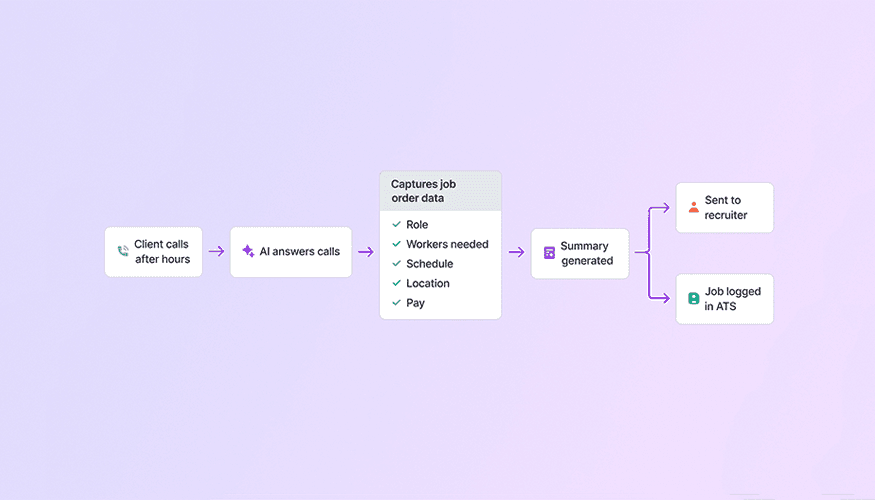
The process typically looks like this:
1. Client calls the staffing agency after hours
2. AI answering service responds immediately
3. The system collects role details, worker quantity, schedule, and location
4. The job order is documented and routed to the assigned recruiter
5. Recruiters receive notifications and can begin candidate outreach
By the time recruiters begin their day, the staffing job order is already documented, routed, and ready for action.
Instead of discovering a voicemail hours later, the agency has already captured the opportunity and initiated the placement process.
How AI Captures Staffing Job Orders Automatically
Staffing firms increasingly use voice AI for staffing agencies and AI answering services for staffing agencies to automate job order intake. Instead of relying on recruiters to answer every inbound call, AI systems respond immediately and capture hiring requests the moment a client reaches out.
AI job order intake systems function as a demand capture layer for staffing agencies. They collect hiring information, structure the request into a job order, and ensure the opportunity enters the staffing workflow without requiring recruiter availability.
The system can ask key questions such as:
- What role are you looking to fill?
- How many workers do you need?
- When does the shift start?
- Where is the job located?
- What pay rate are you offering?
This creates a structured job order capture workflow that ensures no information is lost.
The result is automated staffing order intake that feeds directly into operational systems.
Once a job order is captured, the next step is ensuring that information enters the systems recruiters use every day.
How Job Orders Enter Staffing Systems
Capturing the job order is only the first step. For AI job order intake to deliver operational value, the information must flow directly into the systems recruiters already use.
Modern staffing automation platforms connect intake workflows with ATS, CRM, and communication systems so every client request becomes part of the agency’s operational infrastructure, especially for enterprise staffing organizations managing multiple recruiters, clients, and branch locations.
Once a call is completed, the system can automatically:
- create a job order record in the ATS or CRM
- log the call transcript and interaction summary
- assign the request to the correct recruiter
- trigger recruiter notification workflows
- update the staffing pipeline with a new demand signal
Routing rules determine where the request goes based on factors such as:
client ownership // branch location // job category // urgency level
As soon as the order is logged, recruiters receive alerts through email, SMS, or internal messaging platforms so candidate sourcing can begin immediately.
With solutions like Whippy’s AI receptionist for staffing firms, agencies can implement a 24/7 AI answering service model that ensures every client request becomes a documented opportunity.
What Information AI Collects During Job Order Intake
A properly designed AI job order intake system captures the same information a recruiter would collect during a manual conversation.
Typical fields include:
- company contact details
- hiring manager information
- role description
- worker quantity
- shift requirements
- pay expectations
- urgency level
This creates structured client job orders instead of vague voicemail messages.
The AI then converts this information into a job order record, enabling:
- job order routing
- recruiter notification workflows
- staffing CRM integration
- staffing pipeline management
This level of staffing agency automation transforms phone calls into actionable operational data.
Automated Job Order Routing and Recruiter Notifications
Once a job order is captured, the system immediately initiates follow-up workflows.
The AI can automatically:
generate a structured summary of the request
route the job order to the correct recruiter
notify the account manager
log the order inside the CRM or ATS
trigger follow-up workflows for the next business day
This job order routing process ensures the opportunity enters the pipeline immediately.
Instead of waiting for voicemail checks or manual callbacks, recruiters receive decision-ready information.
This type of AI workflow automation for staffing significantly improves response speed and operational visibility.
The Operational Impact of Automated Job Order Intake
Job Order Intake Is the Top of the Staffing Funnel
In staffing operations, job order intake sits at the very top of the revenue funnel. Every placement, interview, and candidate screening process begins with a client hiring request entering the system.
If that demand is not captured, the rest of the staffing pipeline never activates.
This is why demand capture is fundamentally different from other recruiting tasks. Recruiters can only source candidates, conduct interviews, and coordinate placements after a job order has been documented and routed internally.
When job order intake is inconsistent, several operational problems emerge:
- recruiters spend time chasing incomplete client requests
- hiring demand enters the system too slowly
- candidate sourcing starts later than competing agencies
- pipeline visibility becomes fragmented across teams
By contrast, when staffing agencies implement automated job order intake, every client request becomes a structured demand signal that immediately enters the staffing pipeline.
This creates three strategic advantages:
Consistent demand capture:
Every inbound request becomes a documented job order, even outside office hours.
Faster pipeline creation:
Recruiters receive hiring demand immediately, allowing candidate sourcing to begin sooner.
Improved recruiter workload management:
Recruiters spend less time collecting job details and more time focusing on sourcing, screening, and placements.
For staffing firms, this shift transforms job order intake from a reactive administrative task into a strategic demand-generation layer at the top of the staffing funnel.
Faster demand capture
AI ensures staffing agencies capture job orders the moment clients call, protecting revenue opportunities and eliminating missed demand caused by unanswered calls, even outside traditional office hours.
For example, one staffing operation automated communication and workflow processes and saved over $90,000 annually while eliminating hundreds of hours of manual follow-up. You can read the full case study here.
Improved staffing demand generation
Every documented call becomes part of a staffing demand generation system, giving teams visibility into incoming opportunities.
Standardized staffing client communication
AI creates consistent staffing client communication workflows, ensuring every request is handled the same way.
Reduced administrative workload
Recruiters spend less time collecting information and more time filling roles.
By automating intake and documentation, agencies increase recruiter capacity and allow recruiting teams to focus on sourcing, relationship management, and candidate placement.
Stronger staffing pipeline management
Structured intake improves:
- recruiter productivity
- candidate matching
- client satisfaction
Because job orders are documented and routed immediately, agencies can begin sourcing candidates faster, reducing time-to-fill and improving client responsiveness. Many staffing firms also combine AI job order intake with AI recruiter systems that automatically screen and qualify applicants after a job order enters the system.
Over time, this operational improvement leads to higher job order capture rates, stronger client retention, and more predictable staffing demand pipelines.
This is why staffing call automation, voice AI for staffing agencies, and AI voice assistants for staffing agencies are rapidly becoming core infrastructure for modern staffing operations.
AI Job Order Intake and Staffing Sales Outreach
While many job orders arrive through inbound calls, demand can also be generated proactively.
AI systems can support staffing sales outreach by:
- calling prospective clients
- leaving personalized voicemails
- capturing callback intent
- documenting hiring interest
When a company confirms they are hiring, the system can automatically convert that interaction into a client job order intake record.
This approach transforms outbound activity into structured staffing agency client request automation, creating a measurable pipeline of hiring demand.
How Staffing Agencies Capture Job Orders Automatically with AI
Many agencies ask the same question:
How can staffing agencies capture job orders automatically?
The answer lies in combining voice AI, automation workflows, and CRM integration. The following workflow shows how an AI job order intake system captures and routes staffing requests from the moment a client calls.
How AI Job Order Intake Works Step-by-Step
A modern AI job order intake system captures staffing job orders automatically through a structured workflow:
1. Client calls the staffing agency: A hiring manager contacts the staffing firm requesting workers for a specific role or shift.
2. AI receptionist answers immediately: An AI answering service for staffing agencies responds instantly, ensuring the call is not lost to voicemail.
3. AI collects job order details: The system asks structured questions to capture role requirements, worker quantity, schedule, location, and pay information.
4. The system generates a structured job order: The captured information is converted into a documented job order record inside the staffing system.
5. Recruiters receive notifications and routing alerts: The system automatically routes the request to the assigned recruiter or account manager so candidate sourcing can begin.
This step-based workflow allows staffing firms to capture staffing job orders automatically and convert inbound calls into documented hiring demand.
Why AI Job Order Intake Is Becoming Essential
Staffing agencies operate in competitive markets where speed determines success.
Clients expect immediate responses. Candidates expect fast placement. Recruiters face growing operational complexity.
As hiring volumes increase, many agencies are adopting automation systems that connect job order intake, screening, and candidate engagement into a single workflow, especially in high-volume recruiting environments.
Without automation, these expectations are difficult to meet.
This is why AI automation for recruiting firms is shifting from experimental technology to operational infrastructure.
With AI voice assistants for staffing agencies, agencies can ensure every client interaction contributes to structured staffing pipeline management and revenue growth.
Capture Staffing Job Orders 24/7 with AI
For staffing firms, the difference between a missed call and a captured job order is often the difference between lost revenue and a successful placement.
With AI job order intake, staffing agencies can:
- capture staffing job orders automatically
- automate client job order intake
- route opportunities instantly to recruiters
- improve recruiter productivity
- strengthen staffing demand generation
Instead of relying on voicemail and manual callbacks, agencies can implement a 24/7 AI answering service that captures client hiring requests and turns them into structured job orders immediately, effectively functioning as a 24/7 answering service staffing agency solution that captures client demand automatically.
Request a demo to see how Whippy helps staffing agencies capture job orders automatically and ensure no client request is ever missed.
Key Takeaways
Job order intake is the operational entry point for staffing agencies because every placement begins with a client hiring request.
Missed calls and delayed responses often lead to lost revenue, especially when staffing demand occurs outside traditional office hours.
AI answering services allow staffing agencies to capture staffing job orders automatically and ensure no hiring request goes unanswered.
Automated job order intake improves recruiter productivity by eliminating manual call handling and administrative intake tasks.
Structured job orders accelerate candidate sourcing and placement by routing hiring requests directly into recruiter workflows.
FAQ: AI Job Order Intake for Staffing Agencies
Q: What is job order intake in staffing?
A: Job order intake in staffing is the process of capturing and documenting a client’s hiring request so recruiters can begin sourcing candidates. A job order typically includes role requirements, worker quantity, schedule, location, and pay details. Many staffing agencies now use AI job order intake systems to capture and route job orders automatically.
Q: How can staffing agencies capture job orders automatically?
A: Staffing agencies can capture job orders automatically using AI answering services that respond to inbound client calls, collect hiring details through structured conversations, and create documented job orders. The system then routes the request to the appropriate recruiter and logs the interaction inside the agency’s CRM or ATS.
Q: What is automated job order intake?
A: Automated job order intake is the use of AI systems to capture, document, and route client hiring requests without requiring a recruiter to answer every call. AI answering services gather role details, create structured job orders, and notify recruiters immediately so candidate sourcing can begin without delay.
Q: Why do staffing agencies lose job orders?
A: Staffing agencies often lose job orders when client calls go unanswered or are sent to voicemail. Many hiring requests occur outside traditional office hours, and clients typically contact the first agency that responds. Automated job order intake ensures every request is captured immediately, reducing missed opportunities.
Q: How does AI help staffing agencies capture demand?
A: AI helps staffing agencies capture demand by answering inbound calls instantly, collecting job order details, and converting conversations into structured hiring requests. Instead of relying on recruiter availability, AI systems ensure client requests are documented and routed automatically, allowing agencies to respond faster to staffing demand.
Q: What information is collected during job order intake?
A: During job order intake, staffing agencies typically collect the company name, contact information, role title, job description, number of workers required, shift schedule, job location, pay rate, and urgency level. AI job order intake systems gather this information automatically and convert it into structured job order records.
Table of Contents
Table of Contents
- What is Job Order Intake in Staffing?
- Why Staffing Agencies Miss Job Orders?
- When Staffing Job Orders Typically Arrive
- How Staffing Agencies Capture Job Orders Today
- How to Automate Job Order Intake
- How AI Captures Staffing Job Orders Automatically
- What Information AI Collects During Job Order Intake
- Automated Job Order Routing and Recruiter Notifications
- The Operational Impact of Automated Job Order Intake
- AI Job Order Intake and Staffing Sales Outreach
- How Staffing Agencies Capture Job Orders Automatically with AI
- Why AI Job Order Intake Is Becoming Essential
- Capture Staffing Job Orders 24/7 with AI
- Key Takeaways
- FAQ: AI Job Order Intake for Staffing Agencies
Try Whippy for Your Team
Experience how fast, automated communication drives growth.

Related Articles
Best AI Recruiting Tools for Franchise Staffing
 Elizabeth Long
The Staffing Operating System for Avionté
Elizabeth Long
Automated License Verification for Staffing Agencies
Elizabeth Long
Write Job Descriptions That Make AI Recruiters Perform
Elizabeth Long
The Candidates You Need Are Already in Your ATS
Elizabeth Long
Payroll Communication for Staffing Agencies
Elizabeth Long