


Table of Contents
Try Whippy for Your Team
Experience how fast, automated communication drives growth.
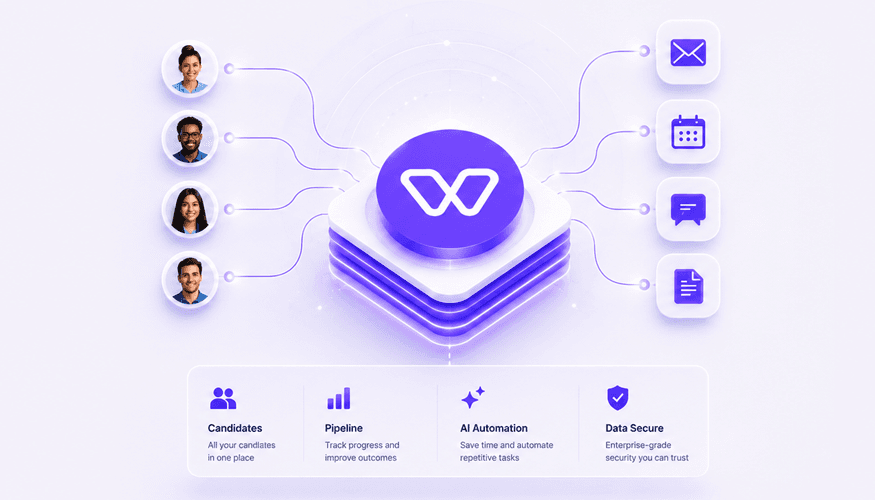
The Bullhorn Marketplace has more than 300 technology partners. Most staffing firms use fewer than five. The ones consistently winning placements have stopped chasing tools and started building deliberate stacks: a small number of deeply adopted integrations that remove friction at exactly the right moments.
This guide covers what Bullhorn integrations actually are, which categories move the needle, what separates surface integrations from deep ones (with real screenshots), and how to evaluate any tool before you commit.
What Are Bullhorn Integrations?
Bullhorn integrations are third-party tools that connect to Bullhorn ATS/CRM via API to extend its native capabilities. They automate workflows, sync candidate and client data, and improve communication without forcing recruiters to leave the platform.
Bullhorn recruitment software handles applicant tracking, CRM, and reporting at enterprise scale. What it doesn't replace are the specialized tools built for texting a candidate at 11 p.m., running AI candidate matching the second an application lands, or launching a targeted SMS campaign to hundreds of contacts in your database. That's the job of integrations.
From job board integration and automated candidate outreach to AI recruiting tools and recruitment CRM integration, staffing integrations let agencies build a high-performance tech stack with Bullhorn as the single source of record. Everything flows in. Nothing gets siloed outside.
Why the Right Integrations Change Everything
Speed is the variable that determines whether a staffing firm wins or loses a placement. The faster a qualified candidate is contacted after applying, the higher the chance they stay engaged. The faster a requisition is screened and shortlisted, the faster it fills. Every manual step in that chain is a delay that costs candidates.
The data is consistent across every major staffing industry study: top-performing firms are significantly more likely to use AI-powered tools, firms that adopt AI screening report meaningful KPI improvements, and the highest-growth agencies complete placements faster than their peers. The common thread is not headcount or job ad spend. It is the removal of manual friction at key workflow moments through the right integrations.
This doesn't mean more integrations. It means the right ones, deeply adopted. High-growth agencies remove friction at the exact moments where speed determines whether a candidate takes their offer or someone else's.
The Four Categories That Drive Results
1. AI Recruiting & Candidate Engagement
This is the highest-leverage category in staffing today, and the one where the performance gap between early adopters and everyone else is most visible.
What it does: An AI recruiter integration monitors Bullhorn for new candidate applications in real time. The moment one lands, whether from job boards, job listings, candidate portals, or triggered job alerts, the AI sends outreach via SMS, email, or WhatsApp without recruiter involvement. It then runs intelligent pre-screening using configurable screening questions with conditional logic, scores responses against the job requirements pulled directly from Bullhorn, and writes everything back into the candidate record automatically.
Recruiters open Bullhorn to find candidates already contacted, screened, scored, and organized into Hotlists. No raw inbox. No manual triage.
The components that matter:
- Speed of automated candidate outreach. Outreach needs to fire in under a second, not under a day. Response rates drop sharply within the first few minutes after an application lands. By the time a recruiter manually reviews an application and types a message, top candidates have often already replied to faster firms. Converting applications that would have otherwise ghosted is the single most measurable impact of AI recruiting tools.
- Conditional logic in screening. A nurse gets asked about active licensure. A warehouse applicant gets asked about shift availability. A developer gets asked about stack experience. Screening questions should be generated automatically from the job context pulled from Bullhorn, not from a generic questionnaire applied to every role. Look for custom forms, role-specific question generation, and conditional logic that adapts the flow based on each answer.
- AI candidate matching with useful output. After screening, the system should rank applicants against Bullhorn job requirements and surface which strengths a candidate showed, which requirements went unanswered, and where gaps exist. That is what lets a recruiter make a decision in 30 seconds, not 30 minutes.
- Writeback transcripts and scores into structured fields. Every conversation and score must sync back into Bullhorn automatically, into specific fields rather than free-text notes. Transcripts writeback enables compliance documentation, manager visibility, and candidate rediscovery months later. If this data lives only in the AI tool, you have a silo and a compliance risk.
- Hotlists that reflect real ranking. Qualified candidates should populate Bullhorn Hotlists automatically with scores and screening notes already attached. For high-volume requisitions, this is the difference between a manageable pipeline and an unworkable one.
Inside Bullhorn, recruiters can launch automated SMS campaigns directly from their dashboard to engage entire candidate lists at once, with every response syncing back in real time:

Bulk SMS to a pharmacist distribution list, launched directly from Bullhorn. Every response logs back automatically, no external tool required.
Whippy's AI recruiter for Bullhorn ATS handles all of the above as a single system: pulling job context from Bullhorn, triggering outreach in under a second, running role-specific screening with conditional logic, applying AI candidate matching, and writing every transcript and score back in real time. Agencies using this model see 30 to 40% higher candidate response rates and eliminate the manual gap between application receipt and first contact, which is where most candidate drop-off occurs.
2. Texting & Omnichannel Communication
Email response rates in recruiting hover around 20%. Text message open rates exceed 90%, typically within three minutes. For high-volume staffing pipelines, that difference is not marginal. It often determines whether a role gets filled or reopened.
What it does: Bullhorn texting integration embeds two-way SMS and MMS directly into candidate and contact records. Recruiters send and receive messages without leaving Bullhorn. Every conversation logs automatically to the right record. Automated texts trigger on ATS status changes. Bulk campaigns run from distribution lists or Hotlists, with all response data written back.
Every conversation, score, and screening response is automatically logged inside Bullhorn in real time. Here is what the writeback looks like inside a candidate record after a full screening conversation:

Candidate's Notes tab after a 15-message screening conversation. Every exchange written by "Whippy API", timestamped, structured, zero manual entry.
Fifteen notes. One per message. Each timestamped and authored by "Whippy API." Zero recruiter involvement. Every note is searchable, reportable, and immediately visible to any recruiter who opens this record. This is what compliance-ready writeback looks like in production.
Whippy's Bullhorn texting integration supports SMS, MMS, and WhatsApp with full merge field personalization, status-change triggers, and real-time sync on every message. From Hotlists, recruiters can jump directly into one-on-one conversations with top candidates, with each message logged to Bullhorn for full visibility and compliance:

One-on-one SMS with a candidate, live inside Bullhorn. Every message logs automatically, no tab-switching, no manual copy-paste.
The Whippy panel opens alongside the Bullhorn candidate record. The recruiter sees the conversation in real time and replies instantly. Every message, sent and received, is written back to Bullhorn the moment it happens. The candidate experiences a fast, responsive recruiter. The recruiter never leaves the ATS.
3. VoIP & Call Automation
Phone calls still close placements. Manually logging them, switching apps, and tracking which candidates you actually reached is a compounding time drain across any team doing real volume.
What it does: A Bullhorn VoIP integration enables one-click calling from candidate and client records, records and logs calls automatically, syncs call notes to Bullhorn in real time, and in advanced implementations, runs AI voice follow-up for initial qualification calls.
What to look for: Click-to-call from within Bullhorn profiles without manual dialing. Automatic call logging with duration, outcome, and notes written to the right record. Call recording with transcription stored in Bullhorn. AI call automation for voicemails and initial qualification, with writeback so every outcome is documented.
Whippy's Bullhorn VoIP integration combines click-to-dial, AI-driven voice follow-up, and full writeback. Calls, texts, and emails are all stored on the same candidate record, giving recruiters and managers a complete view of every touchpoint without any manual consolidation.
4. Job Board Connections & Workflow Automation
Job board integration determines whether applications flow into Bullhorn cleanly enough to trigger downstream AI workflows, or whether they land in an unstructured inbox that someone has to process manually.
What to look for: bidirectional sync rather than just outbound posting, real-time application sync that creates structured Bullhorn candidate records immediately, and compatibility with your AI recruiting layer so new applications trigger outreach and screening without a human initiating anything.
Whippy's job board integrations connect listings across Bullhorn and major job boards, sync applications in real time, and immediately launch the full AI recruiting sequence the moment a candidate applies. Staffing firms stop buying more job ads and start converting more of the applications they are already receiving.
Bullhorn automation workflows define what happens automatically when something changes in the ATS: a candidate advances, a job fills, a contract expires, a client record updates. Well-designed automation cuts recruiter admin by hours daily. Poorly designed automation creates noise that erodes trust in the system.
What to look for: native Bullhorn event triggers that fire in real time rather than on a polling schedule, conditional logic for complex if/then branching, configurable field mapping, and a full audit trail. The best Bullhorn automation use cases eliminate the manual handoff moments that slow placements: interview reminders, reengagement sequences for cold candidates, compliance documentation triggers on placements. Whippy's workflow engine handles all of these natively, with every action logged back to Bullhorn automatically.
What Deep Integration Actually Looks Like
Vendors use "integration" loosely. A surface integration pushes a candidate record into Bullhorn when someone applies. That is table stakes.
A deep Bullhorn integration does all of this:

Pulls job context from Bullhorn to inform every downstream action
Triggers workflows the moment ATS events fire, not on a polling schedule
Writes structured data back into Bullhorn fields, not just notes
Keeps candidate dashboards accurate without recruiter intervention
Maintains a complete, timestamped audit trail for compliance and reporting
Logs every touchpoint (messages, calls, scores, transcripts) to the right record automatically
When evaluating any Bullhorn integration for candidate screening or communication, ask the vendor to show you what the Notes tab looks like after a completed screening flow. One generic "candidate screened" note is a surface integration. Fifteen structured, timestamped entries, one per message, is a deep integration.
The one question to ask every vendor: "When a candidate finishes screening, walk me through exactly what appears in Bullhorn, field by field".
How to Evaluate Any Bullhorn Integration
Before signing with any vendor, these five questions cut through the marketing faster than any demo:
Question | What you want to hear | Red flag |
|---|---|---|
Does it write back to Bullhorn, or just read from it? | "We write scores, transcripts, stage changes, and field updates back in real time." | "We sync data nightly" or vague answers about notes |
Is the sync real-time or scheduled? | "A candidate response appears in Bullhorn immediately." | Any mention of polling intervals, batch jobs, or hourly syncs |
How is field mapping configured, and who does it? | "We configure it with you during implementation and validate before go-live." | "You set it up after onboarding" or no field-level control |
Is it a Bullhorn partner engagement ecosystem member? | Confirmed presence in the Bullhorn Marketplace or Recruiter Insider program. | No Marketplace listing, no mention of Bullhorn partnership |
What does the compliance audit trail look like? | A live demo of the actual Notes or Activity tab in Bullhorn after a screening flow. | "We have logs on our side" without showing Bullhorn itself |
30-Day Implementation Roadmap
Week 1: Connect & validate
Establish the API connection via the Merge Bullhorn API integration (Unified API). Validate field mapping for candidate data, job orders, and placements. Confirm real-time sync flows cleanly in both directions before anyone uses it in production.
Week 2: Build screening flows & automation sequences
Configure Bullhorn automation workflow triggers. Build screening questions with conditional logic for your three highest-volume job types. Customize outreach templates with Bullhorn merge fields. Test every flow end-to-end with internal accounts before any candidate sees them.
Week 3: Pilot with one live requisition
Run the full integrated workflow on a single real role. Confirm Hotlists populate with scores attached, verify writeback transcripts and scores appear in Bullhorn records, and check that stage advancement fires correctly. Refine here before scaling.
Week 4: Expand & measure
Deploy across additional requisitions. Track time-to-first-contact, candidate response rate, screening completion rate, and time-to-fill against the week-one baseline. The numbers at this stage tend to make the internal adoption conversation straightforward.
For specialized verticals, see Whippy's guides on construction recruiting with Bullhorn, Bullhorn AI assistant workflows, and Bullhorn automation use cases by industry.
Build the Stack That Wins Placements
Bullhorn is the foundation. Integrations are what make it fast.
The framework: start with the AI recruiting layer (automated outreach, intelligent screening, writeback transcripts and scores, Hotlists). Add omnichannel communication so two-way SMS and VoIP log everything back to Bullhorn automatically. Connect your job boards for real-time application sync that immediately triggers your AI workflows. Then automate the process logic to eliminate the manual handoffs between stages.
Whippy covers all four categories in a single platform built specifically for Bullhorn. It connects via the Merge Bullhorn API integration for clean data flow from day one, supports every channel your candidates use, and writes everything back to Bullhorn automatically so your ATS stays accurate without manual effort.
See it working inside your Bullhorn environment:
Request a live demo
FAQs
Q: What is a Bullhorn integration?
A: A Bullhorn integration is a third-party tool that connects to Bullhorn ATS via API to extend its functionality. It can automate candidate outreach, sync job board applications, run AI screening, add two-way texting or VoIP, or automate workflow triggers, with all data flowing back into Bullhorn in real time.
Q: What are the best Bullhorn integrations for staffing agencies?
A: The highest-impact Bullhorn integrations are AI recruiting tools (automated outreach, pre-screening, candidate scoring), texting platforms (two-way SMS inside Bullhorn with full writeback), VoIP tools (click-to-call with automatic logging), job board connections (real-time application sync), and workflow automation (eliminating manual handoffs between stages). For most high-volume staffing firms, the AI recruiting layer delivers the greatest ROI because it eliminates the manual gap between application receipt and first contact, which is where most candidate drop-off occurs.
Q: What is writeback in a Bullhorn integration?
A: Writeback means the integration sends structured data back into Bullhorn rather than just reading from it. Transcripts writeback stores full conversation records against the candidate record. Score writeback updates specific Bullhorn fields with AI-assigned ratings. Stage writeback advances candidates automatically when they meet screening criteria. Deep writeback is what separates genuinely useful integrations from tools that create data silos.
Q: How does an AI recruiter for Bullhorn ATS improve placement speed?
A: It eliminates the delay between application arrival and first contact. The AI triggers personalized outreach in under a second, runs role-specific screening automatically, and delivers a scored shortlist to the recruiter's Bullhorn dashboard. Speed to first contact is the most consistent predictor of whether a candidate stays engaged or accepts a competing offer, and the staffing firms with the fastest placement times are consistently the ones with AI-powered outreach embedded directly in their Bullhorn workflow.
Q: What is the Merge Bullhorn API integration?
A: The Merge Bullhorn API integration, also called the Unified API, is a standardized connection layer that allows third-party tools to integrate with Bullhorn without requiring custom development from the staffing firm. It handles authentication, field mapping, and real-time sync, making implementation faster and more reliable from day one.
Q: What is Bullhorn texting integration?
A: Bullhorn texting integration embeds two-way SMS directly into candidate and contact records inside Bullhorn. Recruiters send and receive messages without leaving the ATS, every message logs automatically to the right record, and automated texts can trigger on ATS status changes. Bulk campaigns can be launched from Hotlists or distribution lists, with all responses written back to Bullhorn in real time.
Table of Contents
Try Whippy for Your Team
Experience how fast, automated communication drives growth.

Related Articles

Best AI Recruiting Tools for Franchise Staffing
 Elizabeth Long
The Staffing Operating System for Avionté
Elizabeth Long
Automated License Verification for Staffing Agencies
Elizabeth Long
Write Job Descriptions That Make AI Recruiters Perform
Elizabeth Long
The Candidates You Need Are Already in Your ATS
Elizabeth Long
Payroll Communication for Staffing Agencies
Elizabeth Long