


Table of Contents
- What Are Reference Checks?
- Why Reference Checks Slow Down Hiring
- What Are Automated Reference Checks in Staffing?
- How to Do Reference Checks
- How Automated Reference Checks Work in Staffing
- From Manual Task to Controlled Workflow
- Compliance, Auditability, and Client Trust
- Use Case: Staffing Agencies and High-Volume Hiring
- Benefits of Automated Reference Checks for Staffing Agencies
- Manual vs Automated Reference Checking
- Best Practices for Automating Reference Checks
- What Questions Should You Ask in a Reference Check?
- Automated Reference Checks Inside Your Hiring Systems
- How Whippy Powers Automated Reference Checks
- When Should You Use Automated Reference Checks?
- Conclusion
- Request a Demo
- FAQs About Automated Reference Checks
Try Whippy for Your Team
Experience how fast, automated communication drives growth.
Reference checks have always been a critical step in the hiring process for HR professionals. They help evaluate candidates, validate experience, and improve the overall quality of hires. But in high-volume recruiting environments, they often become a bottleneck.
Manual calls, delayed responses, and inconsistent feedback slow down placements and create gaps in documentation. As hiring demands increase, this traditional approach no longer scales.
Automated checks solve this problem. As part of modern business automation reference checks AI interviews workflows, they allow teams to scale validation without increasing manual effort.
By combining AI checks, automated outreach, and structured workflows, staffing agencies can transform reference validation into a controlled step in the placement process. See how this fits into a complete staffing automation platform designed for high-volume recruiting.
Instead of being an ad hoc task, checks become a structured part of the qualification phase, standardizing and accelerating post-interview validation into a fast, consistent, and trackable workflow.
This guide explains how automated reference checks work, why they matter, and how they improve hiring efficiency across modern staffing operations.
What Are Reference Checks?
They are a type of pre-employment checks where recruiters contact a candidate’s previous managers or team members to verify their experience, performance, and work ethic.
They are typically conducted after interviews and before final hiring decisions. For staffing agencies, reference checking plays a key role in candidate screening and ensuring placements meet client expectations.
In many cases, an HR reference check helps validate not only experience but also culture fit for a specific job title or open role.
Why reference checks matter

Confirm candidate qualifications
Validate work history and performance
Reduce hiring risk
Support better hiring decisions
In short, reference validation is a safeguard that protects both recruiters and clients during the hiring process.
Why Reference Checks Slow Down Hiring
Despite their importance, these checks are often one of the slowest parts of the recruitment process.
Here are the most common challenges:
- Recruiters must manually contact each reference, often relying on back-and-forth emails or phone calls
- Response times vary and often require multiple follow-ups, leading to low response rates
- Questions are not standardized across candidates
- Feedback is recorded inconsistently
- Documentation is incomplete or difficult to audit
For staffing agencies handling high-volume hiring, these inefficiencies quickly add up. Delays in reference validation can extend time to hire, reduce hiring efficiency, and impact revenue.
A weak reference check process does not just slow hiring. It increases placement risk, exposes agencies to client dissatisfaction, and can damage long-term business relationships, especially in high-volume staffing environments where consistency and trust are critical.
These inefficiencies also introduce unconscious biases, making it harder to consistently evaluate potential candidates across different recruiters.
What Are Automated Reference Checks in Staffing?
Automated checks use AI and workflow automation to standardize and accelerate post-interview validation within the qualification phase of the hiring process.
Instead of recruiters manually managing outreach and feedback, reference checking becomes a controlled and repeatable step in the placement process, ensuring every candidate is evaluated consistently and efficiently.
An AI-powered reference check platform manages:
Identity verification of references and advanced candidate verification
Delivery of structured questionnaires
Feedback collection and analysis
Documentation and system integration
This approach transforms reference checking from a manual task into scalable digital reference checks, positioning it as one of the best reference check software for HR professionals.
How to Do Reference Checks
Understanding how to do these checks effectively is critical for improving hiring accuracy and reducing delays in the recruitment process.
In modern staffing environments, these checks should follow a structured and repeatable workflow:
- Collect references from the candidate: Request professional references during the final stage of the hiring process as part of pre-employment checks.
- Verify reference identity: Confirm that each reference is legitimate and has a direct working relationship with the candidate.
- Use structured questionnaires: Ask consistent, role-specific reference check questions to ensure fair and comparable evaluations.
- Capture feedback in a standardized format: Document responses clearly to make it easier to compare candidates and support decision-making.
- Evaluate and summarize insights: Evaluate candidates based on performance, reliability, and culture fit.
- Store documentation for compliance: Maintain transcripts, summaries, and evaluation records to support auditability and client trust.
While this process can be done manually as part of traditional interview processes, automated reference checks streamline each step, reducing time to hire and ensuring consistency across all candidates.
How Automated Reference Checks Work in Staffing
Automating reference checks introduces a more efficient, system-driven approach, where reference validation operates as a defined stage within the hiring workflow.
This ensures that reference validation is not dependent on individual recruiters, but instead functions as a controlled, system-driven step in the placement process.
Structured outbound outreach
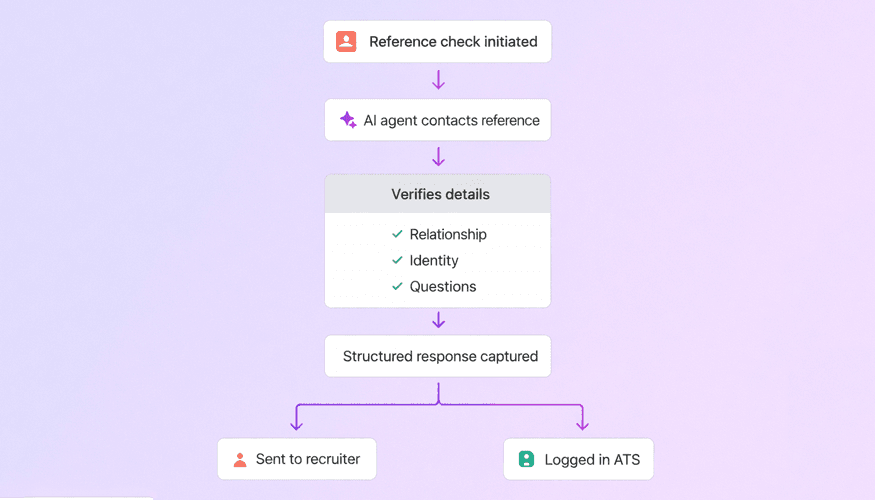
Automated reference checks begin with structured outbound outreach. Instead of recruiters manually contacting references, the system initiates communication instantly via voice or SMS.
Each interaction follows predefined logic to ensure consistency and accuracy:
- Automatically contact references
- Verify the identity and relationship of the reference
- Guide the conversation based on role-specific requirements
- Escalate to a recruiter when needed
This ensures that every reference interaction is consistent, timely, and aligned with the qualification phase of the hiring process.
Configurable question frameworks
Reference checks are powered by configurable question frameworks tailored to each role.
Instead of asking inconsistent or ad hoc questions, structured questionnaires ensure that every candidate is evaluated using the same criteria. These frameworks can include:
- Reliability and attendance
- Technical competency
- Safety compliance
- Teamwork and communication
- Rehire eligibility
This standardization improves hiring accuracy, helps reduce bias hiring, and minimizes the impact of unconscious biases.
Documentation and routing
Every reference interaction generates structured documentation that is automatically captured and stored.
This includes:
- Full transcripts of conversations
- Structured summaries
- Key evaluation points
- Automatic routing to the assigned recruiter
When integrated with an applicant tracking system, this data is written directly into the candidate record, eliminating manual work and improving compliance and auditability. Whippy connects with leading ATS platforms through its integrations, ensuring seamless data flow across your hiring systems.
More importantly, this creates a complete and reliable audit trail for every reference check. Recruiters and stakeholders can review exactly what was said, how responses were captured, and how decisions were made.
For staffing agencies, this level of documentation is critical. It supports compliance requirements, reduces risk exposure, and strengthens client trust by ensuring every placement is backed by verifiable and consistent reference validation.
Step-by-step workflow
- Candidate submits references: At the final stage of the recruitment process, candidates provide their references as part of pre-employment checks.
- AI-driven interaction and data capture: Once outreach begins, the system manages the full interaction with the reference. It verifies identity, delivers structured questions, captures responses, and organizes feedback in real time.
- Evaluation and system integration: All responses are summarized into structured insights and automatically synced to the applicant tracking system, ensuring complete documentation and visibility across the hiring process.
This workflow turns reference checking into a repeatable and scalable operation, fully embedded as a structured step within the hiring workflow.
From Manual Task to Controlled Workflow
In traditional recruiting environments, reference checking is often reactive, leading to delays, inconsistent evaluations, and gaps in documentation.
This approach creates risk. Without a defined structure, reference validation depends heavily on individual recruiter habits, availability, and interpretation.
Automated reference checks fundamentally change this model.
Instead of being handled manually, reference checking becomes a controlled workflow embedded within the qualification phase of the hiring process. Every step follows a predefined structure, ensuring consistency, speed, and accountability across all candidates.
This shift delivers several key advantages:
These checks are completed as part of a defined process, not postponed tasks
Every candidate is evaluated using the same structured framework
All interactions are captured, documented, and stored automatically
Recruiters focus on decision-making rather than administrative work
By turning reference checking into a controlled step in the placement process, staffing agencies gain greater visibility, reduce risk, and improve overall hiring outcomes.
This is what allows modern staffing agencies to move from reactive recruiting operations to structured, scalable hiring systems.
Compliance, Auditability, and Client Trust
In staffing, reference checks are not just about validation. They are also about accountability.
Without proper documentation, it is difficult to prove how a candidate was evaluated or defend hiring decisions if issues arise. Manual processes often leave gaps, with incomplete notes or missing context.
These automated checks create a fully traceable process, where every interaction is recorded and stored, including:
- Verifiable transcripts of conversations
- Standardized summaries across all candidates
- Clear evaluation criteria and outcomes
- Consistent records inside the applicant tracking system
This level of auditability ensures that every reference check can be reviewed at any time, providing transparency across recruiters, teams, and clients.
For staffing agencies, this directly impacts client relationships. When clients trust that candidates are consistently and thoroughly validated, confidence in placements increases.
At scale, this transforms reference checking from a basic verification step into a reliable system for compliance, risk management, and long-term client trust.
Use Case:
Staffing Agencies and High-Volume Hiring
Automated reference checks are especially valuable for staffing agencies operating in high-volume hiring environments.
Recruiters often manage dozens of potential candidates across multiple open roles simultaneously, while balancing client expectations and tight timelines. In this context, manual reference checks create friction because they are not treated as a structured part of the qualification phase, but rather as a reactive, recruiter-dependent task.
In many staffing workflows, this means reference validation can take 1 to 3 days to complete due to back-and-forth communication and recruiter availability. With automated checks, that same process can often be completed within hours, enabling faster placements and significantly reducing time to hire.
Before automation
- Reference validation takes 1 to 3 days
- Recruiters spend hours on calls and follow-ups
- Inconsistent evaluation across candidates
- Documentation is fragmented
- Slower placements
After automation
- Reference checks completed within hours
- No manual outreach required
- Standardized evaluation across all candidates
- Centralized documentation inside the ATS
- Faster hiring and improved client satisfaction
By streamlining reference checking, staffing agencies can reduce time to hire and focus on higher-value activities.
Benefits of Automated Reference Checks for Staffing Agencies
Automating reference checks delivers both operational and strategic advantages.
Faster hiring
Immediate outreach and faster responses reduce delays, enabling faster hiring cycles. In many cases, processes that previously took days can be completed within hours, significantly improving overall hiring speed.
Save time recruiting
Recruiters no longer need to chase references or manually record feedback. This significantly reduces administrative workload.
Improved hiring accuracy
Structured questionnaires and consistent evaluation criteria improve hiring accuracy and reduce subjective decision-making.
Streamline hiring
Automation removes bottlenecks and creates a smoother recruitment process from screening to placement.
Hiring efficiency at scale
Automated workflows allow staffing agencies to handle high-volume hiring without increasing headcount.
Improve transparency
Standardized workflows help answer frequently asked questions from clients and internal stakeholders about how candidates are evaluated.
Better hiring decisions and stronger alignment with long-term recruitment strategy
With standardized data and clear summaries, recruiters and clients can make more confident decisions.
Manual vs Automated Reference Checking
The difference between manual and automated reference checking is substantial, especially for staffing agencies operating at scale.
Manual Reference Checks | Automated Reference Checks |
|---|---|
Takes 1–3 days | Completed within hours |
Recruiter-dependent | System-driven workflow |
Inconsistent questions | Structured questionnaires |
Limited documentation | Full transcripts and summaries |
Hard to audit | Complete audit trail |
This shift from manual to automated checks enables faster hiring, stronger compliance, and more consistent candidate evaluation across high-volume recruitment workflows.
Best Practices for Automating Reference Checks
To get the most value from reference check automation, follow these best practices:
Use structured questionnaires: Standardize your reference check templates to ensure consistency across roles and recruiters.
Align questions with job requirements: Customize reference check questions based on role-specific needs and client expectations.
Integrate with your ATS: Ensure your reference checking solution connects directly to your hiring software for seamless data flow.
Focus on compliance and documentation: Maintain detailed records, including transcripts and summaries, to support audits and compliance.
Monitor and refine workflows: Continuously improve your process using data and feedback collected from reference interactions.
What Questions Should You Ask in a Reference Check?
Strong reference validation depends on asking the right questions.
Common categories include:
- Work performance and technical ability
- Attendance and reliability
- Communication and teamwork
- Compliance and safety standards
- Eligibility for rehire
Using structured questionnaires ensures consistency and helps improve hiring accuracy.
Automated Reference Checks Inside Your Hiring Systems
One of the biggest advantages of modern reference check tools is integration.
When reference checking is connected to your hiring process:
- Candidate data flows automatically
- Feedback is stored in one place
- Recruiters avoid switching between systems
- Documentation is always accessible
This creates a unified workflow where reference checks are part of a complete reference check platform rather than a disconnected task.
How Whippy Powers Automated Reference Checks
Whippy brings together AI, automation, and communication to deliver a complete reference checking solution for staffing agencies.
Using Whippy, teams can:
Run AI reference checks through voice and SMS
Automate outreach without manual effort
Verify references with identity validation
Deliver structured questionnaires tailored to each role
Capture and standardize feedback collection
Generate summaries and evaluation insights
Sync results directly into ATS platforms like Bullhorn, Crelate, Avionté, Aqore, TempWorks, and PCRecruiter
Because Whippy operates inside your existing workflow, it eliminates manual steps and ensures consistency across recruiters and branches.
It is not just reference check software. It is a leading HR tech for reference checks that enables full business automation of the hiring process.
When Should You Use Automated Reference Checks?
Automated checks are ideal for:
- Staffing agencies managing high-volume hiring
- Teams looking to reduce time to hire
- Organizations requiring strong compliance and audit trails
- Recruiters aiming to improve efficiency and consistency
If your team is spending too much time on manual reference validation, automation can deliver immediate impact.
Conclusion
Reference checks are essential, but the traditional approach no longer meets the needs of modern recruiting.
Automated reference checks transform this process into a fast, structured, and scalable workflow, embedded as a controlled step in the placement process that standardizes and accelerates post-interview validation. By combining AI, automated outreach, and seamless integration, staffing agencies can improve hiring efficiency, reduce delays, and make better hiring decisions.
As hiring demands continue to grow, adopting reference check automation is no longer optional. It is a necessary step toward building a more efficient and reliable recruitment process.
Request a Demo
If you want to see how automated reference checks can transform your staffing operations, request a demo and explore how Whippy can help you streamline hiring and scale faster.
FAQs About Automated Reference Checks
Q: What are automated reference checks?
A: Automated reference checks use AI and workflow automation to contact references, ask structured questions, verify identity, and collect feedback without manual recruiter involvement. This creates a faster, more consistent, and fully documented reference checking process.
Q: How do automated reference checks work?
A: Automated reference checks follow a structured workflow. The system contacts references via voice or SMS, verifies their identity, delivers role-specific questionnaires, captures responses, and generates standardized summaries. Results are then stored or synced into the applicant tracking system.
Q: Why are automated reference checks important for staffing agencies?
A: For staffing agencies handling high-volume hiring, automated reference checks reduce time to hire, improve consistency, and eliminate manual bottlenecks. They also create a complete audit trail, which improves compliance and strengthens client trust.
Q: How long do automated reference checks take?
A: Manual reference checks can take 1 to 3 days due to scheduling and follow-ups. Automated reference checks are typically completed within hours because outreach and response collection happen instantly.
Q: What questions should you ask in a reference check?
A: Effective reference check questions focus on performance, reliability, communication, teamwork, and rehire eligibility. Using structured questionnaires ensures consistent evaluation across all candidates and helps reduce bias in hiring decisions.
Q: Can automated reference checks reduce hiring bias?
A: Yes. Automated checks use standardized questions and workflows, which help reduce unconscious biases and ensure all candidates are evaluated using the same criteria.
Q: Are automated reference checks compliant and auditable?
A: Yes. Automated systems capture transcripts, summaries, and evaluation data in a structured format. This creates a complete audit trail that supports compliance, internal reviews, and client transparency.
Q: What is the best way to scale reference checks in high-volume hiring?
A: The most effective way to scale reference checks is through automation. Using AI-driven workflows allows staffing agencies to process large volumes of candidates without increasing recruiter workload, while maintaining consistency and accuracy.
Table of Contents
Table of Contents
- What Are Reference Checks?
- Why Reference Checks Slow Down Hiring
- What Are Automated Reference Checks in Staffing?
- How to Do Reference Checks
- How Automated Reference Checks Work in Staffing
- From Manual Task to Controlled Workflow
- Compliance, Auditability, and Client Trust
- Use Case: Staffing Agencies and High-Volume Hiring
- Benefits of Automated Reference Checks for Staffing Agencies
- Manual vs Automated Reference Checking
- Best Practices for Automating Reference Checks
- What Questions Should You Ask in a Reference Check?
- Automated Reference Checks Inside Your Hiring Systems
- How Whippy Powers Automated Reference Checks
- When Should You Use Automated Reference Checks?
- Conclusion
- Request a Demo
- FAQs About Automated Reference Checks
Try Whippy for Your Team
Experience how fast, automated communication drives growth.

Related Articles

Best AI Recruiting Tools for Franchise Staffing
 Elizabeth Long
The Staffing Operating System for Avionté
Elizabeth Long
Automated License Verification for Staffing Agencies
Elizabeth Long
Write Job Descriptions That Make AI Recruiters Perform
Elizabeth Long
Whippy AI Recruiter: Independent Bias Audit Results
Elizabeth Long
The Candidates You Need Are Already in Your ATS
Elizabeth Long